Firefighter Clothing and Accessories: Your Ultimate
Protection in Dangerous Situations
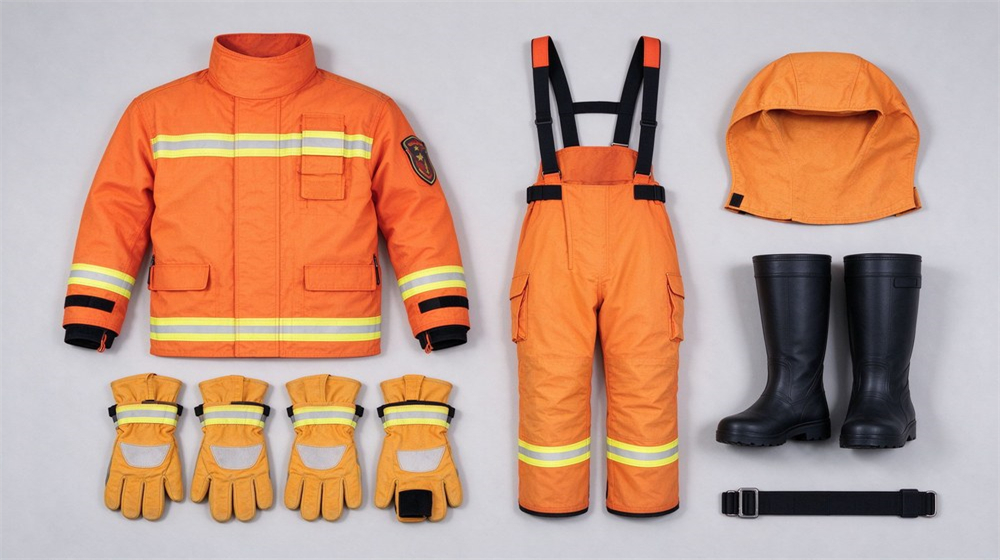
Firefighter Clothing and Accessories: Staying Safe in the Face of Adversity Firefighter Clothing and Accessories are designed for the ultimate protection of firefighters in the line of duty. Made from high-quality materials, these products provide unparalleled durability and functionality. Engineered to withstand extreme heat and flames, this clothing will keep you safe in the most dangerous situations. From firefighting helmets and boots to gloves and face masks, we have everything you need to ensure your safety. So, don't wait another minute. Shop our selection of Firefighter Clothing and Accessories today!


Fire Fighting Equipment Wholesale | PPE SCBA Helmet
Blanket Tools
As a leading fire equipment supplier, YRF brings together six core categories of fire fighting equipment under one roof: personal protective turnout gear, SCBA breathing apparatus, structural fire helmets, fire blankets, high-rise escape ropes and harnesses, and forcible entry rescue tools. With over 400 SKUs available for wholesale fire equipment orders, this page serves fire departments, industrial brigades, school safety officers and government procurement teams who need a single source for fire safety equipment instead of chasing six different suppliers. Whether you are outfitting a new station, refreshing an existing locker or responding to a tender, the categories below map each piece of firefighter gear to its certification, sizing and ordering minimums.
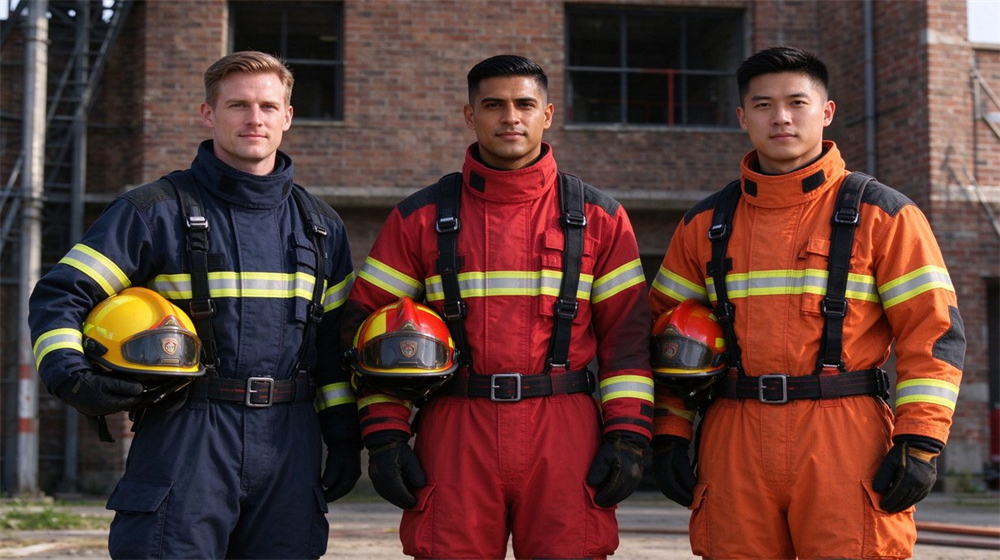
1. Product Categories Overview
7. Forcible Entry & Rescue Tools
2. Personal Protective Equipment (PPE)
8. Complete Equipment Packages
3. Respiratory Protection
9. Certifications & Quality Assurance
4. Head Protection
10. Government Procurement Service
5. Early Fire Suppression
11. FAQ
6. High-Rise Escape & Rescue
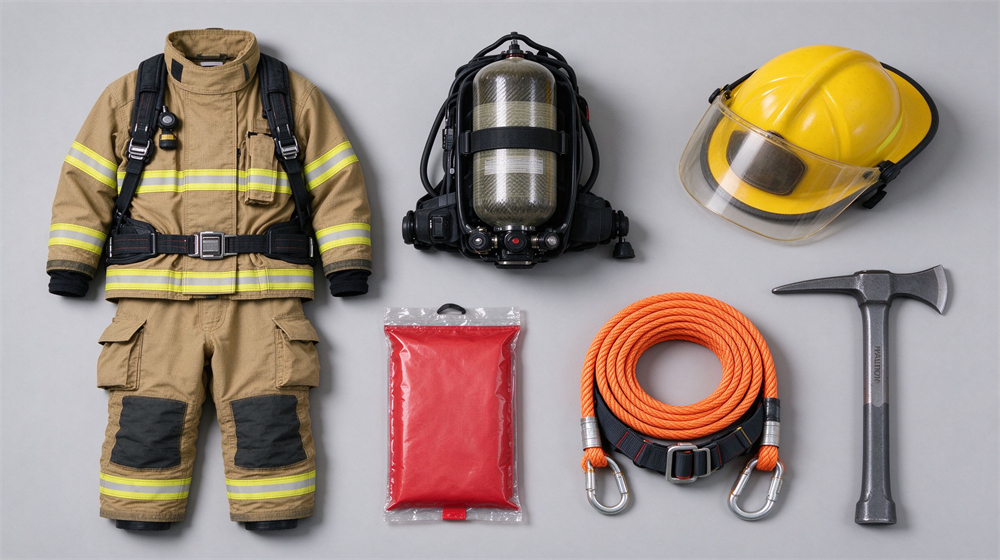
Product Categories Overview
As a fire equipment supplier, buyers who need to equip a fire station, an industrial brigade or a government emergency response unit usually do not want to chase six different suppliers. They want one catalog of fire safety equipment that covers what a firefighter wears, what they breathe through, and what protects their head. They also want what stops a small fire before it grows, what gets them out of a high rise, and what opens a locked door. This wholesale fire fighting gear catalog organizes all of that into six clear categories so procurement officers can build a wholesale fire equipment locker list without missing a single piece.
The six categories work as a system, not as isolated items. Each piece of firefighter gear works as a system. Every category of fire safety equipment works as a system. A turnout coat without an SCBA is a fashion piece. An SCBA without a helmet leaves the face exposed. Every piece of fire safety equipment connects to the next. A helmet without gloves and boots leaves the hands and feet unprotected. This page walks through each category of firefighter gear, explains what matters when buying it, and links to the dedicated long form page where each piece of fire safety equipment and firefighter gear is detailed. Whether you are outfitting new firefighter gear for a department from scratch or refreshing an existing locker, the structure below helps wholesale fire equipment buyers see how the pieces fit together when ordered from a single fire equipment supplier.
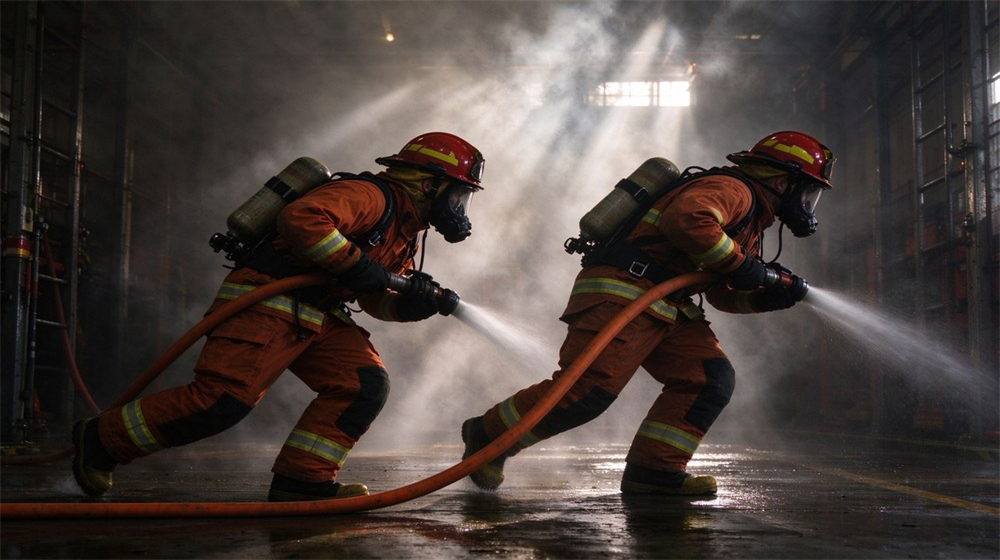
Six Core Categories and 400 Plus SKUs
The catalog covers firefighter PPE turnout gear in 268 configuration combinations across colors, sizes and layer options. It covers SCBA breathing apparatus in 85 configurations from 30 to 60 minute cylinders with carbon fiber or steel options. It covers fire helmet shells in 20 configurations across structural, rescue and wildland duty. It covers fire blanket sizes and materials in 23 configurations from kitchen to industrial spill.
Beyond personal protective gear, it covers fire escape rope and harness systems in 16 configurations for high rise and rescue. It covers fire rescue tools from Halligan bars to hydraulic spreaders in over 100 tool SKUs. That breadth is what makes one stop sourcing realistic. This firefighter PPE range is built for any fire department equipment refresh or new station setup.
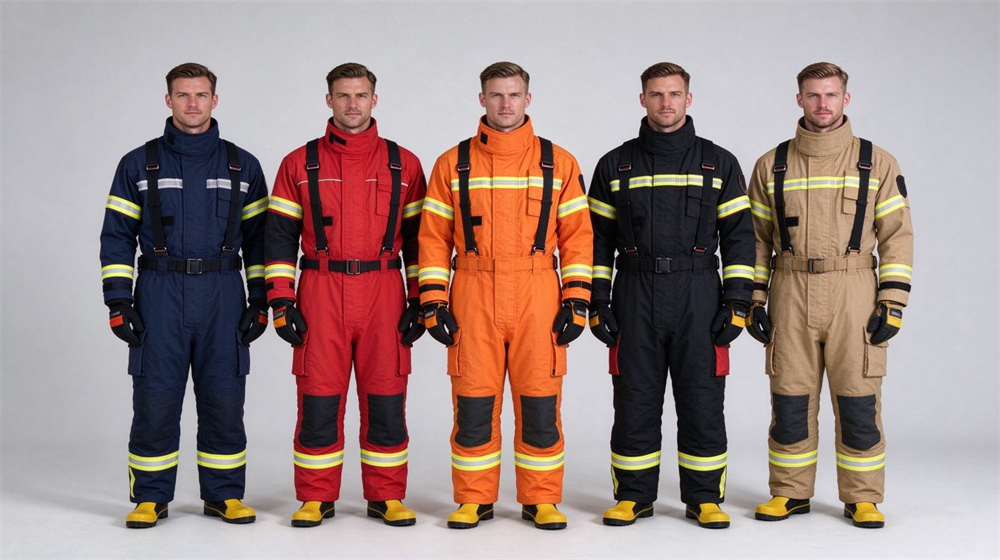
How the Categories Work Together
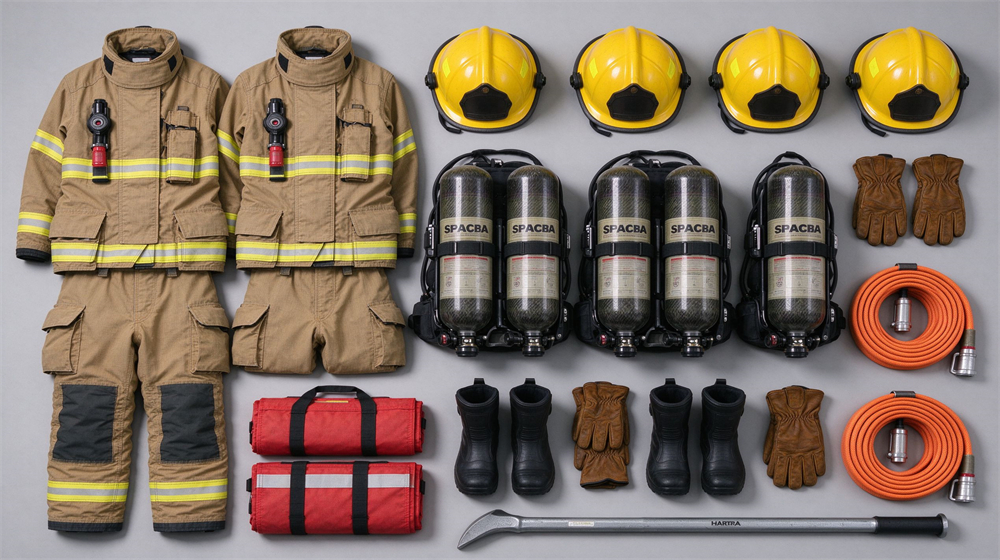
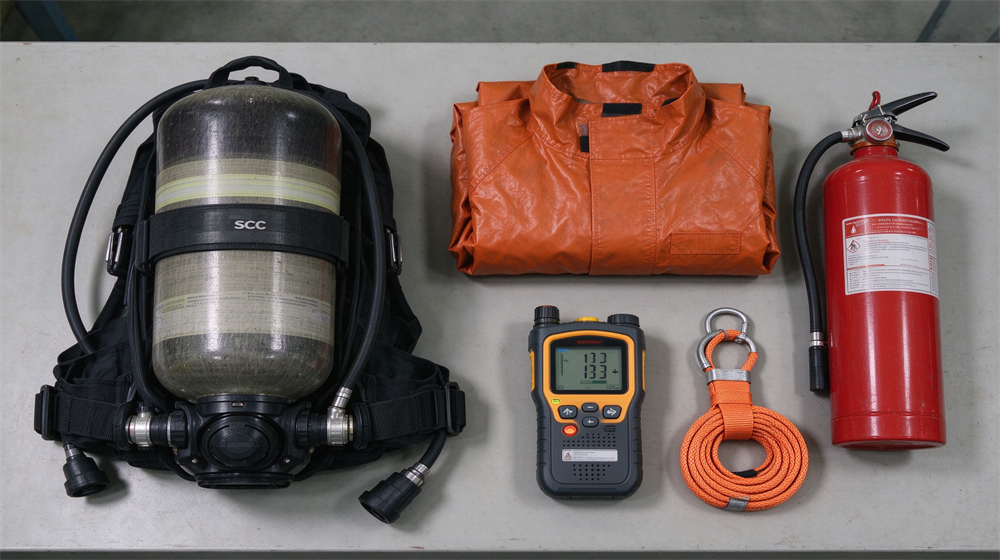
Outfitting a four person crew means each firefighter gets a personal set: turnout coat and pants, SCBA, helmet, gloves, boots. The station shares team equipment: fire blankets per apparatus, a fire escape rope kit for high rise calls, and a forcible entry tool set at the entrance. The fire equipment package section shows how personal and shared items combine into a locker ready configuration. The goal is a locker where every item has a place, is inspected on schedule, and is tested to the right standard before service.
Procurement teams often start with a budget and a catalog, but the better starting point is a risk assessment. What types of calls does the department run most often? Structural fire in wood frame buildings needs a different balance than a brigade that covers a refinery. A station in a low rise urban area may never need a 50 floor escape rope kit, while a high rise station cannot afford to be without one.
This catalog lets you pick and choose within each category rather than buying a fixed bundle that includes gear you will never use. The internal links on this page open dedicated pages for each product family, so you can deep dive on the specs that matter to your risk profile. Before you send out a tender, the step by step checklist in our fire equipment buying guide helps you map each required item to a SKU without gaps.
Buying gear on price alone is another point to confirm. A turnout coat twenty percent cheaper upfront may use thinner shell fabric that wears out in half the time. A budget-friendly SCBA may need regulator replacement every two years instead of five. Over ten years, that cheaper option costs more from replacement parts and downtime. The test report shows what the gear is actually made of.
Use this table as a locker list checklist. Cross off each row against your crew's actual call types, then dive into the dedicated SKU page.
|
Category |
What It Covers |
SKU Range |
Key Standard |
|
Turnout PPE |
Coat, pants, hood, gloves, boots |
268 configs |
NFPA 1971 / EN 469 |
|
SCBA |
Cylinder, regulator, face mask, frame |
85 configs |
NFPA 1981 / EN 137 |
|
Helmets |
Shell, visor, neck flap, lamp mount |
20 configs |
NFPA 1971 |
|
Fire blankets |
Fiberglass, silicone, various sizes |
23 configs |
EN 1869 |
|
Escape rope |
Kernmantle rope, harness, descender |
16 configs |
EN 358 / EN 361 |
|
Rescue tools |
Halligan, axe, hydraulic spreader |
100+ SKUs |
Service grade |
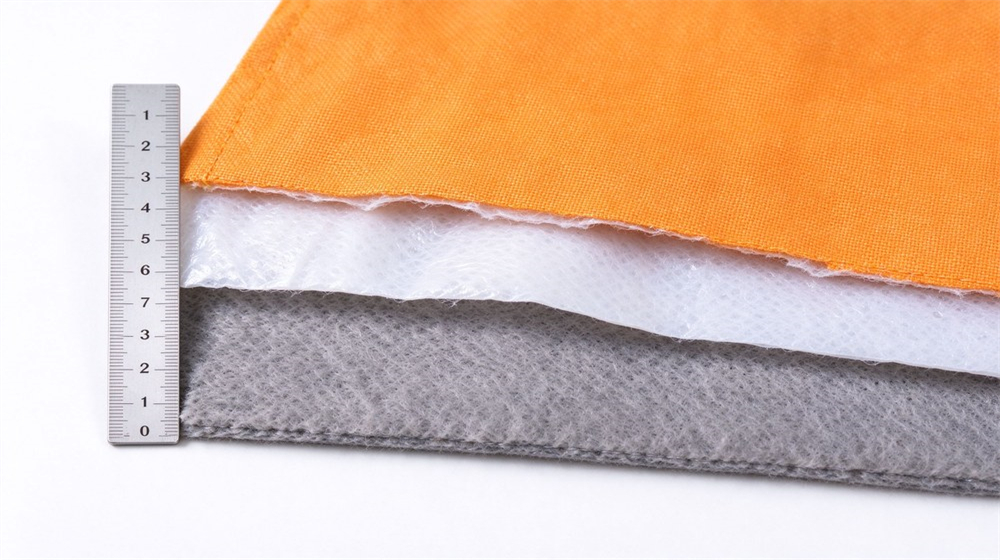
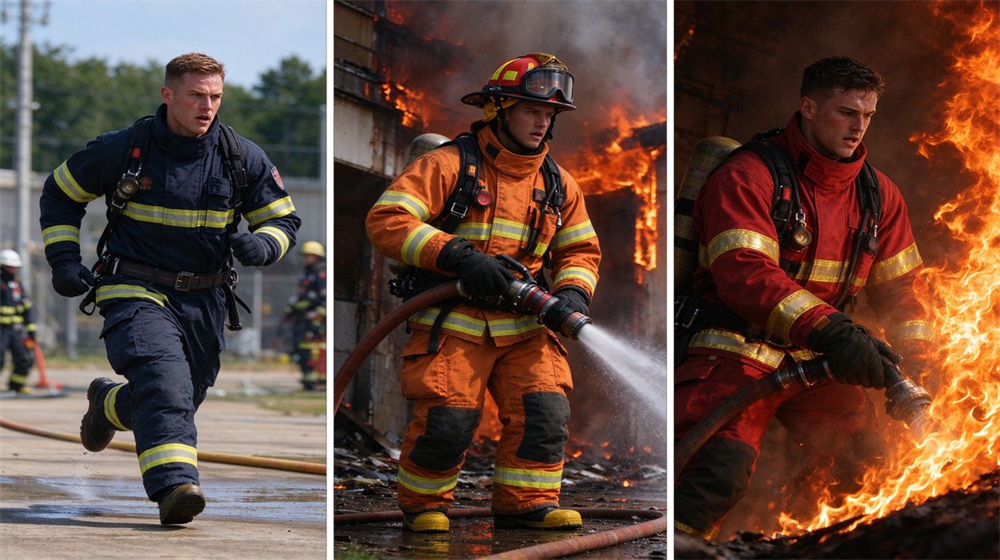
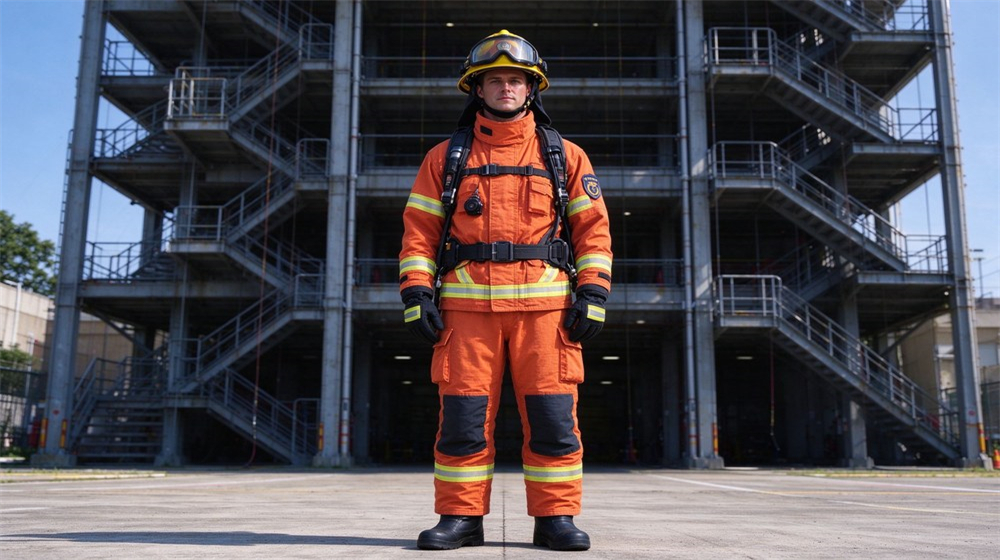
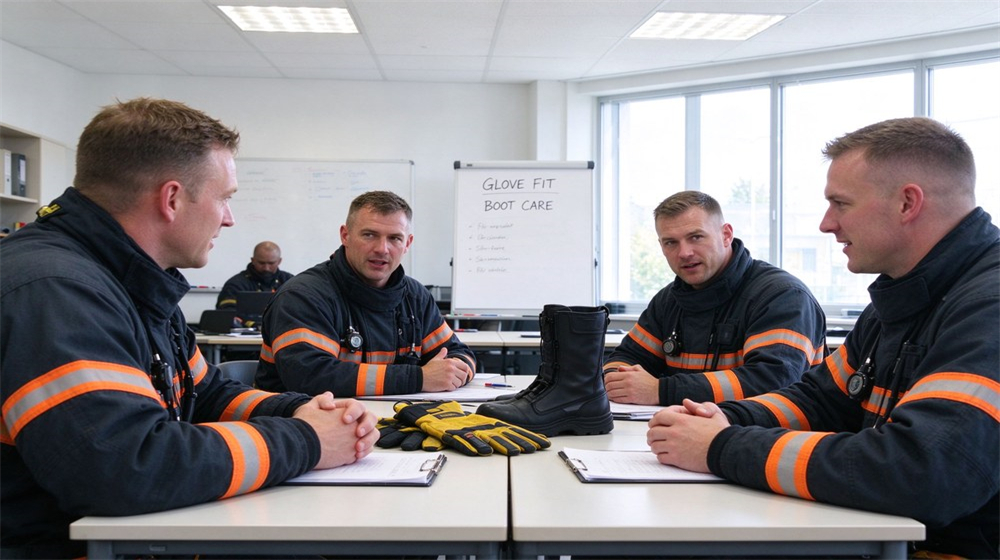
The turnout ensemble is the most visible piece of fire fighting equipment and the one that contacts heat, water and debris every shift. A proper set is not a single fabric. It is three layers bonded together. The outer shell sheds water and resists abrasion, the moisture barrier blocks liquid while letting sweat vapor escape, and the thermal liner slows heat transfer to the skin. This is the firefighter PPE system that NFPA 1971 and EN 469 were written to define.
Three Layer Nomex Construction and TPP Rating
The outer shell uses Nomex aramid fabric in weights matched to the duty: lighter for wildland, heavier for structural. The thermal protective performance rating, or TPP, measures how long the material can block a combined convective and radiant heat source before a second degree burn would occur. NFPA 1971 requires a TPP of at least 35, and our standard sets run above that threshold. The moisture barrier keeps bloodborne pathogens and liquid chemicals out while the liner traps air for insulation. For the full shell weight, layer and sizing details, see the firefighter turnout gear page.
268 Configurations: Colors, Sizes and Layer Options
A department does not buy one size fits all. Turnout gear comes in five standard colors, across a full size range from small to triple extra large, and with layer options that trade heat protection against breathability. Reflective tape placement, pocket layout, storm flaps and knee pad pockets all vary by configuration. With 268 possible combinations, the procurement team should measure each firefighter, record sizes on a roster, and order by measured size rather than by a guess. LOGO embroidery on the shoulder panel is available in bulk orders.
Gloves, Boots and Hoods Complete the Ensemble
A turnout coat and pants only cover the torso and legs. The hands need structural gloves in cowhide or goatskin with a Kevlar palm. The feet need leather boots with steel toe and puncture resistant sole, and the neck needs a Nomex hood that tucks under the collar. These wear items are replaced on a schedule, not when they fall apart, because heat damage is invisible on the surface. Browse the firefighter gloves and boots page for glove materials, boot constructions and sizing guides that pair with the turnout set.
Turnout gear also needs a care plan. After a fire, the coat and pants go through a cleaning cycle that removes soot and chemical residue, because embedded contaminants accelerate fabric degradation. Never dry gear on a radiator or near heat, because high heat cooks the moisture barrier and lowers TPP without visible sign. Each set is logged with serial number, purchase date and retirement date, so the safety officer can pull it before the fabric reaches end of life. A set through a serious fire should be inspected for heat damage even if it looks fine.
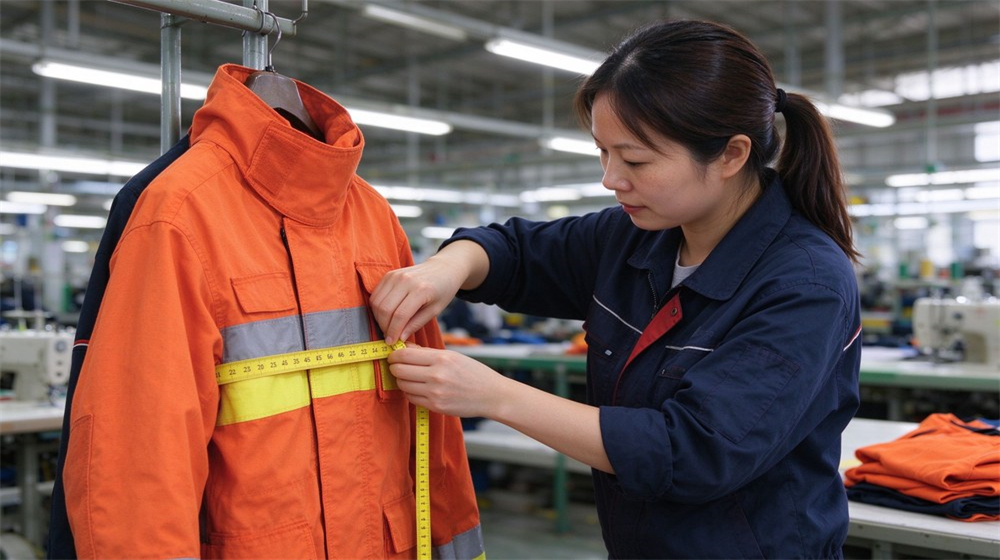
Sizing is another detail that trips up procurement teams. Firefighters come in all body types, and a coat that fits in the shoulders may be too long in the sleeves when the arms are raised. Measured sizing across the crew roster means taking chest, waist, inseam and height measurements, then matching them to the size chart rather than guessing from street clothing sizes. Each firefighter should try on the sample set before bulk production starts, because a suboptimal fit cannot be fixed after the embroidery is on the shoulder.
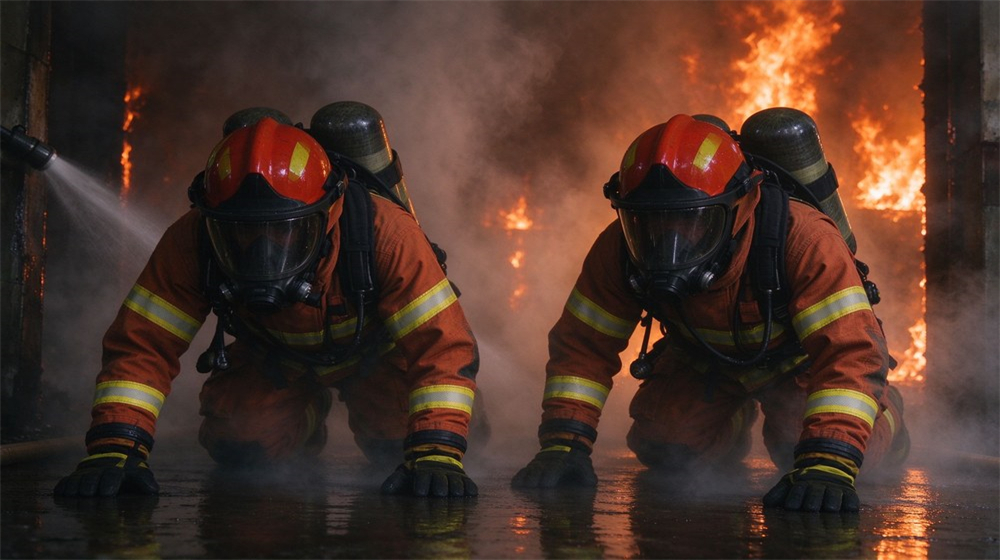
Respiratory Protection
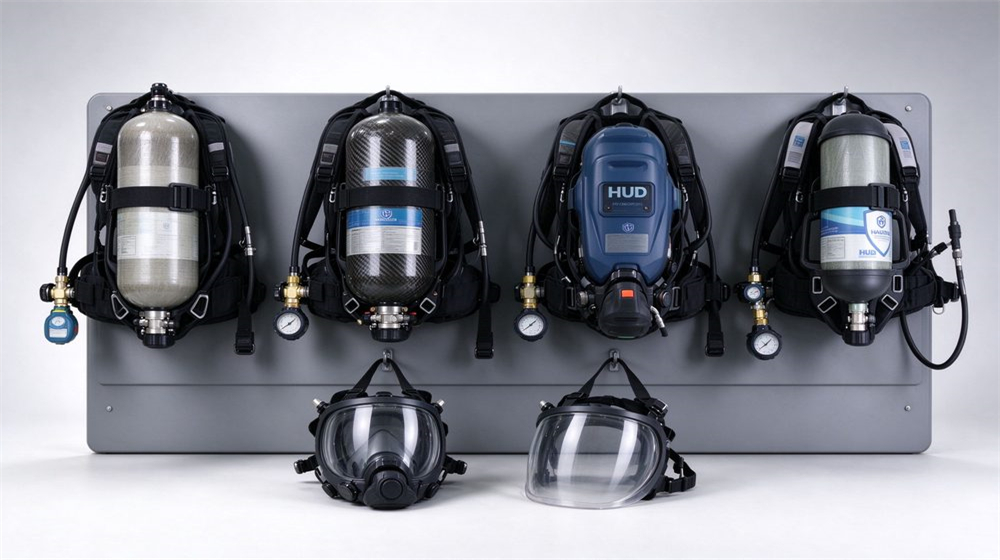
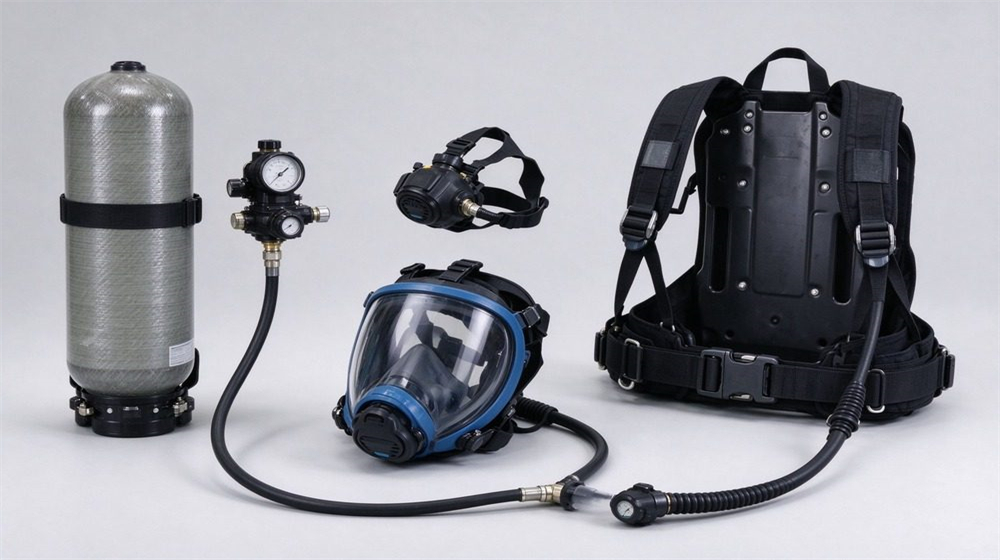
Smoke kills before heat does. Carbon monoxide, hydrogen cyanide and oxygen deficient air will drop a firefighter in minutes without a clean air supply. The SCBA breathing apparatus is the single piece of equipment that every firefighter must wear before entering an atmosphere that OSHA defines as immediately dangerous to life or health. It is also the most technically complex piece in the catalog, with cylinder pressure, regulator logic, face mask seal and alarm system all working together.
30, 45 and 60 Minute Cylinder Options
We offer nominal 30, 45 and 60 minute cylinders in 6.8 liter volumes at 300 bar. Nominal rating is at rest, so actual working time under moderate effort runs about 60 percent of the label. A 45 minute cylinder gives about 25 to 30 minutes of working air before the low alarm. Long industrial entries should specify the 60 minute option or dual cylinders. All units are tested to NFPA 1981 and EN 137, with the low pressure alarm at 55 plus or minus 5 bar. See the SCBA air breathing apparatus page for cylinder options, spare bottles and communication modules.
Panoramic Face Mask and Regulator
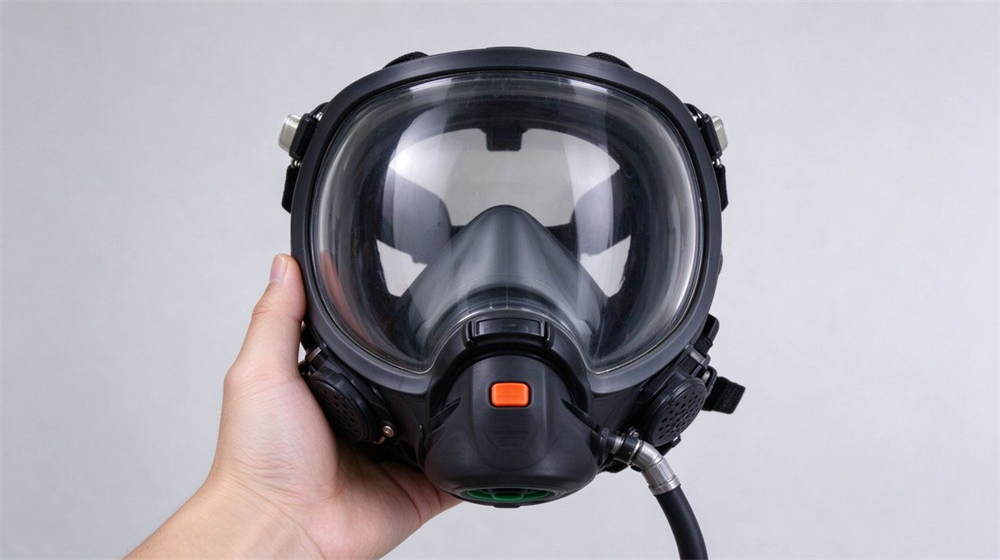
The full face mask uses a panoramic polycarbonate visor for wide peripheral vision and a silicone face seal that fits multiple face shapes. The demand regulator delivers air on inhalation and alarms with a loud whistle when pressure drops. A buddy breathing coupling allows two firefighters to share air in an emergency. Mask fit testing should be done per department protocol, because a mask that leaks at the seal turns the whole SCBA into dead weight.
Carbon Fiber Versus Steel Cylinders
Carbon fiber wrapped cylinders weigh roughly half of equivalent steel cylinders, which means less shoulder fatigue over a two hour search. Steel cylinders cost less upfront and resist impact better in rough rescue environments. Both carry the same pressure rating and the same hydrostatic retest schedule. The selection comes down to budget versus weight, and many departments run carbon fiber for front line crews and steel for spare training bottles.
SCBA maintenance is a daily habit, not annual. Before every shift, the firefighter checks the cylinder pressure gauge, listens for the low alarm whistle when the valve cracks, and inspects the mask seal for tears or dirt. After smoke use, the mask wipes with a disinfectant and the regulator gets a post incident check. Cylinders are hydrostatically retested on the local regulatory schedule, and any dropped or flame exposed cylinder is pulled from service immediately. An uninspected SCBA is not a spare, it is an operational risk.
Communication modules are worth specifying at order time rather than retrofitting later. A radio interface built into the regulator lets the firefighter talk hands free without pulling the mask off. A heads up display projects remaining air pressure on the inside of the visor, so the firefighter does not need to look down at the chest gauge. These modules add cost up front but improve safety and coordination during a working fire. They are available across the SCBA product family.
Head Protection
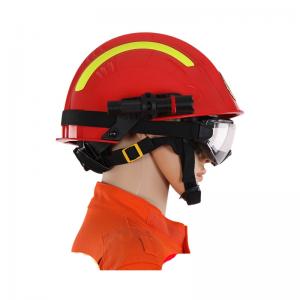
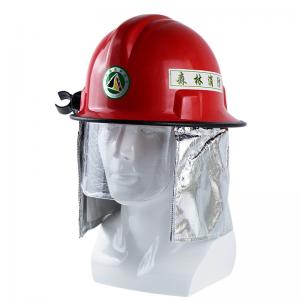
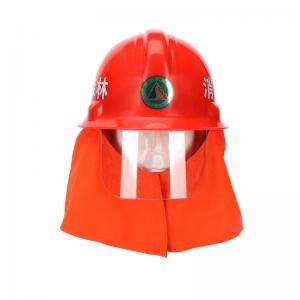
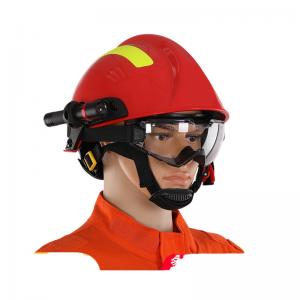
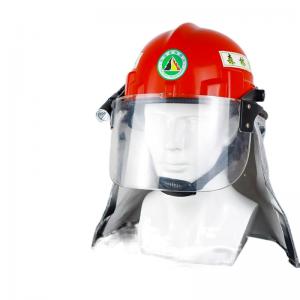
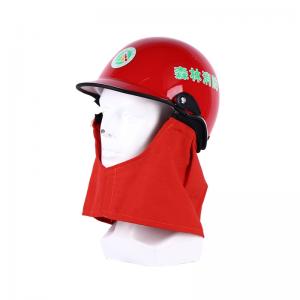
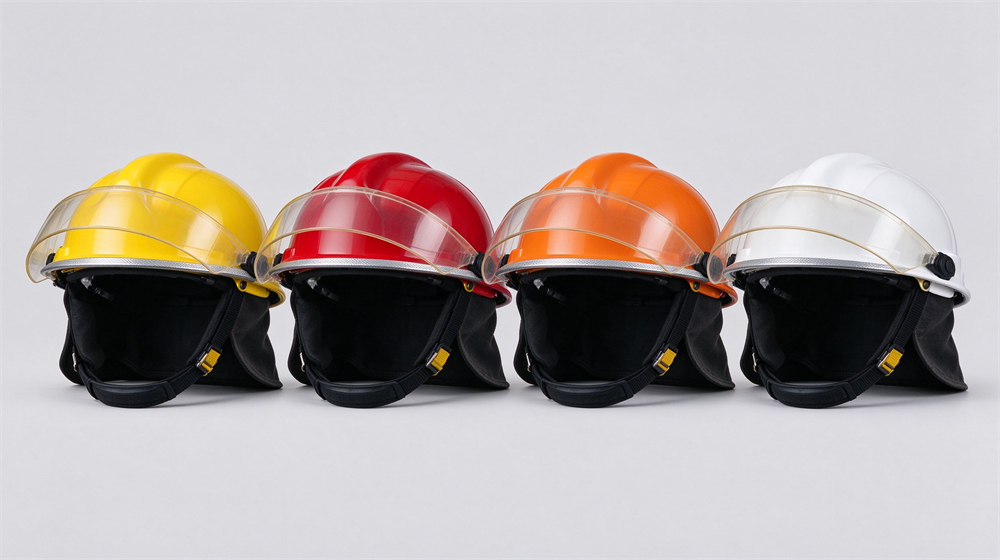
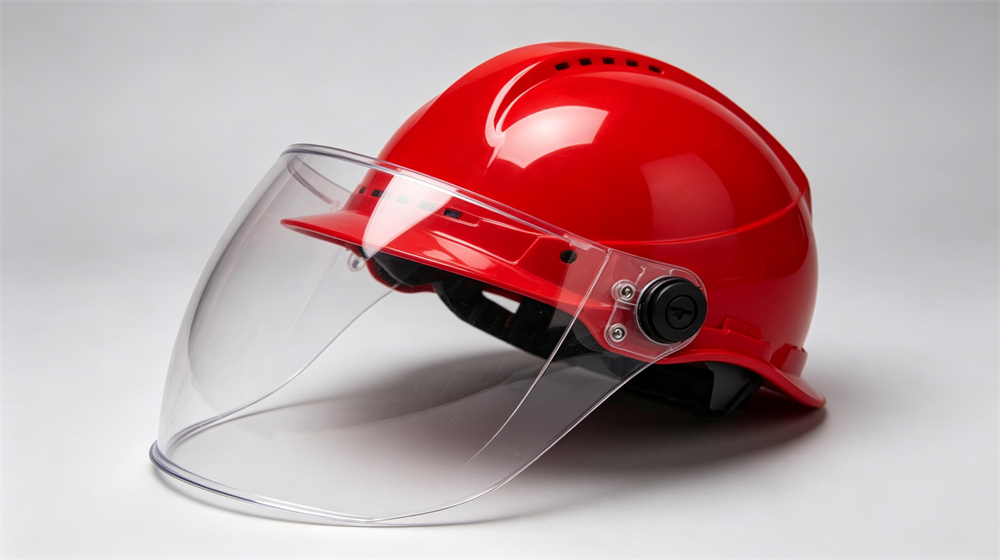
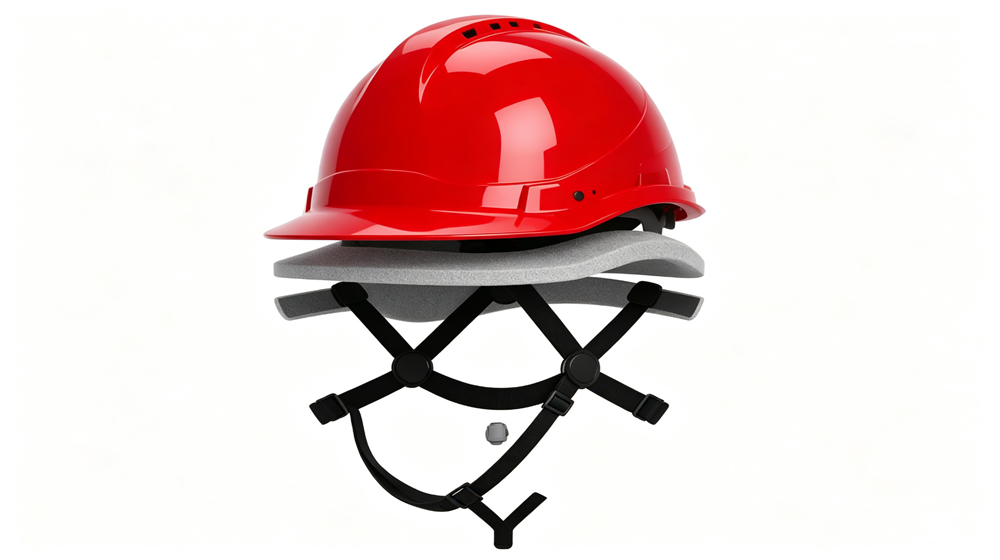
The head takes the first impact in a fall, a swinging debris load or a low ceiling collision. A structural fire helmet is not a construction hard hat. It adds a chin strap that stays on during movement and a brim that deflects water and debris. It also has a polycarbonate visor that shields the face from heat and flying objects, plus a Nomex neck flap that covers the ears and neck. It must stay on when the firefighter bends, crawls and runs.
Carbon Fiber and ABS Shell Options
Carbon fiber composite shells are the lightest option at under 1.5 kg while maintaining high impact and heat resistance. ABS shells are durable, cost effective and available in bright colors for visibility. Both shell types are tested to NFPA 1971 for penetration, impact and heat resistance. The interior uses a four point suspension system with a rear adjustment knob so the helmet fits snug without wobbling. Colors include red, yellow, blue, white and black, with custom department colors available in bulk. Explore the fire helmet page for shell materials, visor options and accessory compatibility.
Visor, Lamp Mount and Neck Flap
The front visor raises and lowers on a pivot, protecting the face from radiant heat and flying debris while the SCBA mask covers the breathing zone. A headlamp mount on the front accepts a standard fire service light for zero visibility search. The Nomex neck flap covers the ears and back of the neck, tucking under the turnout coat collar. All of these accessories are replaceable, so a damaged visor does not mean a new shell.
Helmets are not one size fits all. The interior suspension system adjusts with a rear knob that fits head sizes from about 52 to 64 centimeters. A helmet that rides forward over the eyes or rocks side to side during movement is a safety hazard, not a comfort issue. Sizing should be checked with the firefighter wearing the Nomex hood, because the hood adds bulk. The chin strap should buckle snug under the chin, not loose on the throat. Over time, the suspension webbing stretches and should be replaced rather than adjusted tighter, because a stretched suspension loses impact absorption.
Color coding is a quiet but useful organizational tool. Many departments use helmet colors to rank roles: white for command officers, red for company officers, yellow or black for firefighters. This lets the incident commander identify roles at a glance in a smoky scene. We supply all standard colors and can match custom department colors in bulk orders. Reflective trim on the shell edge improves visibility at night operations. The shell itself should be inspected after any impact, because a crack that is invisible on the surface can compromise protection on the next hit.
A complete head protection set includes shell, visor, neck flap, chin strap and spare suspension. Buying as a matched set ensures full compatibility between parts.
Early Fire Suppression
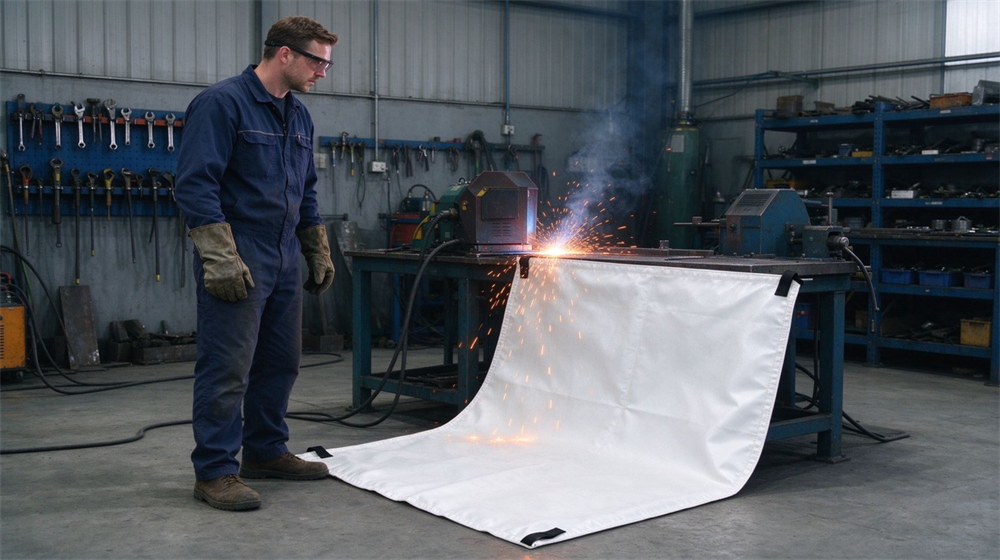
Not every fire starts as a building involved blaze. A pan on the stove, a welding spark on a rag, a small electrical fault on a printer, all start small and grow within minutes. A fire blanket is the simplest early suppression tool in the catalog: it cuts oxygen, smothers the flame and leaves no cleanup mess. It is also one of the few pieces of equipment that untrained office and kitchen staff can use safely within seconds of an alarm. Community preparedness guidance from USFA recommends exactly this kind of simple first response tool in kitchens, workshops and vehicle kits.
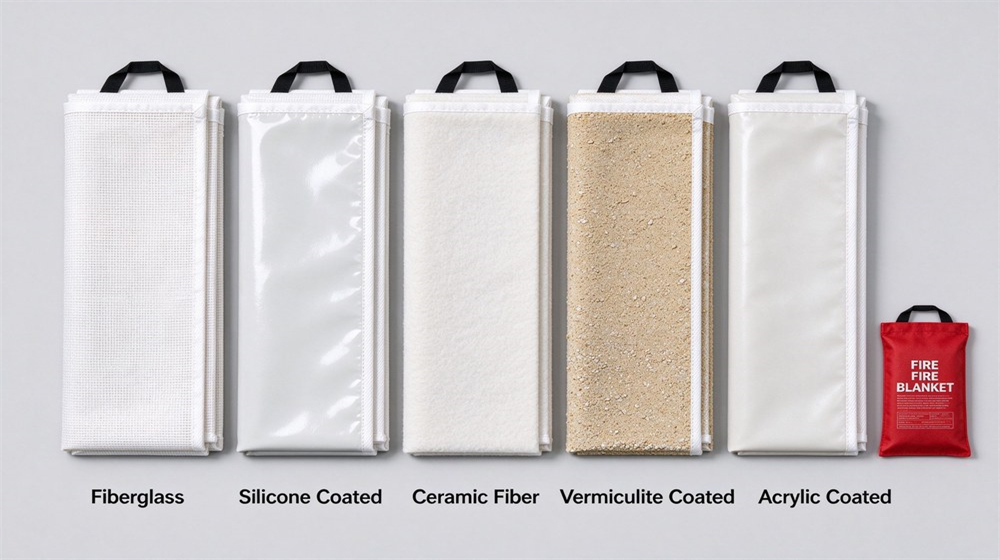
Fiberglass and Silicone Materials, 550 to 1200 Degrees
Standard fiberglass blankets handle 550 degrees Celsius short duration exposure. Silicone coated fiberglass blankets withstand up to 1000 to 1200 degrees Celsius for higher heat tasks. Buyers often ask what fire blanket temperature rating they need for a given room: kitchens and offices use the standard 550 degree version, while welding stations and industrial spill rooms specify the silicone coated 1000 degree version. Both are tested to EN 1869, the European standard for fire blankets used on small pan and clothing fires.
Blankets come in sizes from 1 by 1 meter for kitchen counters to 1.8 by 2 meter for industrial spill stations. They ship in soft bags or hard boxes with a pull tab that deploys the blanket in one motion. See the fire blanket page for material comparison, size selection and packaging options.
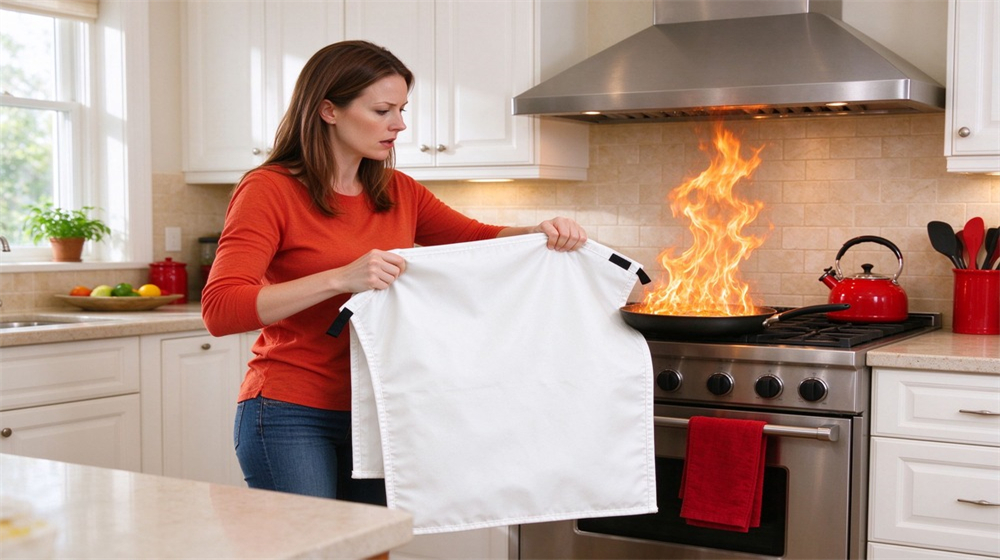
Where to Mount a Fire Blanket
A blanket that stays in a warehouse closet is useless at a kitchen fire. Mount blankets on the wall above kitchen stoves, next to welding stations, in hotel room closets, in server rooms and in vehicle emergency kits. The key is distance from the likely fuel source: within three steps of a stove, within two steps of a welding bench. Wall mounted storage keeps the blanket visible and accessible, and the pull tab design means a pan fire is covered before the fire truck arrives.
A fire blanket is not a fire extinguisher replacement, but it handles situations where an extinguisher makes things worse. A hot oil pan fire will splash if you spray water or chemical extinguishing stream at it. A blanket cuts off oxygen without moving the fuel, the safest first response. For electrical fires on a printer or server, the blanket also avoids extinguishing powder residue. Staff training covers both tools: blanket for small pan and clothing fires, extinguisher for larger involvement, and evacuation when the fire grows beyond either tool.
Blankets should be inspected monthly and replaced if the packaging is torn, the pull tab is broken or the fabric is visibly stained or stiff. A used blanket that has smothered a fire should be replaced, not reused, because heat damage to the fiberglass fibers is not always visible. Soft bag packaging works for wall mounts in offices and kitchens, and hard boxes for dusty industrial stations. Both deploy with the same two pull tab motion.
High-Rise Escape and Rescue
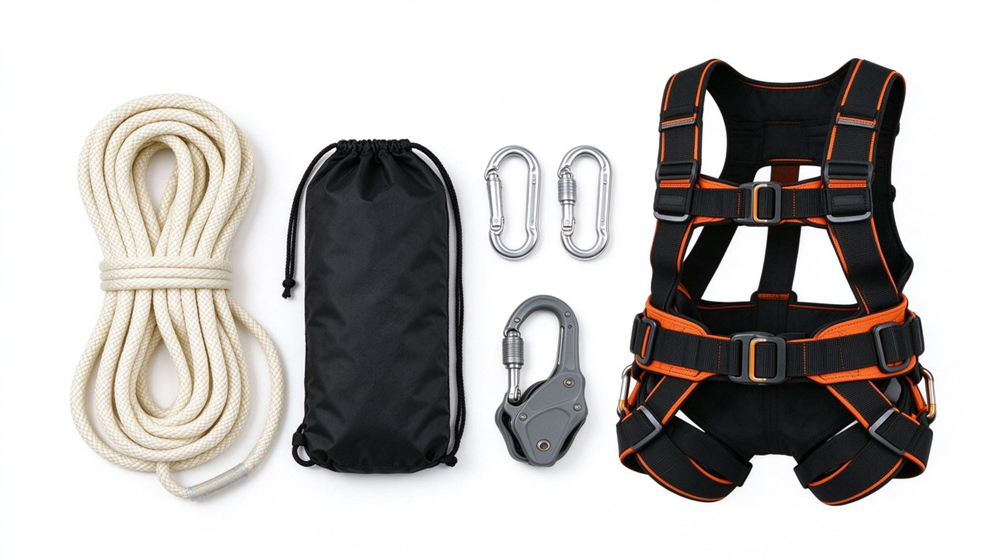
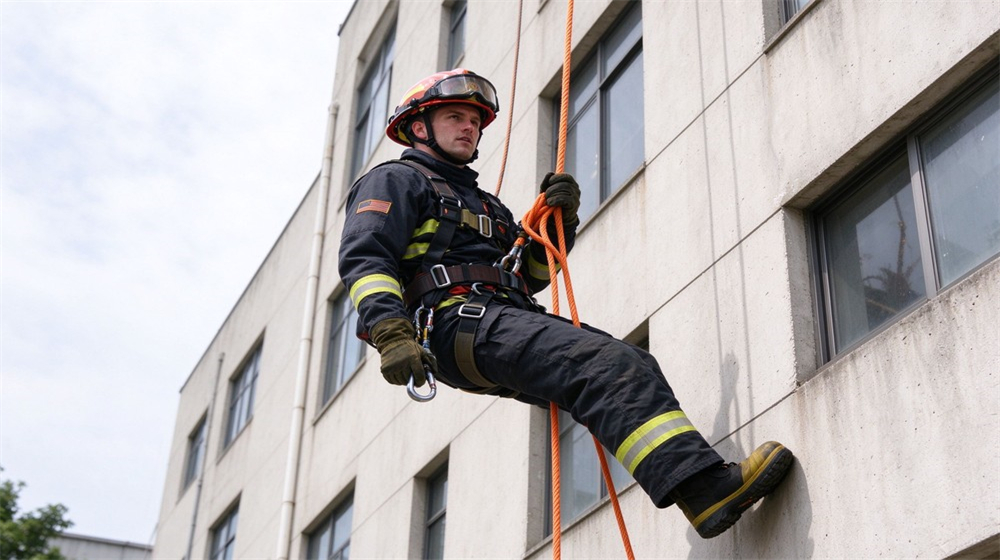
When a stairwell fills with smoke and the elevator stops, the only way out of a high rise is down the outside. A fire escape rope system with a controlled descender and a full body harness lets a trained firefighter evacuate occupants or escape themselves from up to 50 floors. It is also used for rope rescue between buildings, window operations and confined space retrieval. For floor by floor building planning and anchor point selection, see the high rise fire escape guide in this matrix.
50 Floor Rating, 0.5 to 2 Meters per Second
The kernmantle rope is 10.5 mm static rope with a 22 kN minimum breaking strength, tested to EN 892. Buyers often ask how high can escape rope gear be used: our systems are rated for up to 50 floor high rise evacuation. The descender controls descent speed between 0.5 and 2 meters per second regardless of body weight, so a 60 kg rescuer and a 100 kg rescuer descend at a safe controlled rate. For example, water rescue equipment wholesale for professional teams.
The full body harness is a five point design with front and rear D rings, tested to EN 358 and EN 361. Rope lengths up to 50 meters cover most high rise applications. For rope constructions, harness sizing and descender options, see the escape rope and safety harness page.
Anchoring and Buddy System
A rope is only as strong as its anchor. Before a descent, the firefighter selects a structurally sound anchor point: a reinforced window frame, a stairwell handrail anchor or a dedicated roof anchor. The carabiner clips the rope to the harness D ring, and a second firefighter on the floor above belays the line. A solo descent without a belay is not rescue, it is a risk. Training on anchor selection and body position during descent is essential before this gear goes on the truck.
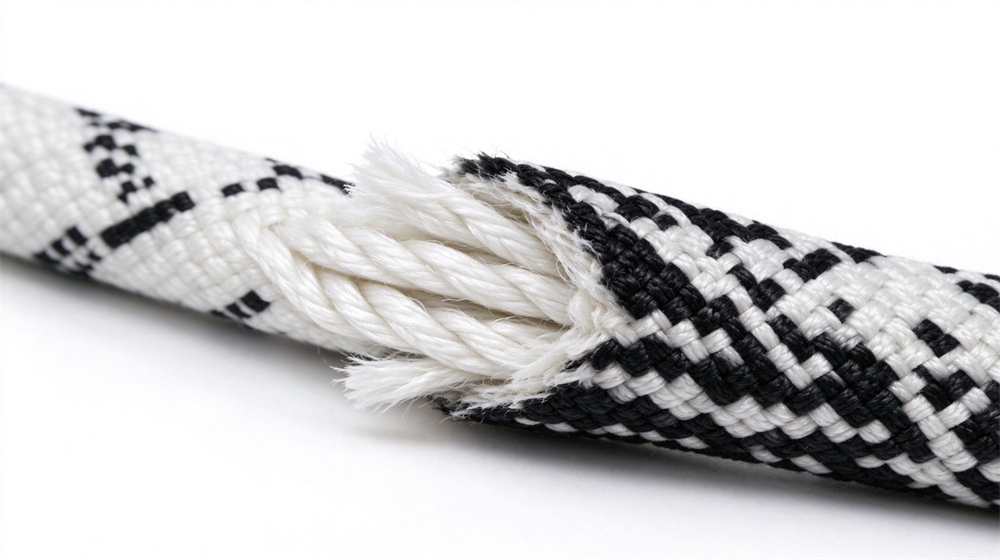
Rope inspection is visual and tactile, not a quick glance. After each use, the firefighter runs the rope through both hands checking for cuts, abrasions, soft spots or discoloration. A rope exposed to chemicals, dragged through broken glass or loaded in a fall is retired immediately, even if it looks fine. Kernmantle rope has a braided outer sheath protecting the parallel core, but a deep sheath cut can compromise it. Ropes are stored coiled in a rope bag away from sunlight and chemicals, because UV degrades nylon and polyester over time.
The harness fits over turnout gear, not under it. Leg straps adjust to fit snug without binding when the firefighter kneels or climbs. The chest D ring is for vertical lift, the rear D ring is for fall arrest and the front D ring is for rappelling. A harness sized for street clothes will be too small over a turnout coat, so sizing is done with the full gear layer on. Carabiners are screw gate or triple action, and the gate must be closed and screwed before loading. These basic details determine whether a rescue works or struggles on the first load.
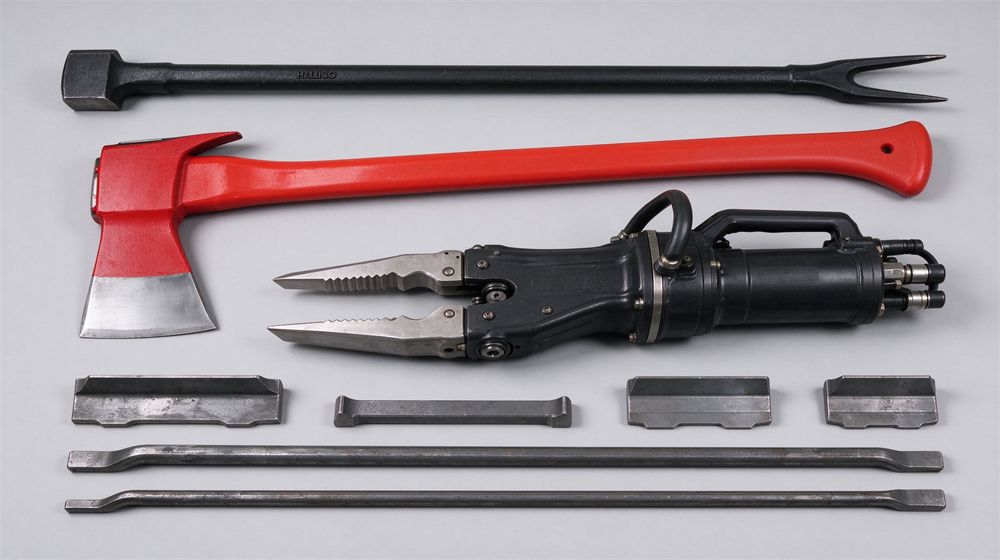
Forcible Entry and Rescue Tools
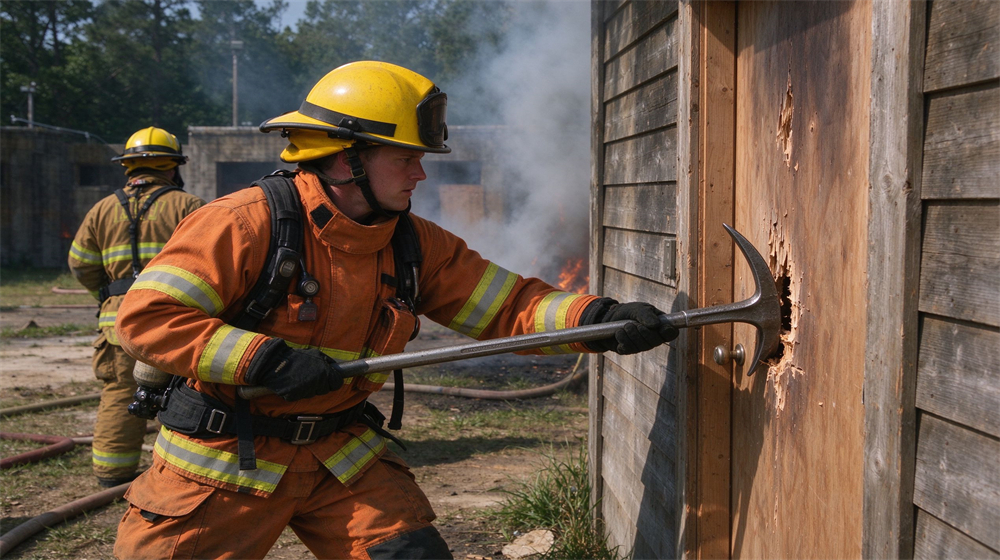
Firefighters rarely enter through the front door it was locked, chained or blocked by fire damage. Fire rescue tools are the hand tools that open the way: prying doors, breaking locks, spreading jammed frames and cutting through barriers. This category runs from a single Halligan bar to a full hydraulic spreader kit, with over 100 tool SKUs in the catalog. For example, emergency lighting equipment wholesale for fire and rescue.
Halligan Bar and Fire Axe: The Classic Pair
The Halligan bar is the signature forcible entry tool: one end has a curved fork for prying lock sets, the other has a pick and adze for puncturing and twisting. Used with a flat head axe as a striking tool, the pair opens most residential and commercial doors in under a minute. Both tools are made from forged steel with non slip grips, sized for one handed carry on the apparatus. Over 100 tool SKUs range from mini Halligan bars for vehicle rescue to long pry bars for structural collapse.
Hydraulic Spreader and Power Tools
For vehicle extrication and heavy forcible entry, a hydraulic rescue spreader opens jammed door frames and crumpled panels with 30 kN of spreading force. Battery powered combinations spread, cut and lift without a hose line. These tools are shared equipment per station, sized to the call volume, and inspected after every use. The tool bag also carries steel wedges, flat pry bars and a glass breaking punch for secondary tasks.
Tool care is what separates a working set from a rusted pile. After every use, the Halligan bar wipes down with a rag, the axe edge gets a light coat of oil to prevent rust, and the hydraulic spreader checks fluid levels and battery charge. Tools should be mounted in designated brackets on the apparatus so they do not slide around during transport.
A loose Halligan bar bouncing in a compartment becomes a projectile during braking. Each tool gets a serial number tag and an inspection date, and any tool with a cracked handle, bent fork or hydraulic leak is pulled from service immediately. Training on proper striking technique prevents the axe handle from splitting, which is the most common tool challenge.
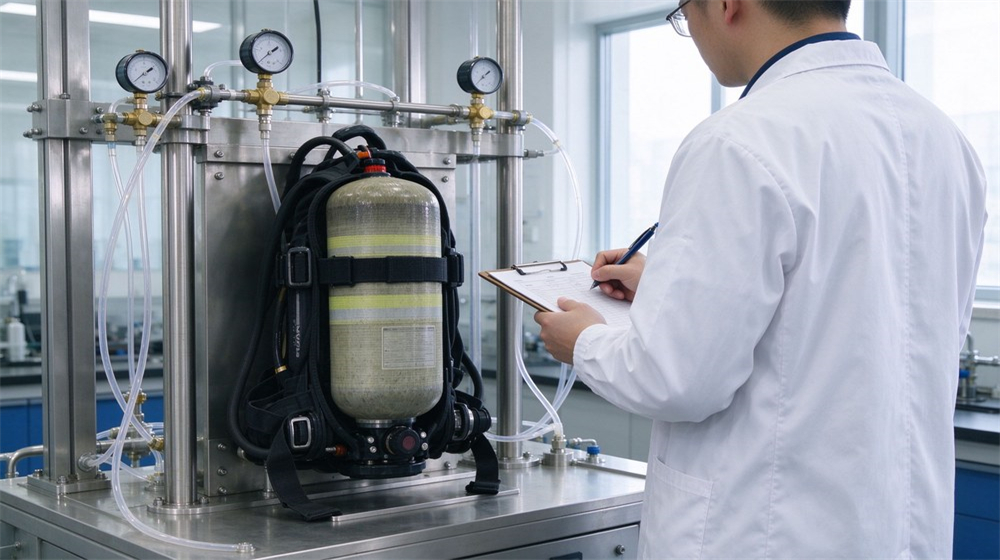
Complete Equipment Packages
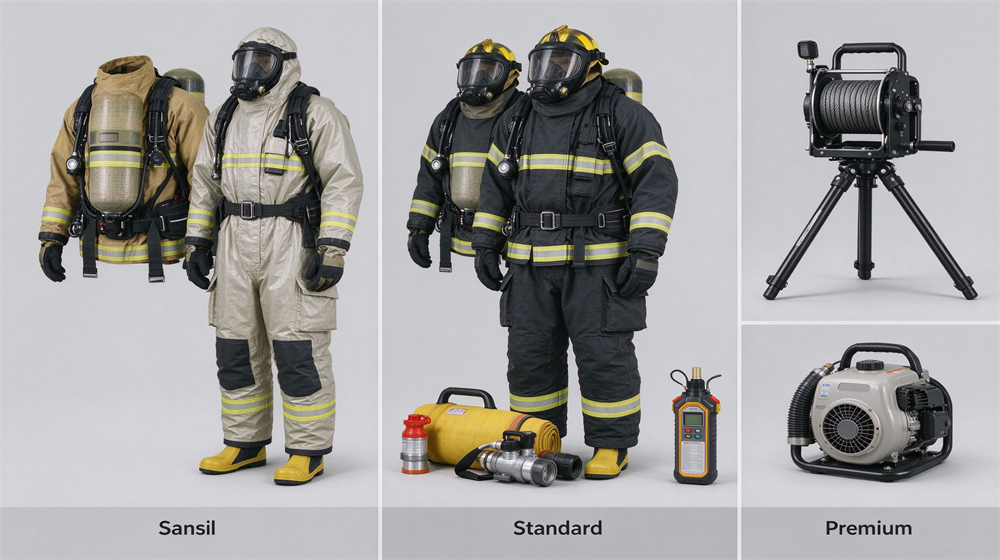
Rather than ordering each category separately, most procurement officers ask for a matched package. The fire equipment package approach puts personal gear for each firefighter plus shared station equipment into one order, with one contents manifest, one inspection schedule and one shipping carton set. We configure three tiers: standard, special and hazmat, each sized for a four person team.
Standard Package for Structural Response
The standard package outfits four firefighters for structural fire attack: four turnout sets in measured sizes, four 45 minute SCBA units, four helmets, four pairs of gloves and boots, two fire blankets per apparatus, two escape rope kits and one Halligan axe set. This is the baseline locker for a suburban station or an industrial brigade doing structural and spill response. It ships with a contents manifest taped inside the cabinet door so the safety officer can walk the locker in under two minutes.
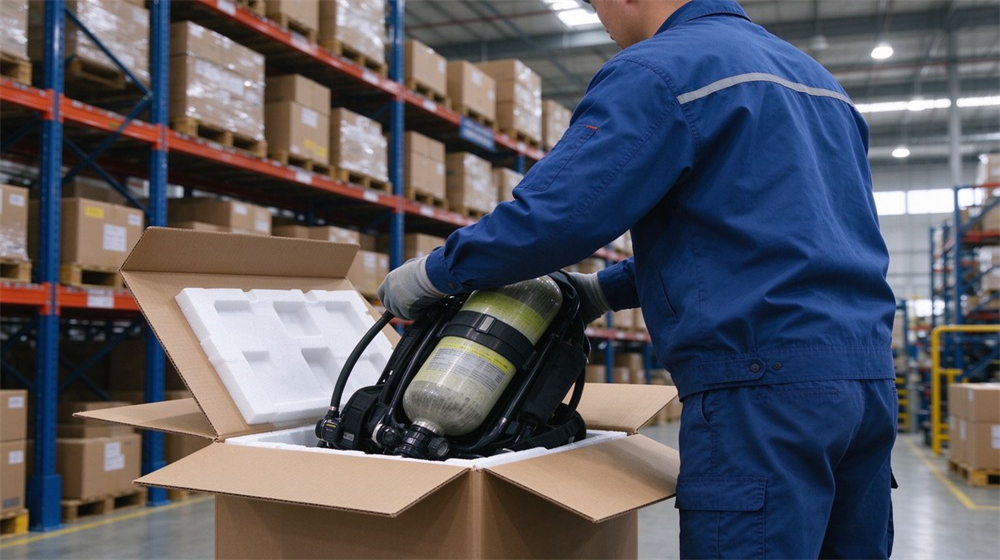
Special and Hazmat Packages
The special package upgrades to 60 minute SCBA cylinders, adds a hydraulic spreader kit and includes chemical splash suits for industrial spill calls. The hazmat package adds fully encapsulating suits, dual cylinder SCBA and gas detection equipment. Each tier builds on the one below it, so a department can start standard and upgrade later without reordering the base gear. For bulk wholesale fire fighting gear orders, package configuration reduces the number of line items and simplifies the tender.
A well organized locker decides whether a drill starts in two minutes or ten. Each piece of equipment has a labeled spot on the shelf. The contents manifest taped inside the cabinet lists every item, so the safety officer can confirm nothing is missing without opening every bag. Cylinders stand upright in a rack, ropes hang on hooks, tools sit in designated brackets, and spare gloves and boots sit in labeled bins. After each use, equipment goes back to its spot, not to a corner. This discipline turns a procurement box into a response system that works shift after shift.
The three tiers share the same base turnout and helmet, so upgrading mostly changes cylinder duration and added tools.
Tier
Core Gear
Typical User
Configuration
Standard
Turnout set, 45 min SCBA, helmet, gloves, boots
Structural fire station
4 person team
Special
60 min SCBA, hydraulic tools, splash suits
Industrial brigade
4 person team
Hazmat
Encapsulating suit, dual SCBA, gas detector
Chemical response unit
4 person team
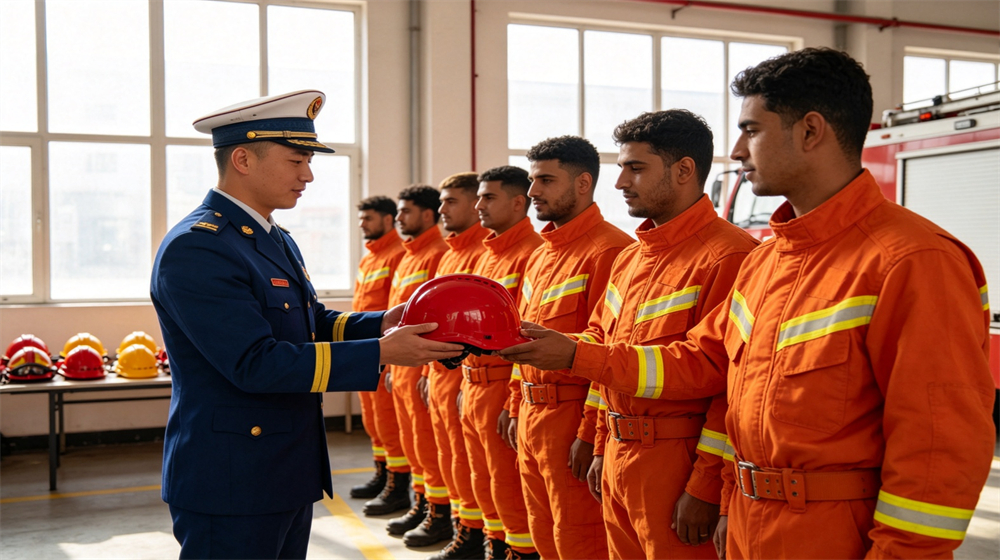
Certifications and Quality Assurance
A gear list on paper is only as good as the test behind each item. Every product in this catalog ships with documentation that traces it to a relevant standard. We use the wording tested to rather than a formal compliance claim, because the test report is the evidence and the buyer should read the report before signing. This section explains what the documentation covers and how the quality control process runs before shipping.
NFPA, EN and ISO Standards Covered
Turnout gear is tested to NFPA 1971 and EN 469. SCBA units are tested to NFPA 1981 and EN 137. Helmets follow NFPA 1971. Fire blankets follow EN 1869. Ropes and harnesses follow EN 892, EN 358 and EN 361. The production management system runs under ISO 9001. Each lot includes third party test reports, datasheets and a compliance matrix mapped to the tender clauses. Buyers comparing fire fighting equipment prices should always ask for the full report set before committing, because a quote without test files is only half a procurement.
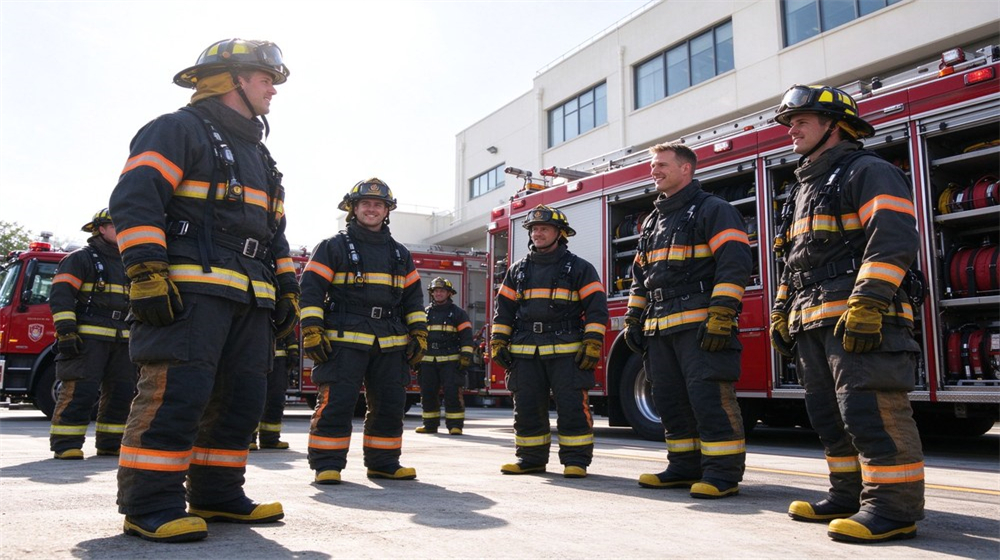
Incoming, In-Process and Final Inspection
Raw fabric rolls are checked for weight, weave and color before cutting. Seams are inspected for stitching density and reflective tape adhesion after assembly. SCBA units go on an air tightness test bench that checks cylinder pressure, regulator function and alarm whistle at the specified set point. Helmets get impact and visor checks. Each finished unit is serial numbered, tagged with the production date and logged in the inspection record. Records follow the order through shipping so any future warranty question traces back to the specific lot.
Post delivery inspection schedules matter as much as factory inspection. Turnout gear is checked after every fire for heat damage and cleaned on a regular cycle. SCBA cylinders get a visual check before each shift and hydrostatic retest on the regulatory schedule. Helmets get a shell and suspension check after any impact. Ropes get a visual run through after each use. Fire blankets get a monthly packaging check. Tools get a post use wipe down and fluid check. The safety officer maintains an inspection calendar listing every piece of gear, its last inspection and next due date. An inventory without a calendar is just a list, not a maintenance system.
Government Procurement and One-Stop Service
Government, military, hospital and school procurement cycles run on paperwork: tender clauses, compliance matrices, batch traceability, packaging standards and payment terms. Our wholesale program is built around that process, not around a quick sales call. This section covers what to expect when a firefighter PPE order goes out to public bid. Public agencies that coordinate emergency preparedness through FEMA typically ask for the same documentation set described below.
Tender Support and Documentation
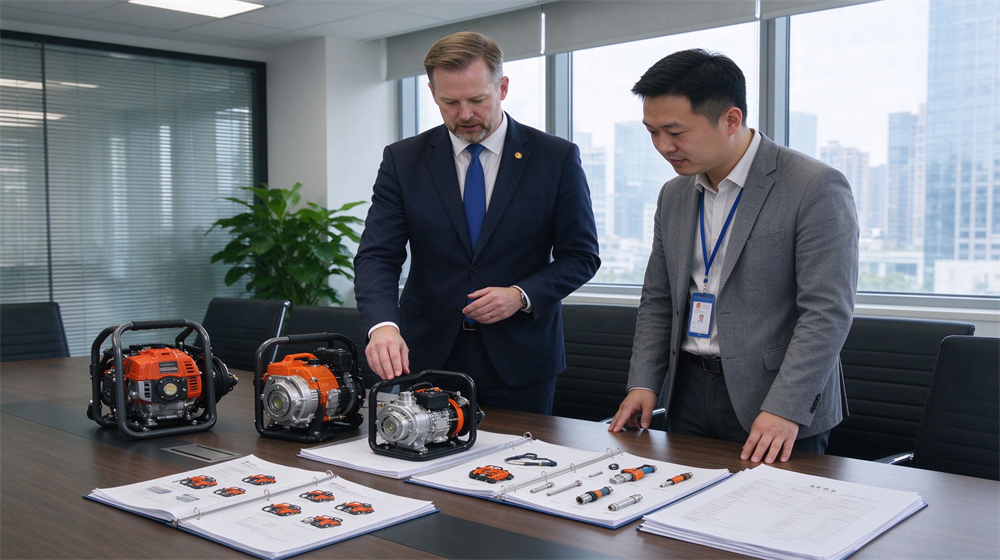
We work with the procurement officer to map each tender clause to a specific product SKU and test report. The submission package includes datasheets, third party test reports, factory audit files, packaging specifications and a sample set for evaluation. After award, production runs against the approved sample, and pre shipment inspection is arranged before container loading. MOQ and lead time are stated per contract rather than as a universal number, because a 50 set order and a 500 set order do not run on the same production window.
LOGO, Packaging and After-Sales
Bulk orders size suits across a measured crew roster, pair each SCBA with a unique cylinder number, and embroider department LOGO on shoulder panels and helmet fronts. PMS color matching keeps marking consistent across lots. Packaging is export cartons with English shipping marks, palletized for container loading. After sales support includes spare parts, expired cylinder replacement guidance and new crew training materials. Payment terms are agreed in the contract, with L C available for larger government contracts. Reach out through the footer contact for a quote on your next procurement cycle.
The typical order flow runs through five stages. First, the buyer sends a spec or a tender document, and we return a technical clarification and a quotation. Second, the buyer requests sample sets for fit and quality evaluation, and we ship samples on a separate lead time. Third, after sample approval, the buyer places the bulk order and agrees on production and shipping dates.
Fourth, pre shipment inspection is arranged, either by the buyer or by a third party inspection firm. Fifth, the order ships, arrives at the port, and after sales support begins. This flow works for a 10 set sample order and for a 500 set bulk contract, because the documentation and inspection steps scale with the order size rather than changing.
Spare parts planning is often forgotten at order time but becomes urgent when a mask valve needs service or a zipper breaks. Order spare face masks, regulator parts, zipper kits, visor replacements and glove pairs alongside the main order, so the station has replacements on the shelf. Wear items such as gloves, hoods and boot laces should be stocked at ten to twenty percent of crew size. This planning step is included in the package configuration conversation.
Keep this document checklist in the tender file. Most bid rejections come from a missing datasheet rather than price.
Document
What It Covers
When Provided
Datasheet
Specs, materials, dimensions
Before order
Third party test report
NFPA / EN compliance data
With each lot
Compliance matrix
Tender clause to SKU mapping
Tender submission
Packing list
Carton count, pallet layout
Before shipment
Contents manifest
Locker inventory per package
With package delivery
Fire Fighting Equipment FAQ: Categories, Packages & Orders
Common questions buyers ask when sourcing fire fighting equipment, covering standards, packaging, cylinder duration and procurement documentation.
1. What categories of fire fighting equipment do you supply?
We supply six core categories: personal protective turnout gear, SCBA breathing apparatus, fire helmets, fire blankets, escape ropes and safety harnesses, and forcible entry rescue tools. Together they cover over 400 SKUs for one stop procurement.
2. Can you supply a complete equipment package for a four person team?
Yes. We configure standard, special and hazmat packages that cover four firefighters from head to toe, including turnout gear, SCBA, helmets, gloves, boots, blankets and rescue tools. Each package ships as a matched set with a contents manifest.
3. What standards is the turnout gear tested to?
Turnout gear is tested to NFPA 1971 and EN 469 requirements. The three layer construction uses Nomex outer shell with TPP rating above 35, moisture barrier and thermal liner. Datasheets and test reports are available per lot.
4. How long does the SCBA air cylinder last?
We offer 30, 45 and 60 minute nominal cylinders. Actual working time under moderate effort is roughly 60 percent of nominal, so a 45 minute cylinder gives about 25 to 30 minutes of working air. All units are tested to NFPA 1981 and EN 137.
5. What is the difference between carbon fiber and steel SCBA cylinders?
Carbon fiber wrapped cylinders weigh about half of equivalent steel cylinders, which reduces firefighter fatigue over a long shift. Steel cylinders are lower cost and more impact resistant. Both are available in 6.8 liter 300 bar configurations.
6. What fire helmet shell material should I choose?
Carbon fiber composite helmets are the lightest at under 1.5 kg with high impact and heat resistance. ABS shells are durable and cost effective for training and rescue duty. All helmets are tested to NFPA 1971 with clear polycarbonate visors.
7. What temperature can a fire blanket withstand?
Fiberglass blankets handle 550 degrees Celsius short duration exposure. Silicone coated fiberglass blankets withstand up to 1000 to 1200 degrees Celsius. We supply blankets tested to EN 1869 for kitchen, vehicle and industrial spill use.
8. How do I use a fire blanket on a person on fire?
Pull the tabs to release the blanket, hold it between your hands as a shield, wrap it around the person to smother the flames, and call emergency services immediately. Do not remove the blanket until medical help arrives.
9. How high can the escape rope system be used?
Our escape rope systems are rated for up to 50 floor high rise evacuation with descent speed controlled at 0.5 to 2 meters per second. The full body harness is tested to EN 358 and EN 361 with 22 kN minimum breaking strength.
10. What forcible entry tools are included in a standard kit?
A standard forcible entry kit includes a Halligan bar, a fire axe, hydraulic spreader, steel wedges and pry bars. The Halligan bar is the primary tool for prying, puncturing and twisting doors and locks. Over 100 tool SKUs are available.
11. Do you provide test reports and documentation for government tenders?
Yes. We supply third party test reports, datasheets, tender compliance mapping and certification files per lot. Documentation covers NFPA 1971, NFPA 1981, EN 469, EN 137, EN 1869, EN 358, EN 361 and related standards as required.
12. Can you add our department LOGO to the gear?
Yes. We offer embroidery and heat applied LOGO on turnout gear shoulders, helmet fronts and equipment bags. PMS color matching keeps marking consistent across lots. LOGO minimum order quantity is stated per contract.
13. What payment terms are available for bulk orders?
Payment terms are agreed per contract. Typical bulk orders use a deposit against balance before shipment, with L C available for larger government contracts. Sample orders for evaluation are available before bulk commitment.
14. How do you handle quality control before shipping?
Each lot goes through incoming material inspection, in process checks and final inspection before packing. SCBA units get air tightness testing, turnout gear gets seam and reflective tape checks, and helmets get impact and visor inspection. Records are kept per serial number.
15. What is the lead time for a complete equipment order?
Lead time is agreed per contract based on configuration, sizing and LOGO requirements. Standard stock items ship faster than custom colored or branded orders. We confirm the delivery window on the proforma invoice before production starts.
16. Do you provide training for the equipment?
We supply operation manuals, training videos and configuration guides with each package. For large orders we can arrange on site or remote training support. After sales support includes spare parts and replacement guidance for wear items.
YRF Fire Fighting Equipment Wholesale Program
Wholesale turnout gear, SCBA breathing apparatus, fire helmets, fire blankets, escape ropes, safety harnesses and forcible entry tools for fire departments, industrial brigades and government emergency response procurement. Six categories, 400 plus SKUs, one stop sourcing. Documentation per contract.
Przyjazne linki :
prawa autorskie © Custom Disaster - Relief Bedding: Tents, Sleeping Bags, Blankets Wszelkie prawa zastrzeżone
profesjonalny zespół do obsługi !