Kategorie
Last updated: October 24, 2026 | Author: YRF Textile Emergency Preparedness Team | cyclone relief supplies for Africa
Cyclones across Madagascar, Mozambique and Malawi leave families without shelter, power or dry bedding within hours. Relief blanket orders for these regions must survive humidity, repeated washing and long storage before they reach families. This guide covers the practical specs, quantities and packing decisions for cyclone response blanket procurement across affected coastal regions in the western Indian Ocean.
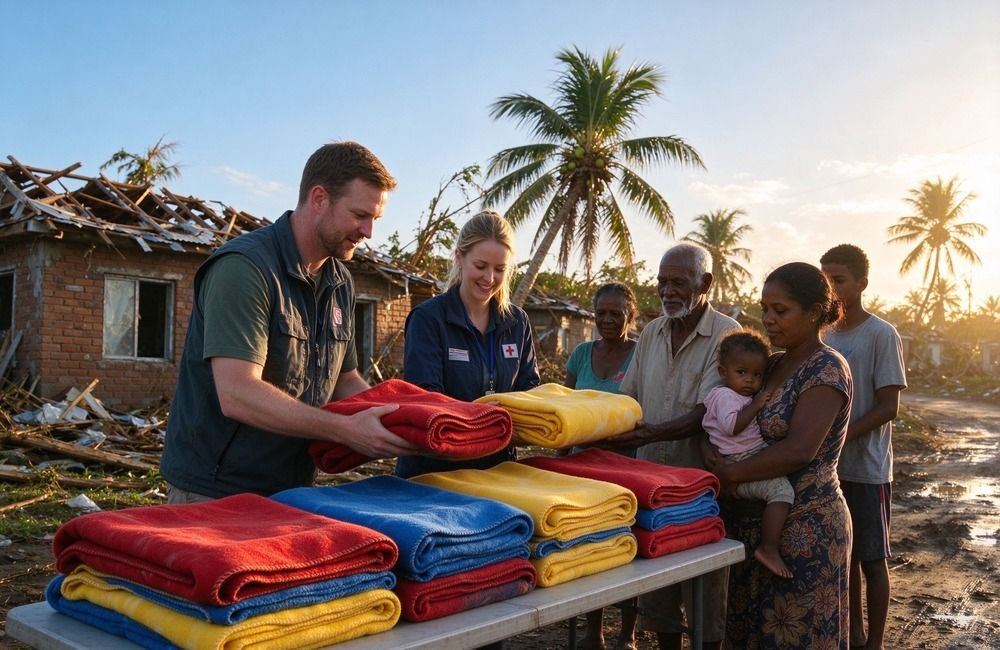
Field distribution of cyclone shelter blankets after a storm.
Related guidance: WHO.
Cyclone response is judged by speed and by specification at the same time. The distribution in the photo happens within the first days after landfall, and the blankets handed out are the ones approved against the storm scenario: dense weave for wind and damp, packed for fast handling, and specified so that every family in the site receives the same standard.

Storm clouds approaching the coast of Madagascar.
The corridor from Madagascar to Mozambique is one of the busiest storm tracks in the world. According to the World Meteorological Organization's cyclone tracking, the 2024-2025 season brought at least three cyclones and heavy flooding across the islands and the mainland coast, and each storm displaced thousands of families in a matter of days. Buyers who wait until a storm makes landfall are already too late. Orders placed before the season move at standard rates and arrive before the first storm.
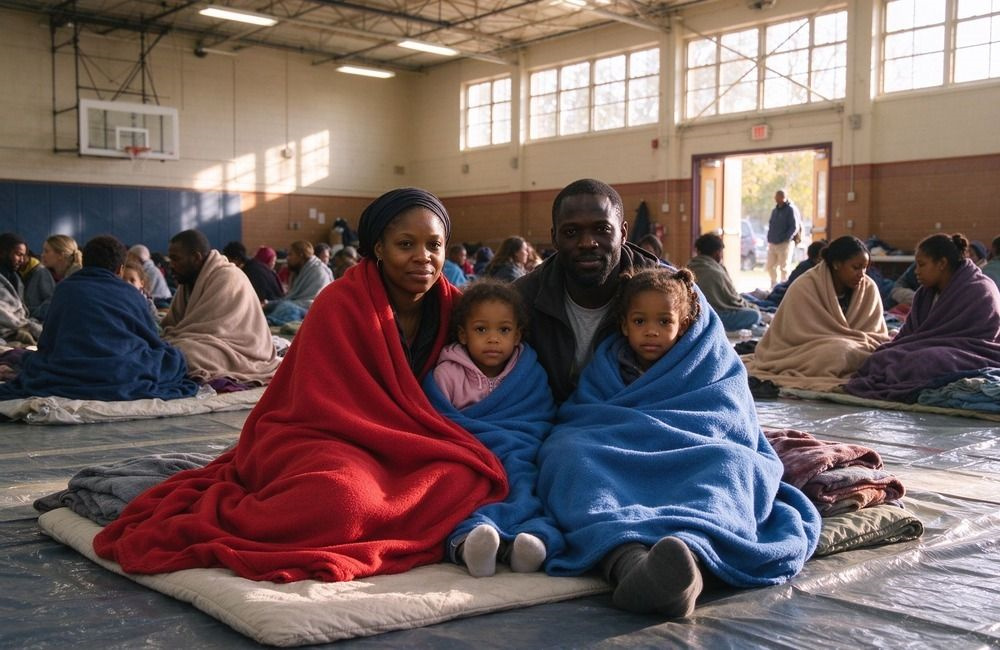
A family sheltered with storm response blankets.
The first hours after a cyclone matter more than most people expect. Homes lose roofs, shelters flood, and families who escaped the wind sleep on wet ground that night. That is exactly where cyclone shelter blankets earn their place in the cargo plan: a dry, warm layer between a family and a flooded floor is basic protection against cold and infection during the first nights. Blankets take up less room than most shelter items, so they reach the most families per container.
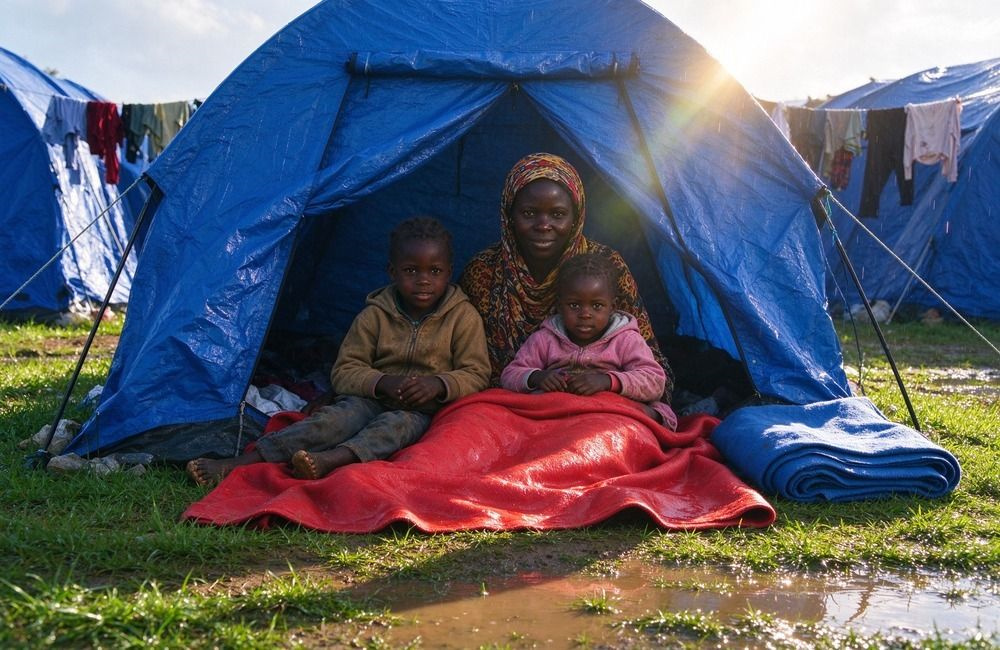
A tarpaulin shelter with waterproof blankets.
Not every blanket survives a storm zone. Rainfall in the corridor is heavy, humidity stays high for weeks after landfall, and bedding that soaks up water becomes a liability instead of a shelter item. Waterproof blankets for tropical storm response use dense fabric and coated or laminated surfaces so they dry fast, stay light in the box, and still breathe enough for a family to sleep under them. Specifying one standard for every bale keeps bids comparable across suppliers and simplifies inspection on arrival.
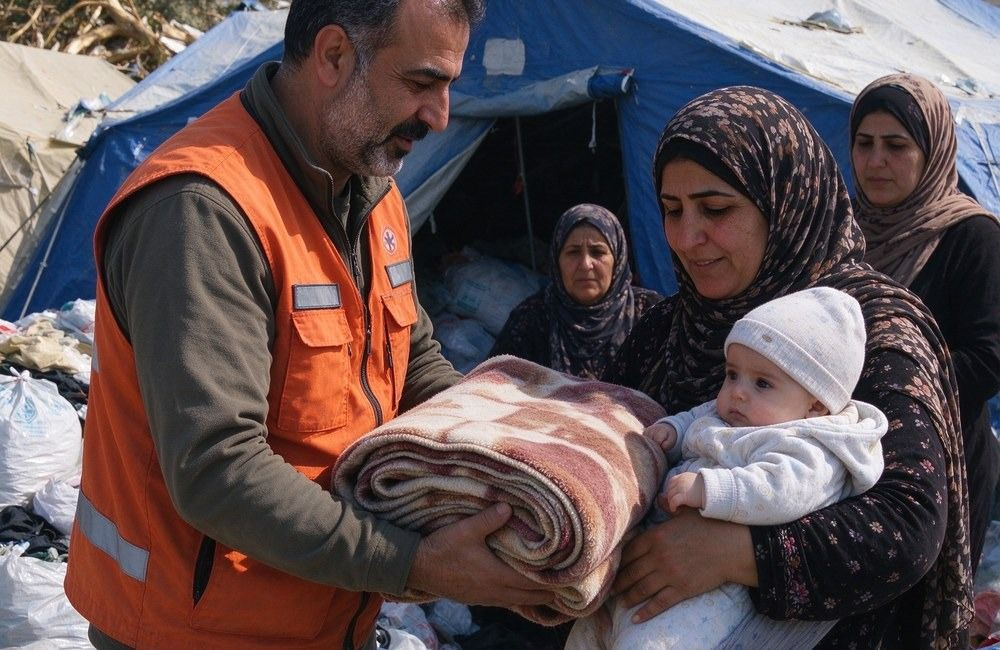
After the cyclone, the translation is simple: families need dry sleeping surfaces, and they need them fast. The blanket handed across in the photo is the same item the procurement order specifies, GSM, weight tolerance and packing must survive the journey from factory to this tent floor.
Cyclone response is judged by speed and by specification at the same time. The distribution in the photo happens within the first days after landfall, and the blankets handed out are the ones approved against the storm scenario: dense weave for wind and damp, packed for fast handling, and specified so that every family in the site receives the same standard.
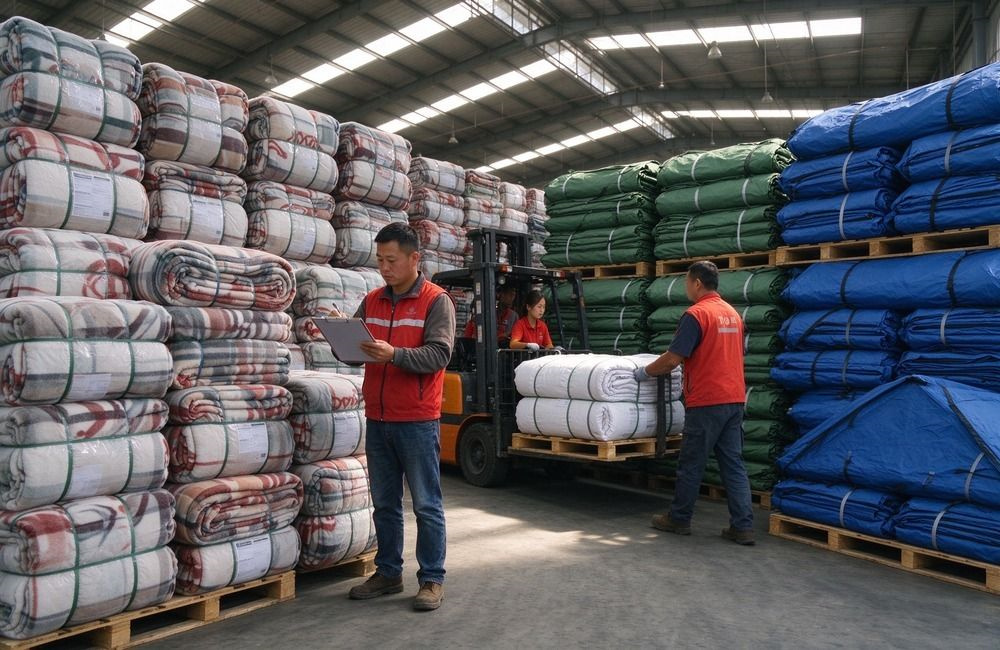
Pre-positioned cyclone relief stock in a warehouse.
The window to act is the quiet season. Agencies that order cyclone season preparedness supplies between April and November lock in production slots, approve samples, and pre-position relief stock before December arrives. Pre-positioning is not a luxury; it is the difference between handing out dry bedding on day one and waiting weeks for a sea shipment after the emergency. The quiet season also means warehouse space is available and freight rates are lower, so budgets go further before demand spikes.
Storm logistics rewards a packing plan that is agreed before the season. Compressed bales survive container handling better when the bale weight is written into the packing list, and the carton inner dimensions are confirmed with the folding size of the blanket. Agencies that name the bale weight, the carton size and the pallet count in the RFQ receive loading plans they can check against the warehouse floor.
Spec verification for cyclone stock covers the same checks as any relief blanket, plus one extra: the water-repellent finish must survive folding and storage, not only the lab test. Ask for the finish test after folding, and confirm the respray or re-treatment instruction for stock that has been stored through a wet season.
Cyclone programs that pre-book the inland leg receive more reliable delivery dates. Name the port, the inland hub and the last-mile route in the RFQ, and confirm who handles the bales between the port and the shelter, because the transfer point is where stock lists and packing lists get mismatched.
Pre-positioned cyclone stock works when the rotation date is written on the bale. Mark the production date and the review month on each bale label, and rotate the reserve once a year, because a blanket that has sat folded for two wet seasons needs a re-check of the water-repellent finish before deployment.
Cyclone season planning also names the review meeting date, so the spec, the quantity and the packing are confirmed before the storm window opens.
Keep the packing photos with the order file, because the next season reuses the same bale configuration.
It also keeps the pre-positioning plan ready for the next storm season.
That single habit keeps the reserve ready.
It also keeps the bale configuration consistent across seasons.
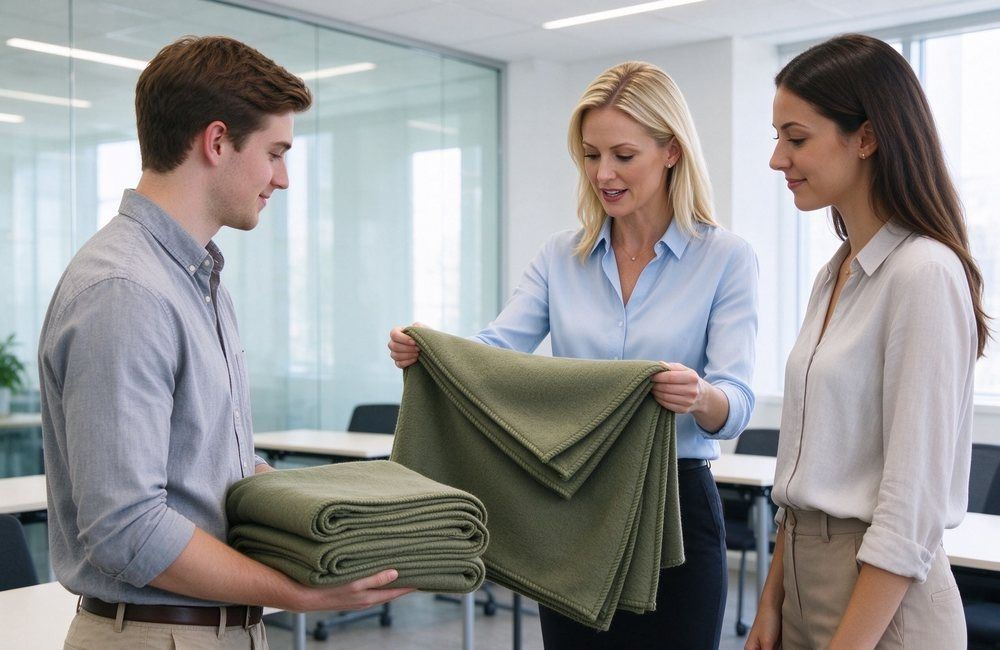
Agency staff reviewing samples for a cyclone program.
The cyclone corridor is a defined region, not a vague coastline. It runs from the Mozambique Channel across the northern and eastern coasts of Madagascar, then west into Mozambique and inland toward Malawi. Storms form over the warm Indian Ocean, strengthen as they approach land, and lose power over land only after they have already dumped heavy rain for hundreds of kilometres. The World Meteorological Organization keeps the official tropical cyclone records for the region, and its season reports show why buyers plan around December to March.
The 2024-2025 season is a practical example. It produced at least three named cyclones plus related flooding, which is a normal load for the corridor, not an unusual year. OCHA Africa overviews of the region list hundreds of thousands of people affected by each major storm, with shelter, bedding and safe water at the top of the response list. For a supplier reading these reports, the translation is simple: families need dry sleeping surfaces, and they need them fast. For the flood response angle on the same corridor, see the flood relief bedding guide for southern Africa.
Malawi sits at the tail of the corridor. Cyclone rain that crosses Mozambique often floods the Shire Valley and the southern districts, so relief buyers there order the same shelter package as coastal agencies but plan for inland flooding rather than wind damage. The specification priorities stay the same even when the geography differs.
Because the season repeats every year on the same calendar, demand is forecastable. Warehouses in the corridor pre-load before December, and agencies that miss the window pay peak freight and wait through backlogs. The pre-positioning logic in this guide follows the same calendar used by flood and drought programs across the region. The data anchor for this guide comes from public WMO and OCHA reporting, which is exactly the source set most procurement teams trust when they justify a pre-season order.
For procurement, the corridor matters in one more way: delivery routes. Ports in Madagascar and Mozambique are the main entry points, with inland movement to Malawi by road or rail. A buyer who names the final province in the RFQ gets a more accurate freight quote than one who just writes 'East Africa'. The more specific the destination, the tighter the price and the schedule.
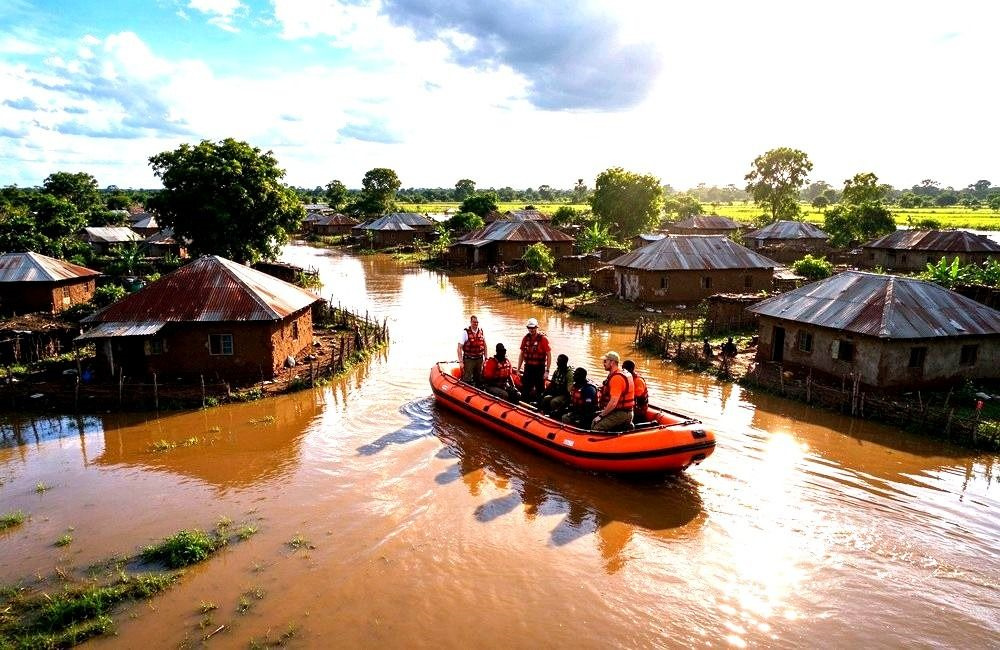
A flooded village after a cyclone in Mozambique.
A cyclone response is a shelter response. The standard package that relief agencies assemble covers four layers: a weatherproof overhead (tent or repaired roof), a dry ground layer, body warmth, and protection from mosquitoes and waterborne illness. Cyclone shelter blankets sit in the middle of that stack, between the family and the floor, and they do double duty as warmth at night and as padding for children on concrete.
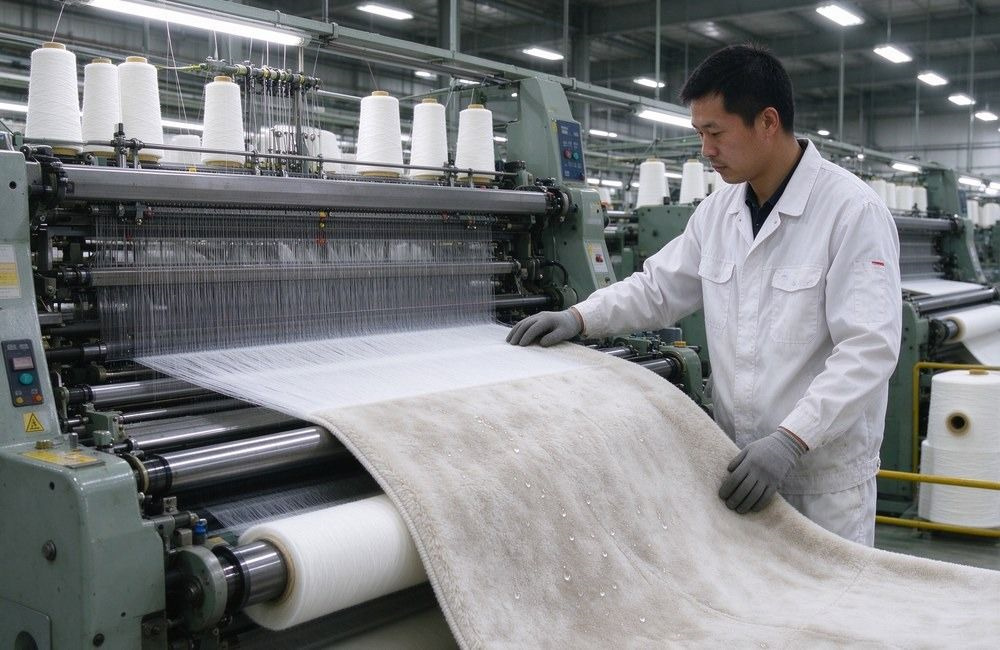
A waterproof blanket for tropical storm use starts with a dense weave that sheds water, not an open knit that holds it. Brushed flannel and coated poly-cotton are the two families buyers most often compare for this corridor, and the weave on the machine decides which one is practical.
Cyclone response is judged by speed and by specification at the same time. The distribution in the photo happens within the first days after landfall, and the blankets handed out are the ones approved against the storm scenario: dense weave for wind and damp, packed for fast handling, and specified so that every family in the site receives the same standard.
Related guidance: FEMA.
The International Federation of Red Cross and Red Crescent Societies publishes operational guidance for cyclone response, and its field reports repeatedly list the same priorities: shelter materials, bedding, safe water and sanitation. A supplier does not need to guess the contents of a cyclone relief kit; the kit follows those published priorities. Blankets, ground sheets, tarpaulins and simple tents cover most of the list.
One practical difference between cyclone response and other emergencies is moisture. Everything a family sleeps on must dry fast or it becomes a health risk within days. That is why storm response blankets for this corridor are specified for quick drying rather than maximum cosiness alone. The fabric choice matters as much as the GSM weight.
Quantities follow the family unit. Relief programs count households, not individuals, so the buying unit is usually a household kit: one or two blankets, a ground sheet, and sometimes a small tent. When agencies ask how many blankets are needed, the answer starts with the number of households in the affected districts, not with a round total.
Keep the checklist short for the first order. Shelters, bedding, water and sanitation cover most needs on day one. Luxury items and single-purpose products add freight cost and slow distribution, so experienced buyers keep the first shipment tight and add specialist items only when the field reports ask for them.
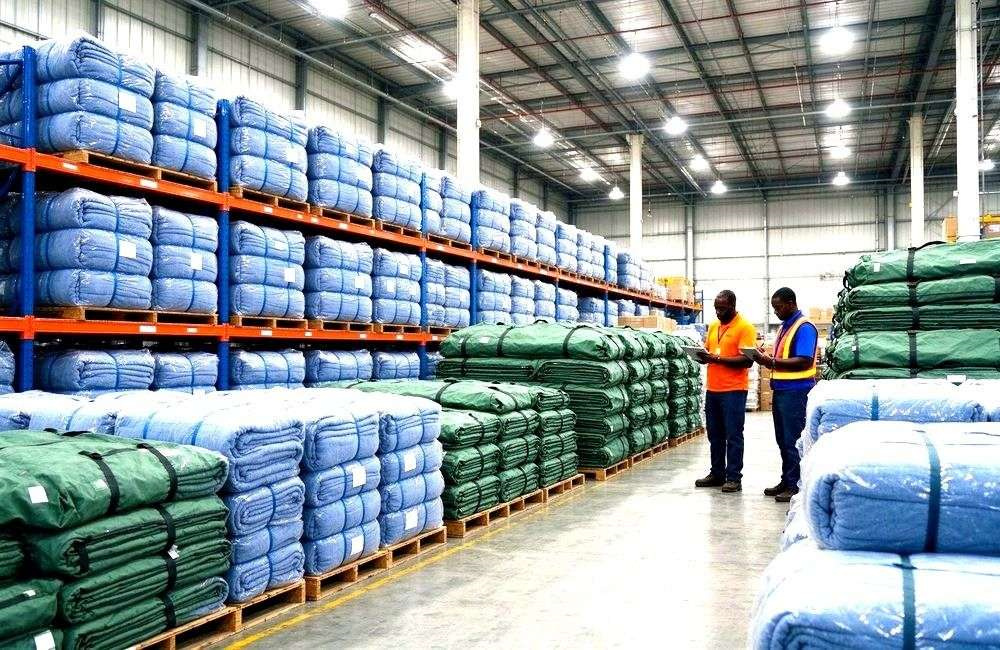
Blanket bales ready for cyclone response.
The blanket is the workhorse of the shelter package, so its specification deserves the same attention as the tent. A waterproof blanket for tropical storm use starts with a dense weave that sheds water, not an open knit that holds it. Brushed flannel and coated poly-cotton are the two families buyers most often compare for this corridor.
Dense brushed flannel is the volume choice for cyclone programs. It dries quickly because the surface is smooth and tight, it is comfortable in humid heat, and it folds to a small bale for freight. GSM weight is the honest way to compare: 250 GSM flannel suits most storm nights, 300 GSM suits cooler highland nights, and 180 GSM suits hot lowland districts where the priority is a dry layer rather than deep warmth.
Coated or laminated poly-cotton blankets add a waterproof layer for outdoor use, where a family may sleep under a tarpaulin rather than in a tent. The coating must stay flexible after folding, and the reverse side should remain breathable so condensation does not form underneath. Ask for the coating type and its wash tolerance in writing.
Wind resistance is mostly about edges and size. A blanket that is too small lifts off a sleeping child in a gust; a 180 x 220 cm family size stays anchored under bodies and packs. Seams on reinforced versions prevent tearing at stress points, and a bound hem stops the edges from fraying during repeated washing in shelters.
For buyers comparing quotes, the specification sheet tells the real story. Compare weave, GSM, coating type, wash rating and size on one line each, and the differences between suppliers become visible. Samples let a buyer feel the weight and test the drying time, which is the fastest way to separate a storm-ready blanket from a general-purpose one.
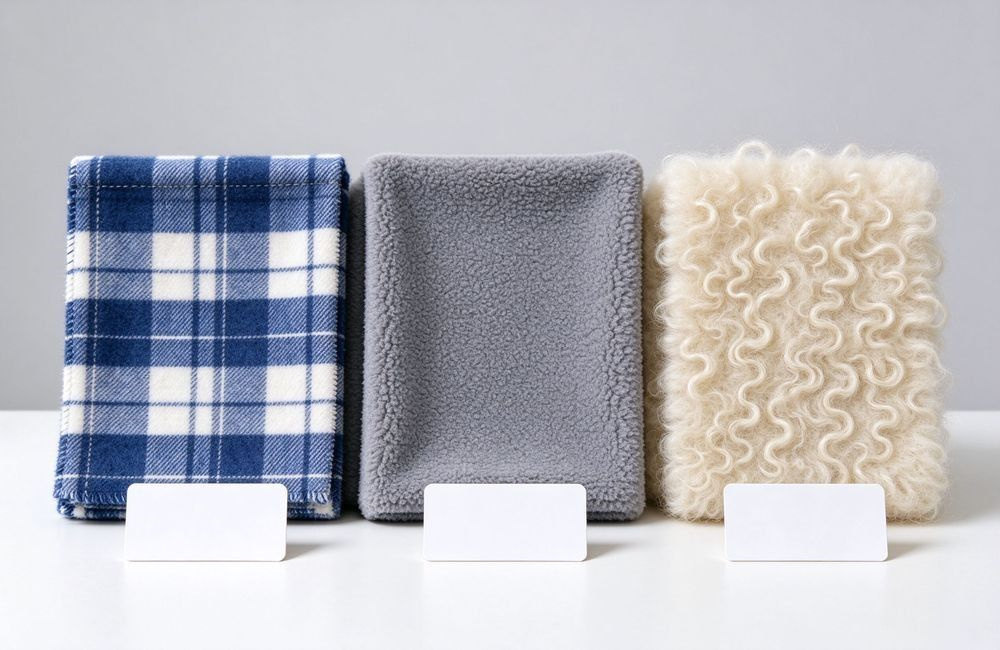
Fabric swatches compared for cyclone program selection.
Emergency tents for cyclone zones are engineered for wind first: low profile, strong poles or frames, and guy lines anchored to the ground. Dome and tunnel shapes shed wind better than flat roofs, and a full-floor model keeps rain and crawling insects out of the sleeping area.
Not every shelter comes as a tent. Tarpaulins and plastic sheeting are the fastest shelter materials in the first week because one sheet covers a family under a damaged roof or on open ground. Relief programs often order tents for longer-term sites and tarpaulins for the emergency phase, so a supplier that offers both gives the buyer one less coordination problem.
Size follows the household again. A 4-person tent covers the average displaced family, while 8-person or larger tents suit shared shelters and temporary health posts. Agencies ordering for camps usually combine: a stock of family tents for new arrivals plus a smaller stock of large communal tents for overflow.
Ground sheets matter more in cyclone zones than in dry emergencies. Rain pools under tarpaulins, so a waterproof ground sheet keeps the first layer dry. The same bale that holds blankets can include ground sheets at very little extra freight, and buyers appreciate one supplier who coordinates the whole sleeping package.
Check the wind rating and the setup time in the specification. A tent rated for storm gusts with a 15-minute setup is worth more to a field team than a heavier tent that takes an hour to pitch. Field crews work in wind and rain, so every simplification in the tent design saves real time on site.
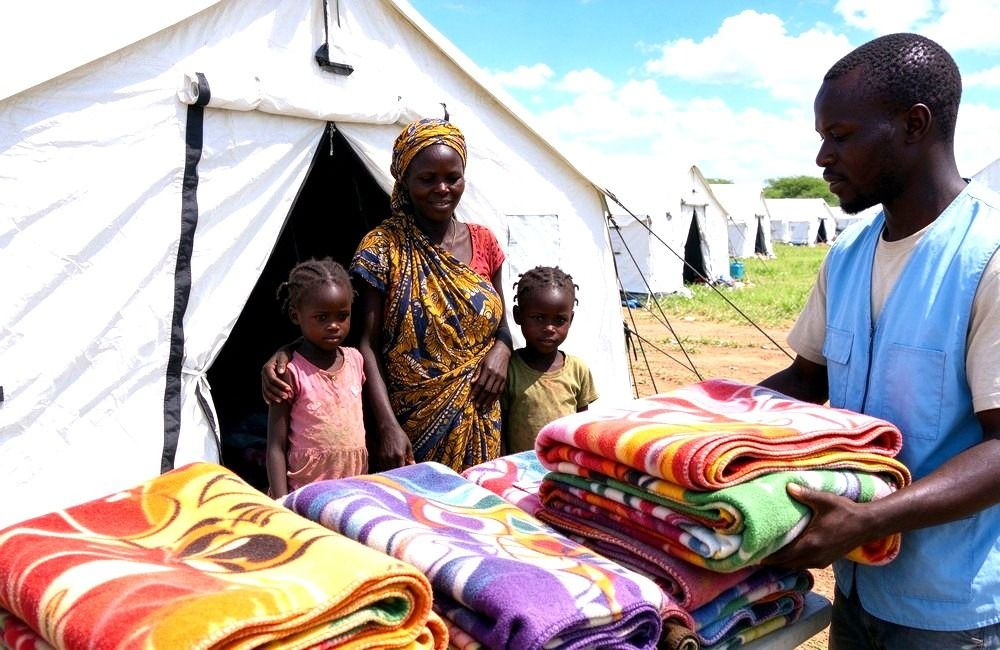
A tent camp for families after a cyclone.
Pre-positioning is the single biggest difference between a fast response and a slow one. Cyclone season preparedness supplies are ordered and warehoused before the storm window, so the first truck can roll the day after landfall instead of waiting for production. National disaster offices across the corridor run pre-positioning programs precisely for this reason.
The calendar drives the whole plan. Order in the quiet months, produce between June and October, and have stock sitting in or near the corridor by November. A program that pre-positions avoids three costs at once: peak-season freight, production backlogs, and the premium prices suppliers charge for rush orders during an emergency.
Where the stock sits matters as much as when it was ordered. Warehousing in a coastal city close to the affected districts shortens the last-mile delivery, while national-level warehouses serve the whole country. Agencies often split the difference: a central stock for the country plus smaller forward stocks in high-risk districts.
Pre-positioned stock must survive months of hot, humid storage. The packing rules from the next section apply here directly: compressed bales with liners, off-floor pallets, and clear labelling so field teams can count and dispatch without opening everything. A bale that survives storage intact is a bale that arrives dry.
Stock rotation keeps pre-positioned goods usable. Blankets stored for a year should be inspected for damp, odour or pest damage, and older stock should be rotated into training or smaller distributions before the new season's stock arrives. Written rotation rules turn pre-positioning from a one-time purchase into a sustainable system.
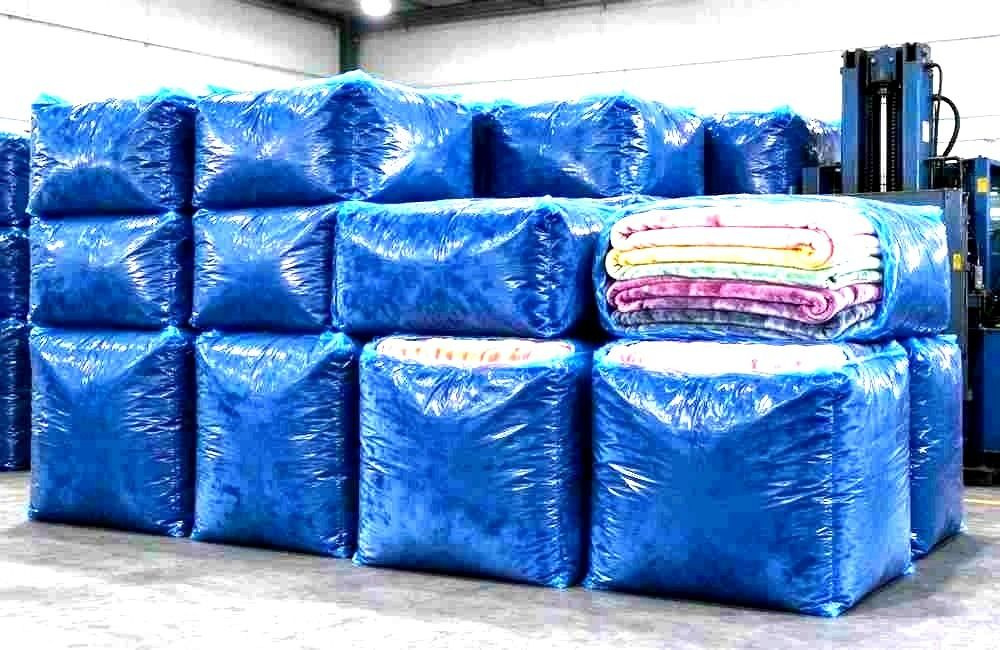
Compressed bales on pallets for dispatch.
Household kits are the cleanest way to buy bedding for a cyclone program. Instead of ordering loose blankets and hoping the distribution team builds fair bundles, the buyer orders a defined kit per family and the numbers add up by design. Blanket and bedding kits per household usually contain two blankets, one ground sheet and one washable pillow or roll mat, packed together.
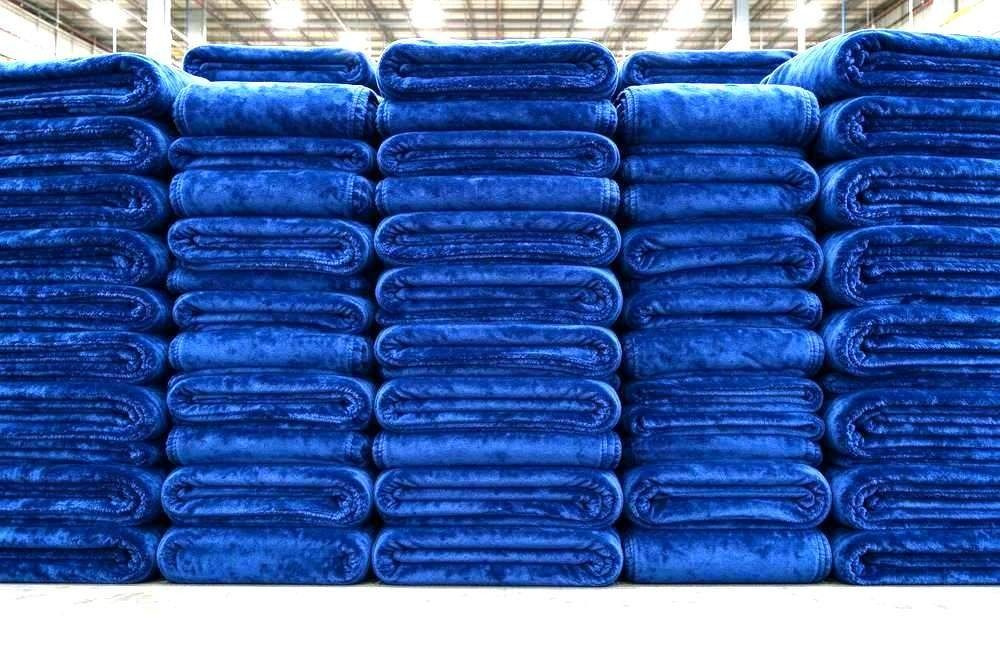
Folded blankets packed into household kits.
Kit contents follow the family size. The standard household kit in most African relief programs covers four to five people: two adult-size blankets at 180 x 220 cm, one child blanket, one waterproof ground sheet, and one bar of wash soap. Some programs add a small tarpaulin and call the whole thing a shelter kit, which combines the bedding and overhead layers.
Kitting has a hidden benefit for distribution: counting. A warehouse worker counts boxes instead of individual blankets, and a field team hands one box to one family. Disputes about fairness disappear when the kit is identical for every household, and leftover stock can be tracked by the box.
The table below shows a typical household kit specification. Use it as a starting point and adjust for your climate, family-size data and budget. The important habit is to define the kit before you ask for quotes, so every supplier prices the same list.
For larger programs, kits scale naturally. 10,000 households equal 10,000 kits, and the freight is easier to estimate because the box dimensions are fixed. Suppliers that have packed kits before can give a per-kit volume figure that makes container planning exact.
The five lines make one complete household unit. Adjust the blanket GSM for your districts, but keep the kit structure identical for every household so distribution stays fair and countable.
|
Kit item |
Specification |
Purpose |
|
Adult blanket x2 |
180 x 220 cm, 250 GSM flannel |
Body warmth and dry sleeping layer |
|
Child blanket x1 |
150 x 200 cm, 250 GSM flannel |
Extra warmth for children |
|
Ground sheet x1 |
200 x 250 cm waterproof |
Dry first layer on wet ground |
|
Wash soap x1 |
Bar soap |
Basic hygiene in shelters |
|
Kit box x1 |
Labelled carton |
One box per household for fair distribution |
For a shelter kit, add a 4 x 5 m tarpaulin to the same box. The per-kit volume figure in the quotation then covers the whole sleeping package in one freight line.
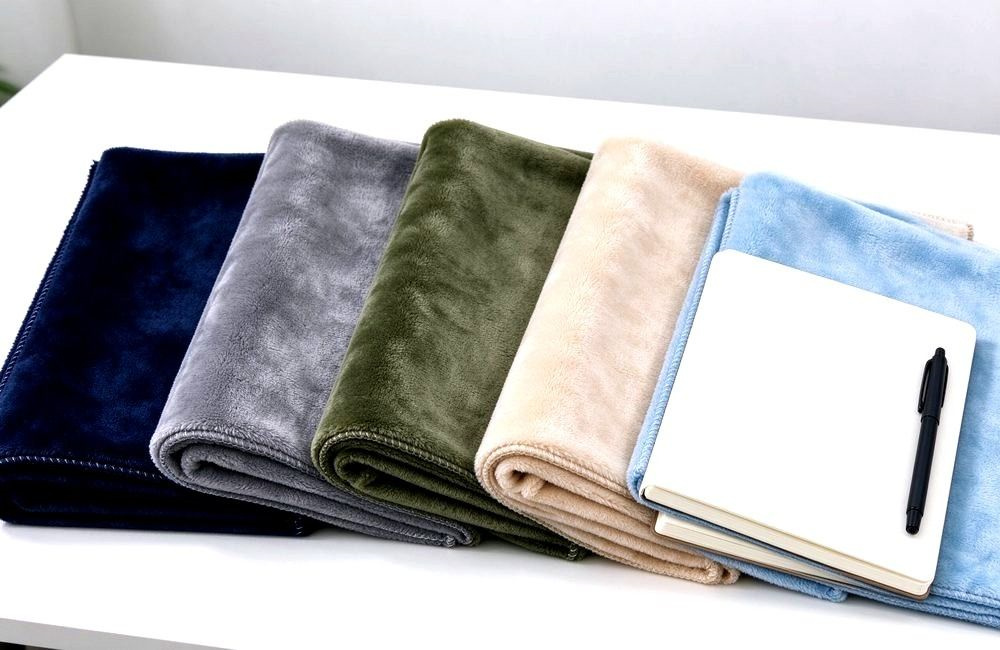
Sample swatches and colour cards for kit confirmation.
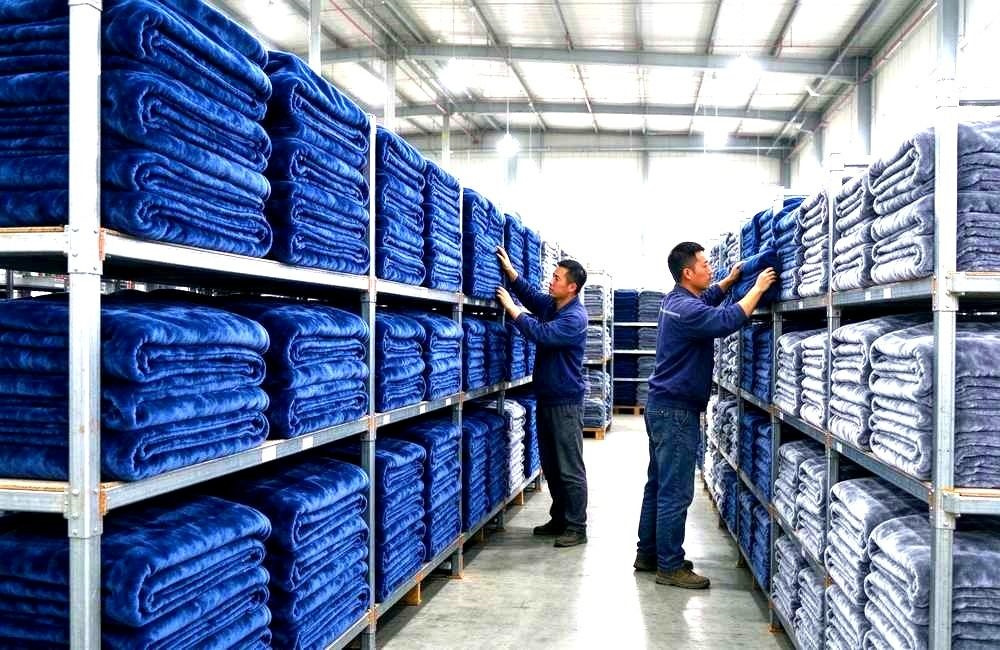
Storm logistics punish bad packing. Sea freight, humid ports and rough road delivery all attack unprotected bedding, so the packing specification is a real part of the product. Pre-positioning relief stock in the corridor depends on bales that survive months of storage and a final rough truck ride.
Compressed bales are the freight-friendly standard for blankets. A compression machine reduces a stack of blankets to a tight, wrapped block, cutting container volume by roughly a third and keeping moisture out. The wrap should be a strong outer film with an inner liner, because the liner is what actually protects the fabric from humidity.
Cartons suit smaller orders and household kits. A kit carton carries a fixed number of kits, is labelled with the contents and destination, and survives warehouse stacking better than loose bales. For mixed orders, buyers often choose bales for blankets and cartons for tents and ground sheets.
Palletisation keeps the cargo off the warehouse floor and speeds container loading. Wooden or plastic pallets with load straps let forklifts move the whole program in a day, and off-floor storage protects against flooding in the port warehouse. Ask the supplier to state the pallet count and weight per pallet in the quotation.
The table below lists the packing elements to confirm with the supplier. Each line is cheap to specify and expensive to miss. A packed sample shipped with the quotation shows the buyer exactly how the goods will arrive, which is worth more than any packing photograph.
All five lines are cheap to specify and expensive to miss. Confirm them in writing before production, especially for pre-positioned stock that will sit in storage for months.
Packing element
Specification
Why it matters
Bale
Compressed, outer film + inner liner
Cuts freight volume; keeps humidity out
Carton
Labelled, fixed kit count
Fast counting; clean distribution
Pallet
Off-floor, load straps
Forklift speed; flood protection
Label
Product code, quantity, date
No guessing in the warehouse
Sample
Packed sample with quotation
Buyer sees the real arrival format
Ask for a packed sample at the quotation stage. One real bale or carton shows the buyer more than any packing photograph.
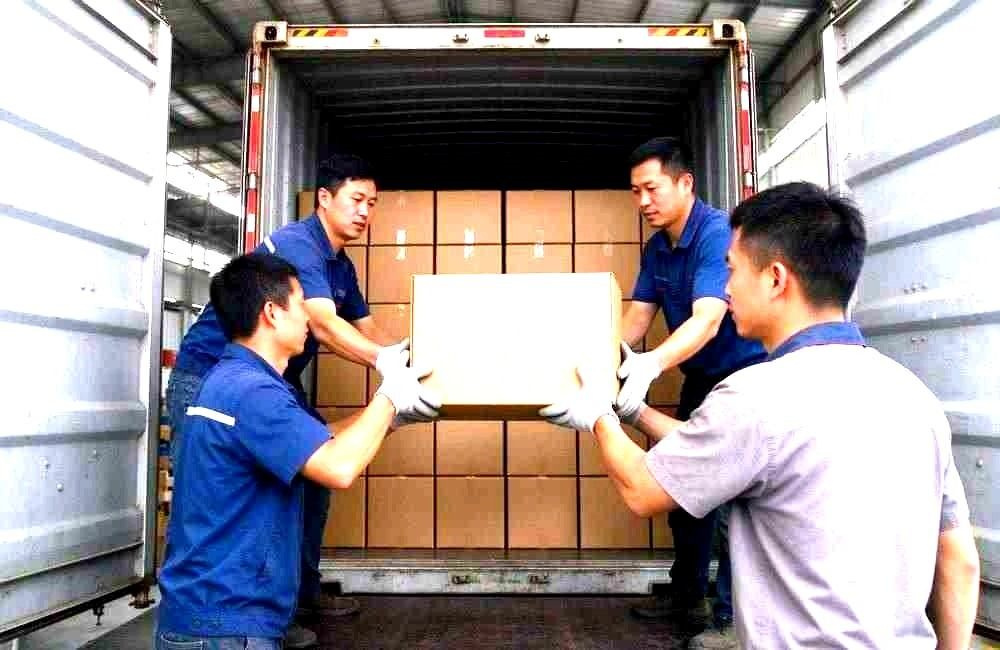
Blanket cartons loaded for cyclone relief delivery.
National disastercoordinate cyclone response, holdnters the country and when. In Madagascar, Mozambique and Malawi, these offices coordinate cyclone response, hold the stock pre-positioned for emergencies, and approve incoming relief goods. Suppliers who understand this channel deliver smoother programs than those who treat the buyer as the only stakeholder.

A procurement team reviewing a cyclone program checklist.
Registration and documentation come first. Most national offices require relief shipments to be declared in advance, with packing lists, certificates of origin and product specifications available on arrival. A supplier who prepares these documents as standard saves weeks of customs delay during an emergency window.
Some programs buy through the national office directly; others are executed by NGOs under a coordination framework. Either way, the specification language used by the national office appears in tenders, so matching your product sheet to that language (shelter kit, household kit, thermal blanket) makes your quotation easier to evaluate.
National stockpiles follow the pre-positioning logic from an earlier section. Offices in the corridor maintain reserve stocks of shelter materials, and their procurement cycles run on the same quiet-season calendar. Being responsive to a national office's sample and documentation requests in July often leads to a confirmed order in October.
Communication is the practical skill. Confirm the delivery point, the documentation list and the inspection procedure in writing before production starts. National disaster offices change staff and priorities, so the written record protects both sides when the season arrives.
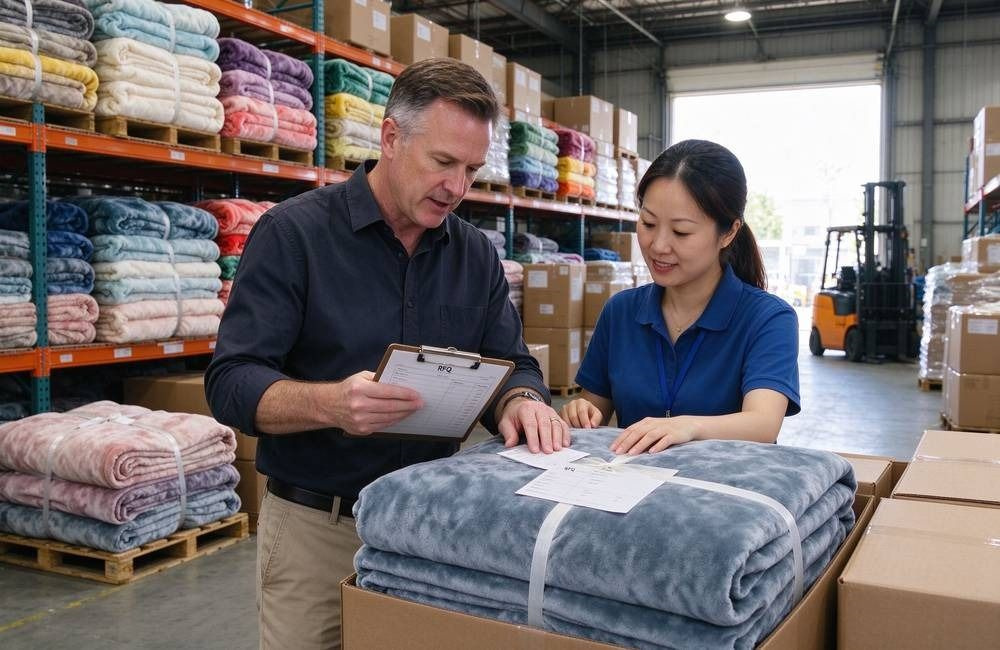
An RFQ check for storm response blankets.
Samples are the cheapest insurance in a cyclone order. Before volume production, every buyer should hold a production sample that matches the final specification: same fabric, same GSM, same size, same packing. Storm response blankets vary between production runs, and the sample is the only honest way to verify the differences.
The verification routine has four steps. First, check the GSM with a simple scale and a known area. Second, test the drying time by wetting a corner and timing it. Third, wash a sample through several cycles to confirm the weave holds and the colour stays. Fourth, inspect the packed sample to see the real bale or carton before it is committed to freight.
Certification documents support the sample but do not replace it. Certificates of origin, inspection reports and material declarations travel with the order, and buyers should request copies before payment. A supplier that can send the document set with the quotation is already ahead of one that cannot.
Wash tolerance deserves special attention in cyclone zones. Bedding in shelters is washed frequently and roughly, so a blanket that survives ten industrial washes is worth more than a cheaper one that fades and frays after three. Ask for the wash-test result in writing, not just a verbal claim.
The sample stage is also the moment to lock the labelling. Family kits should be labelled with contents and destination language; bales should carry the product code, quantity and date. Clear labelling at the sample stage prevents warehouse confusion at the delivery stage.
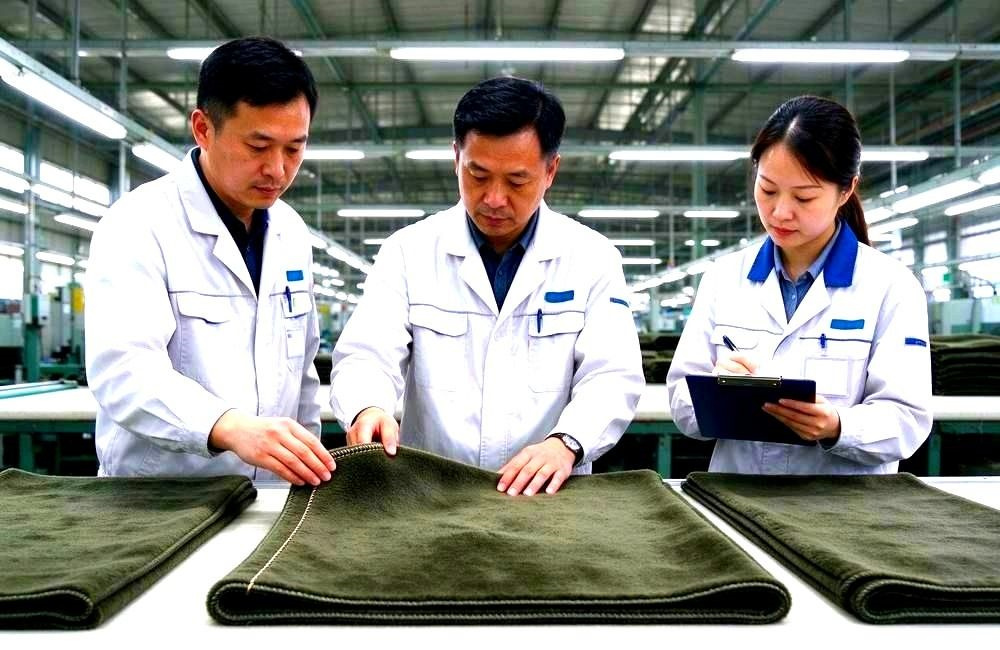
Quality inspection against the cyclone RFQ specification.
A complete RFQ is the difference between comparable quotes and a pile of mismatched offers. Cyclone relief RFQs need the same structure as any bulk relief tender, plus two storm-specific sections: waterproof specifications and pre-positioning terms. The checklist below covers both.
Start with the basics: product type, quantity, destination and required date. Then add the specification lines that matter in storm zones: GSM and fabric, size, waterproof or coated finish, packing type, palletisation and labelling. Every line that is written down is a line that can be compared across suppliers.
An RFQ checklist notebook for cyclone programs.
Delivery terms decide the real cost. The buyer should state the final delivery point (port, warehouse or district level) and the Incoterm, because freight from a Chinese port to Madagascar differs from delivery to a warehouse in Malawi. Suppliers quote very different prices when the destination is left vague.
Pre-positioning terms belong in the same RFQ. Ask for the production lead time, the packing specification for long storage, and whether the supplier can hold stock or deliver in phased shipments before December. These three answers reveal which supplier understands the storm calendar.
End the RFQ with the commercial lines: payment terms, documents required, validity period and contact. A short, complete RFQ gets short, complete answers. The table below is a ready-to-use checklist that matches what national offices and NGOs expect to see.
Fill every line before sending the RFQ. Buyers who list everything get quotes they can compare line by line, and national offices recognise the structure instantly.
|
Category |
Items to list |
Purpose |
|
Product |
Type, GSM, fabric, size, coating |
One specification for accurate quotes |
|
Packing |
Bale, carton, pallet, label |
Comparable freight and storage plans |
|
Delivery |
Final point, Incoterm, timeline |
Clear arrival expectations |
|
Pre-position |
Lead time, phased delivery, storage |
Confirms storm-calendar readiness |
|
Samples |
Production, wash test, packed |
Verify claims before volume order |
|
Terms |
Payment, documents, validity |
Clean commercial close |
Add the two storm-specific confirmations: the waterproof specification for coastal districts and the pre-positioning timeline before December.

A buyer comparing cyclone relief quotations.
Here are the questions agencies ask most often before placing a cyclone blanket order, with practical answers from field programs.
A cyclone blanket needs to dry fast, keep its warmth when damp, and fold small for freight. Dense brushed flannel at 250 GSM is the common choice for the corridor, with 300 GSM for cooler highland nights. The weave matters more than the brand: a tight surface sheds water and resists the humidity that follows a storm.
Yes. We supply low-profile dome and tunnel tents rated for storm gusts, with full floors and guy-line anchor points, in 4-person and larger communal sizes. Each tent ships with its own pegs and repair kit, and the setup time is stated in the specification.
Relief programs in the corridor typically allocate two adult-size blankets and one child blanket per household of four to five people, which is the basis of our standard household kit. Programs with colder highland districts sometimes add a third blanket per family.
Our waterproof line uses dense flannel with a flexible coating on one side and a breathable reverse, available from 180 to 300 GSM. The coating stays flexible after repeated folding, and the wash-test result is provided with the quotation. For outdoor sleeping under tarpaulins, this line is the recommended choice.
Yes. We ship to the main ports in Madagascar and Mozambique, and we coordinate inland delivery to Malawi by road or rail. Name the final province in your RFQ and we will quote the full freight route, including palletisation and port documentation.
Order between April and November to secure production slots and pre-position stock before the December storm window. Programs that order during the season pay peak freight and wait through backlogs. A phased delivery plan can put part of the stock in the corridor before December and the rest shortly after.
Our standard MOQ is 5,000 household kits or 10,000 blankets for a volume order. For pre-positioning programs we can discuss split deliveries and staged production. The MOQ depends on fabric, size and packing, so it is confirmed against the final specification.
Yes. Our brushed flannel dries noticeably faster than open knits because the smooth, dense surface sheds water. For the most humid coastal districts, we recommend the coated poly-cotton line, which dries fastest and adds a waterproof layer for tarpaulin shelters.
We send a production sample before volume production, and we support the buyer's own checks: GSM by scale, drying-time test on a wetted corner, and a multi-cycle wash test. The packed sample shows the real bale or carton. We also provide certificates of origin and inspection reports with the order documents.
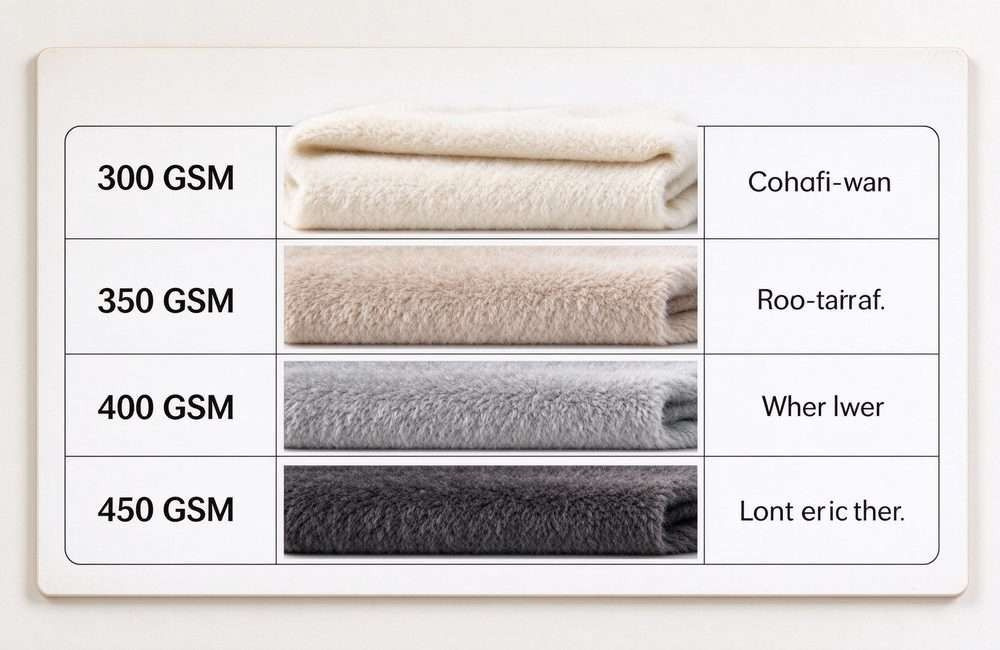
GSM selection guide for cyclone shelter blankets.
Compressed bales with an outer film and inner liner are the freight standard, and household kits ship in labelled cartons. Goods are palletised off the floor with load straps, and each pallet carries a weight and contents label. A packed sample with the quotation shows exactly how the cargo arrives.
Yes. We plan production to have stock ready before the cyclone window, pack for months of hot, humid storage, and support phased deliveries so part of the stock sits in the corridor before December. We provide the packing and rotation guidance that national offices use to keep reserve stock usable.
Standard terms for emergency procurement are a deposit with the order and the balance against shipping documents, with letter of credit available for larger tenders. For pre-positioning programs we can discuss staged payments linked to production milestones. Final terms are confirmed in the contract.
250 GSM dense flannel is the balanced choice for most of the corridor: warm enough for storm nights, light enough for freight, and fast drying. Use 300 GSM for cooler highland districts in Malawi, and 180 GSM for hot coastal lowlands where the priority is a dry layer. The weight is specified per kit, so mixed orders cover different districts in one shipment.
A standard cyclone household kit usually carries two to four waterproof or quick-dry blankets depending on family size and climate. Kits for humid storm zones favour lighter synthetic fabrics that dry fast and resist mildew in storage.
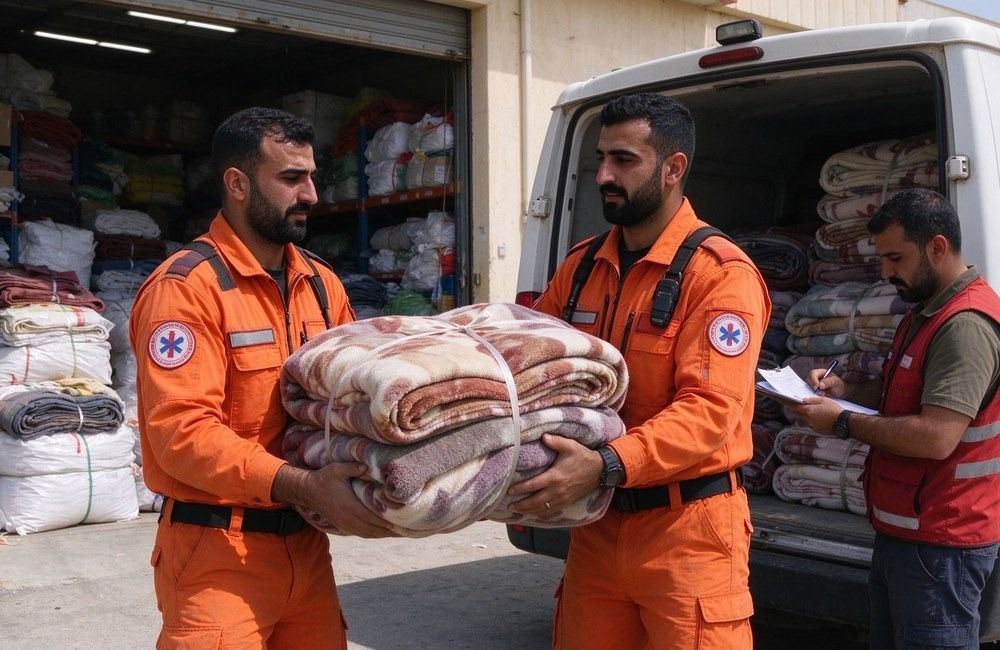
Cyclone response depends on speed after the storm. Pre-positioned stock at the warehouse is loaded within hours, and the loading list names the quantity, the destination and the packing mark. The truck leaving the gate is the moment the procurement order becomes a delivered item.
 |

|
Poprzedni :
Drought Relief Blankets for East Africa: Warmth and Shelter Beyond Food Aid, GSM, Weight, Sizing and Bulk Procurement Decisions for Relief Programmes Serving Pastoral CommunitiesNastępny :
IDP Camp Supplies: Blankets and Bedding for Displaced Families, Sizing, GSM, Hygiene-Friendly Fabrics and Bulk Procurement for Camp Managers and Humanitarian Buyers and RestockingPrzyjazne linki :
prawa autorskie © Custom Disaster - Relief Bedding: Tents, Sleeping Bags, Blankets Wszelkie prawa zastrzeżone
profesjonalny zespół do obsługi !