Kategorie
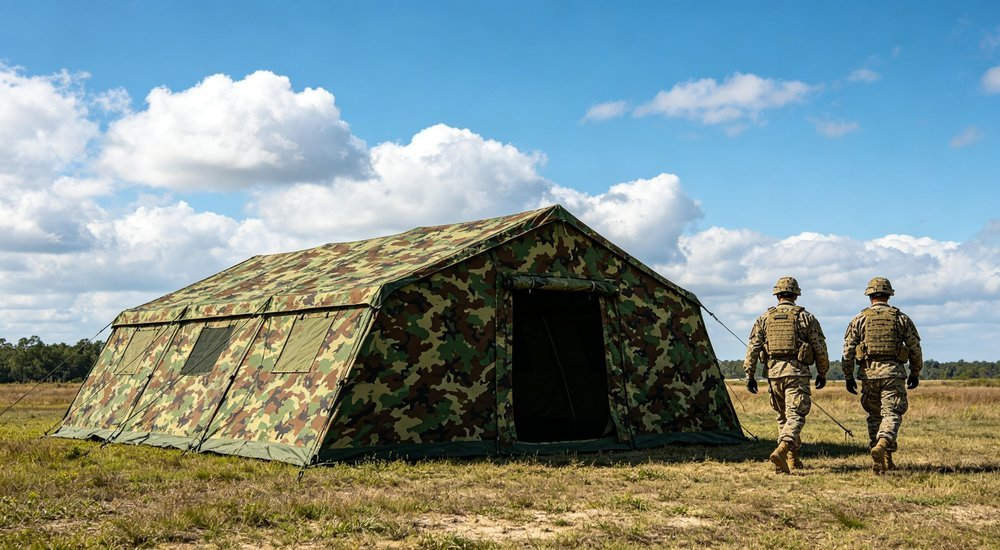
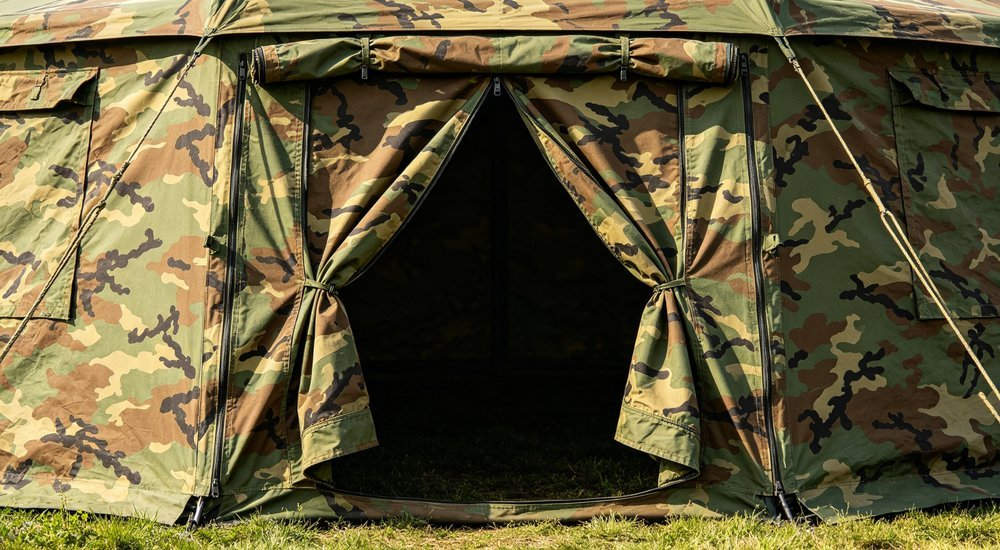
A military camouflage relief tent is a field-grade temporary shelter designed for tactical operations, disaster response, and remote field deployments. Built with a rigid steel frame and high-strength camouflage fabric, it provides reliable protection in challenging environments while maintaining natural concealment. This makes our custom tent ideal for international procurement.
Table of Contents
This comparison table outlines key specifications for military camouflage tent. Procurement teams use this data to evaluate army shelter tent options, compare pricing structures, and verify compliance with international standards. As an experienced tactical field tent, we ensure every parameter meets field deployment requirements for emergency response operations worldwide. This information is particularly valuable for government procurement teams, NGO aid organizations, and international relief agencies evaluating bulk supply contracts.
This comparison table provides essential specifications for procurement evaluation. Buyers use this data to compare configurations, assess material quality, and calculate total project costs. As a professional tent manufacturer with extensive export experience, we ensure all parameters meet international standards and field deployment requirements. This information is particularly valuable for government procurement teams, NGO aid organizations, and international relief agencies evaluating bulk supply contracts.
| What is a military camo tent | Accessories and maintenance |
| Three camouflage patterns | Military-civil dual use |
| MIL-SPEC criteria | Price range by configuration |
| 5x4m steel frame structure | MOQ and lead time |
| Fabric: 600D Oxford vs 420g | Packing and shipping |
| Concealment in the field | Quality control and testing |
| 20m2 capacity: 8-12 people | Frequently Asked Questions |
| Frame vs inflatable shelters | Surplus grade applications |
| Wind, rain and cold performance |
Military camouflage tents are deployed across diverse operational environments, from dense woodlands to arid desert regions. The camouflage pattern is carefully selected to match the surrounding terrain, ensuring the shelter remains concealed from observation. This makes our tent export ideal for international procurement.
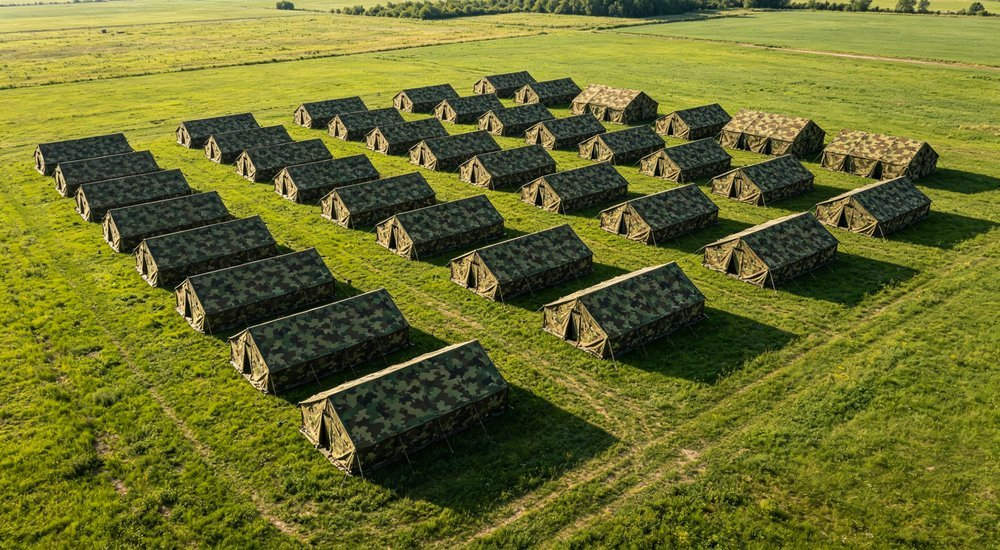
The steel frame construction provides superior structural integrity compared to inflatable alternatives, withstanding high winds, heavy snow loads, and prolonged field use without degradation. This makes our China tent ideal for international procurement.
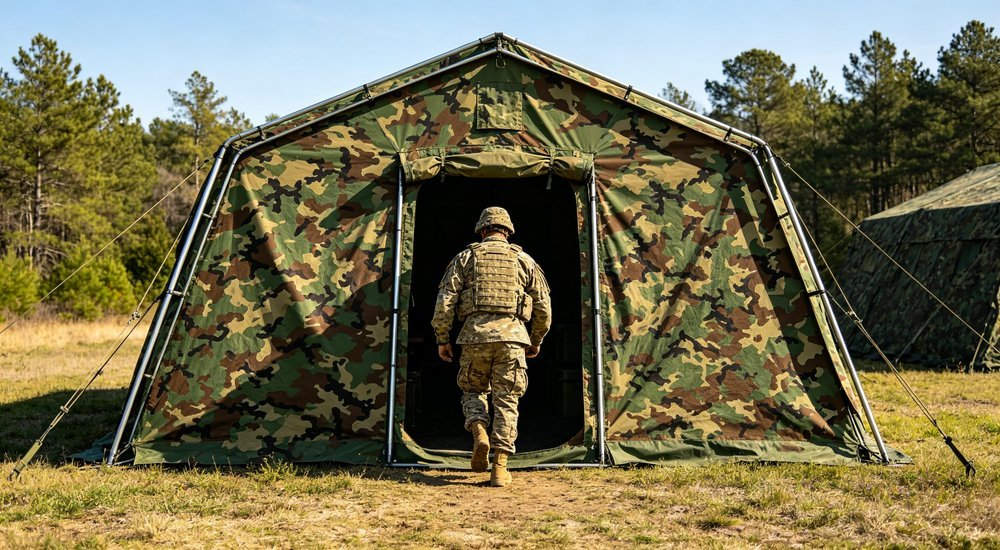
Inside, the tent offers spacious accommodation for personnel, equipment, and command operations, with organized layouts that maximize usable floor area.
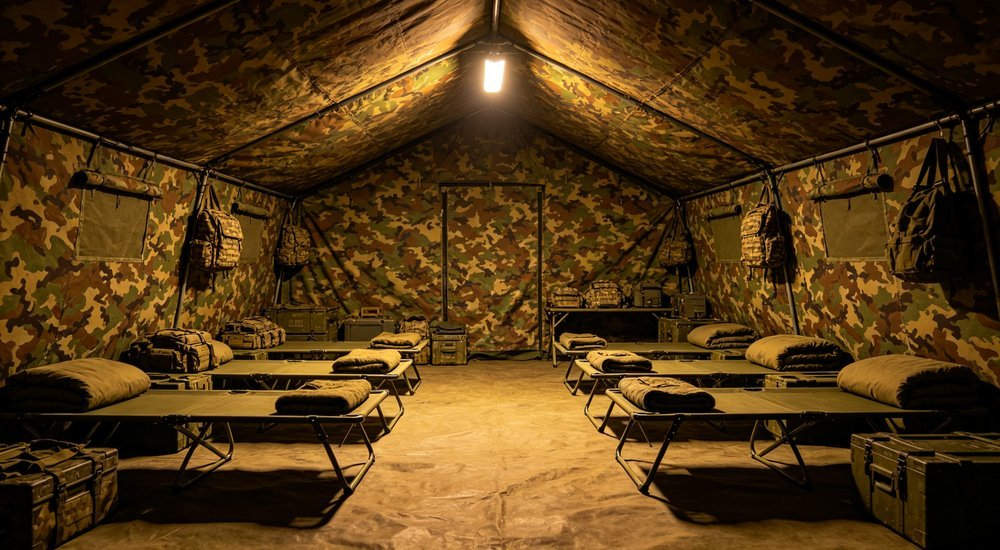
High-strength camouflage Oxford fabric combines waterproof performance with tear resistance, ensuring the shelter remains serviceable through extended deployments in harsh conditions.
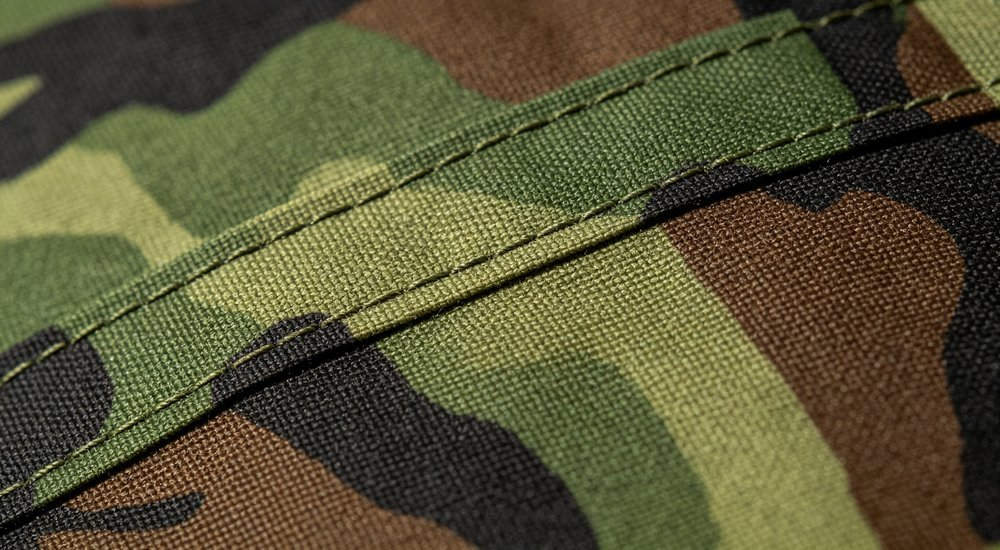
A military camouflage shelter is a field-grade temporary building whose outer cover is printed in a camouflage pattern, whose structure is a rigid steel tube frame, and whose fabric is chosen for tensile strength, water resistance and fire retardancy rather than for looks. It is used for field training, exercise command posts, border and patrol rest points, observation posts, and for disaster response in wooded, scrub or rural terrain where a bright white relief tent would stand out.
As a leading military tent manufacturer in China, we produce high-quality camouflage tent solutions for armed forces, disaster relief agencies, and outdoor organizations. Our army tent products meet strict military specifications and are available for wholesale and OEM orders.
It is deliberately different from an army surplus tent sold on the used market. Surplus stock is old, may have UV-dried fabric, bent poles and no replacement-part continuity. A purpose-built military grade disaster tent ships with a numbered part list, a matching repair-fabric kit, repeatable dimensions, and test reports for the exact fabric lot. When a deployment runs for months in remote terrain, those documents matter more than the purchase price.
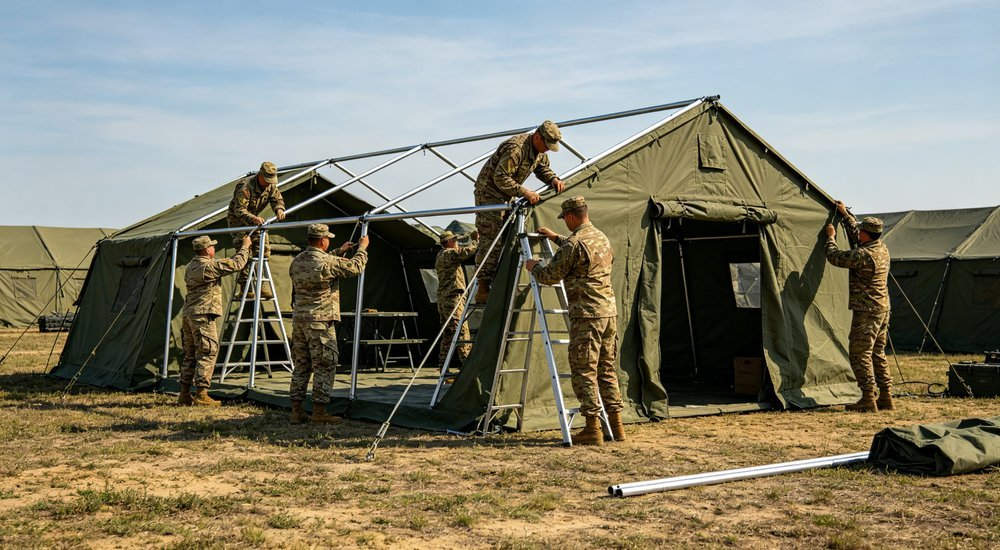
The core product in this guide is the 5x4m relief tent: external footprint 5 m by 4 m, about 20 m2, side wall around 1.9 m, ridge around 2.8–3.0 m. Inside, a squad of 8–12 can sleep on cots, or a command team can work at folding tables. It packs into 3–4 cartons: steel tubes, cover, floor and anchoring kit. A three-person crew raises it in 35–50 minutes.
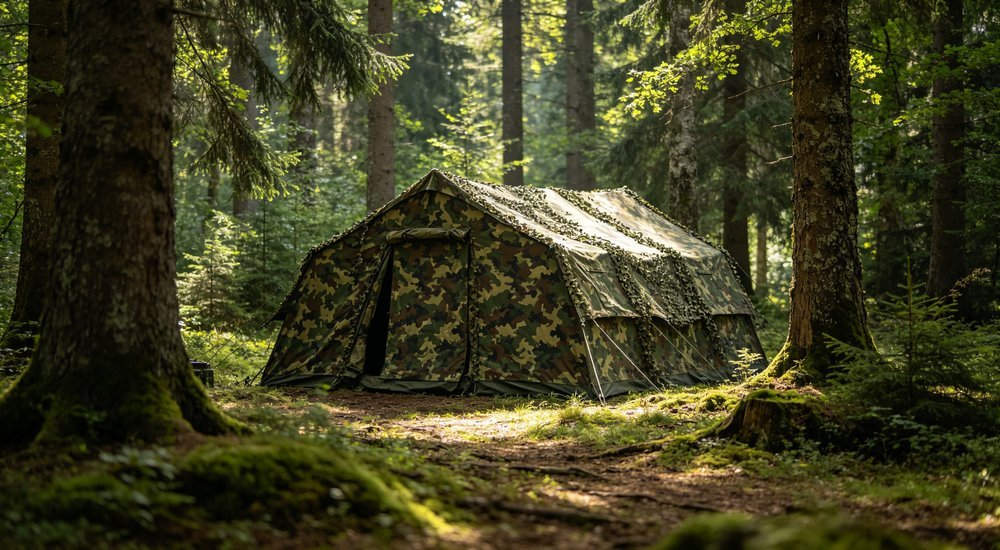
Always confirm the base configuration before negotiating price. "Camouflage tent" tells you the print, not the spec. The questions that decide the product are: which camouflage pattern, which fabric (Oxford or PVC), what tube diameter and wall thickness, whether the fabric is flame retardant, and what waterproof rating the seams carry.
The pattern is the point of the product. A wrong-colored cover defeats the entire reason for buying a camouflage shelter, and the choice has to match the actual operating terrain, not the uniform in the catalog. Below is the practical comparison of the three patterns we print most often.
Our woodland camo tent, desert camo tent, and digital camo tent patterns are designed for different terrain types. Each camouflage shelter provides effective concealment while maintaining the durability expected from a heavy duty military tent.
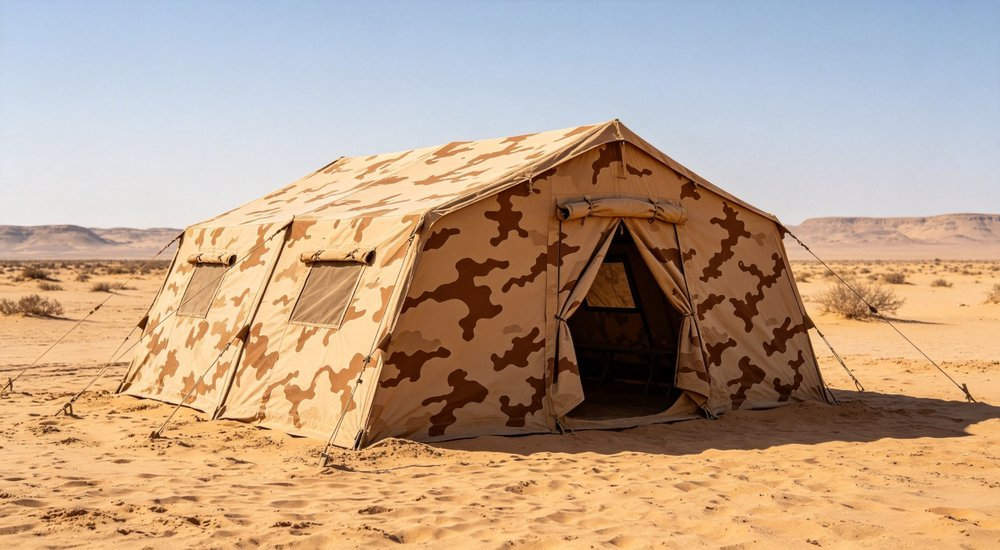
Jungle woodland print works where there is real green cover. If your deployment sits on brown dry grass in October, a green woodland cover actually stands out more than a plain tan one. Desert sand print solves arid and semi-arid terrain. Digital or urban pixel print suits mixed environments where a leaf pattern looks out of place against concrete, roofs and gravel.
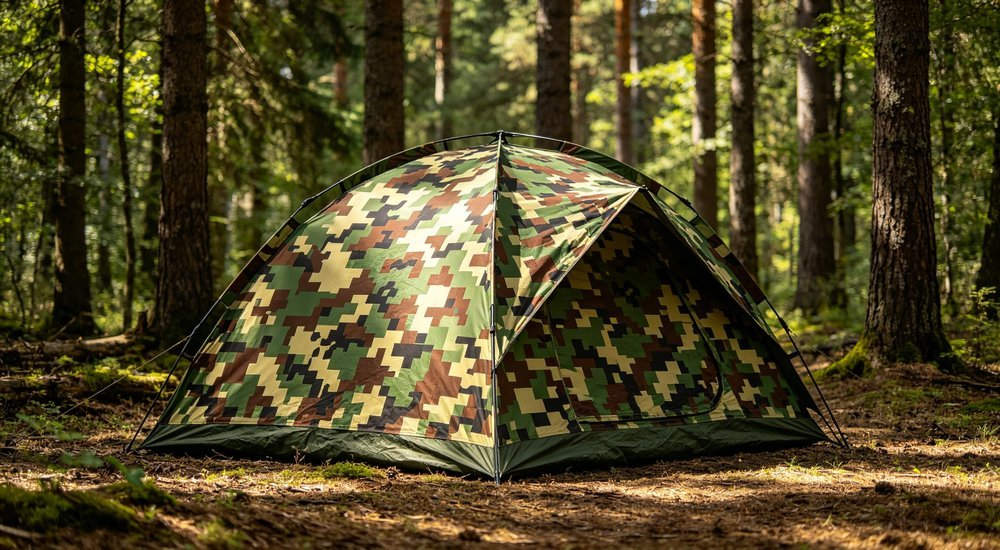
Color fastness and print quality matter. Ask whether the print is printed-on fabric or a pre-printed woven roll, and request a small fabric sample under natural light. A print that looks right on a screen can look too bright, too dark, or too blue in real sunlight. For repeat orders, ask whether the next batch will match the current dye lot — printed camouflage can shift between production runs.
"Military standard" is a phrase, not a certificate. What a buyer can actually verify are four measurable properties: fabric tensile strength, seam strength, flame retardancy and hydrostatic head. Below is the specification table we use as the reference line for a military grade disaster tent.
Every military grade tent undergoes rigorous testing to ensure it meets MIL-SPEC standards. Our tactical tent and combat tent models are trusted by military units worldwide for their reliability in field conditions.
When a supplier says "military grade," ask which of the above clauses the unit actually meets. A shelter can be printed in camouflage and still use a light 150D fabric that tears on first thorn bush. The print is cosmetic; the tensile strength, seam strength and waterproof number are the product.
Flame retardancy deserves a specific warning. A fire-retardant coating slows flame spread; it does not make the shelter fireproof. Inside a field tent used with cooking stoves or heaters, ventilation and a raised, stable heater platform still matter. Never rely on fabric treatment alone for fire safety in an occupied shelter.
This model uses a steel pole tent skeleton, not an inflatable air beam. The choice is deliberate: a fixed field camp has no reason to carry a pump, and a galvanized tube frame holds its shape at temperatures where PVC air beams stiffen and lose pressure. The main poles are 25–32 mm outside diameter galvanized steel, wall thickness 1.2–1.5 mm, with swaged or bolted corner joints. Horizontal ribs connect the corners to the ridge, and the camouflage cover slides over the frame and tensions with webbing straps.
The steel frame construction makes this field tent ideal for extended deployments. As a military camping tent, it offers the stability and durability required for long-term field operations. As a leading tent factory, The geometry matters. A 5×4 m cover with a flat roof ponds rain; the ridge must sit above the side walls by 0.9–1.1 m so water runs off to both sides. Side wall height should clear 1.8 m so seated occupants do not hunch. Door width should accept a stretcher or a camp cot, typically 1.2–1.5 m.
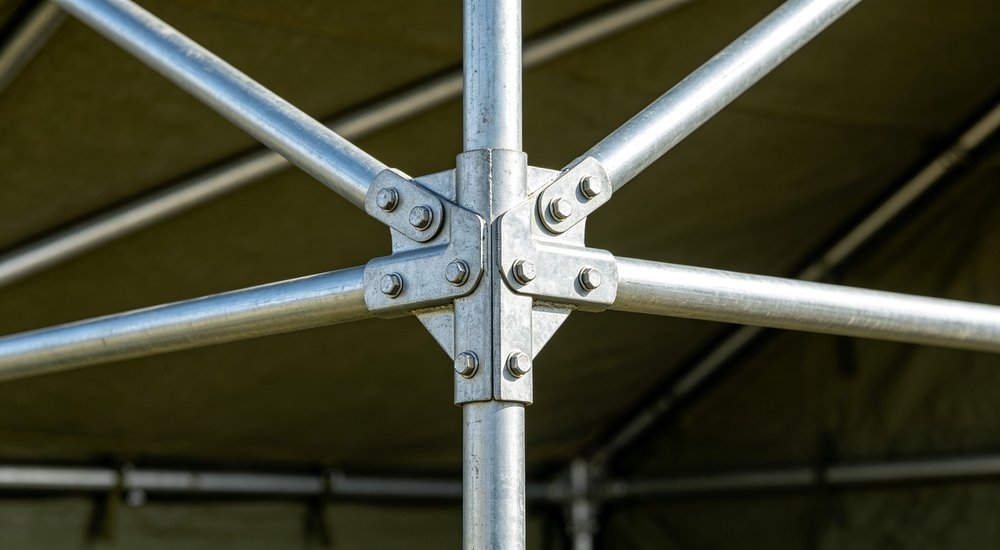
Galvanization is the difference between a three-year frame and a ten-year frame. Painted tubes chip on first field deployment and rust under the paint; hot-dip galvanized tubes rust only if the zinc layer is scratched to bare steel, and touch-up zinc paint covers the scratches. Ask whether the finish is galvanized, powder-coated, or both, and whether touch-up paint is supplied in the kit.
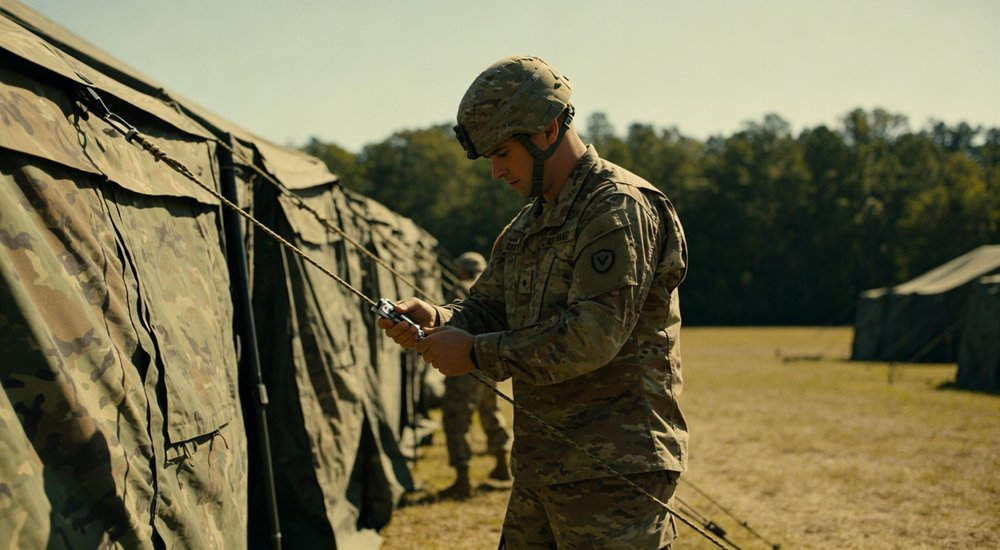
Setup: three people, 35–50 minutes. Raise the four corner poles, connect the ridge and side ribs, slide the camouflage cover over the frame, tension the straps, then stake and guy. Compare that with an inflatable unit needing a pump and pressure check — for a fixed border post that may sit for six months, the pump argument disappears.
Buyers usually ask which cover cloth is "better." There is no universal answer; the right choice depends on deployment climate, packed weight and budget. 600D Oxford with PU coating is lighter, folds smaller, and prints camouflage cleanly. 420 g/m2 PVC is heavier, stiffer, fully waterproof by construction, and more resistant to abrasion and puncture in thorn and brush terrain.
Oxford suits temperate and dry climates, training sites with soft ground, and air-transported units where packed weight and cube matter. PVC suits wet monsoon terrain, brush-heavy vegetation, and deployments where the tent rubs against rocks and branches. PVC is also easier to wipe clean after muddy exercises; Oxford absorbs more dirt and dries slower.
Both options use taped seams. The difference is at the coating: PU3000–5000 mm on Oxford, and a naturally waterproof PVC film on the heavy option. Ask which fabric your quote uses. A quote that says "camouflage cloth, waterproof" without naming Oxford or PVC hides a real cost and weight gap.
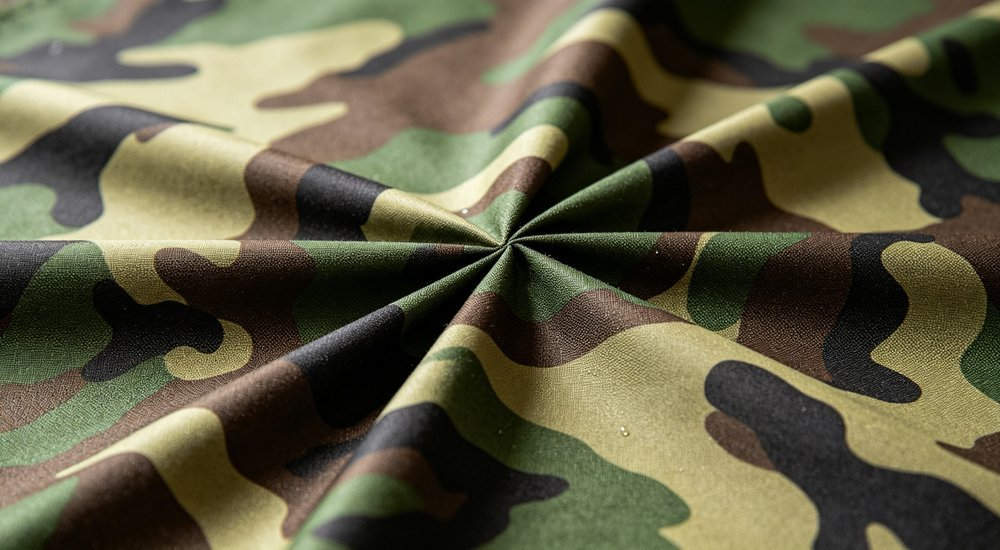
For buyers comparing fabric chemistry across our range, the tent fabric waterproof guide breaks down Oxford, PVC and canvas in more detail. Fabric choice is the single biggest driver of both weight and price in this product line.
The point of a camouflage emergency shelter is not to look military. It is to avoid drawing attention during field training, exercise positioning, border patrol rest points and low-visibility disaster work. That works only if three conditions hold: pattern matches terrain, the roof breaks up its outline, and external gear is also masked.
A military shelter must blend seamlessly with its surroundings. Our camouflage shelter options include woodland camo tent and desert camo tent variants, each optimized for specific operational environments.
A squared tent outline is visible even in the right pattern. Good practice breaks the roof line with low branches, a local netting cover, or a sloped flap that follows the terrain. Bright guy ropes, orange straps and shiny equipment bags defeat the print. Ask whether the cover comes with matte, low-sheen webbing and dark green or brown guy ropes instead of white cord.
Concealment also means slow and quiet set-up. A steel frame built with numbered, color-coded poles assembles without banging loose tubes together; noisy metal-on-metal alerts anyone nearby. This is a small detail, but it is one buyers who run patrol and observation posts actually ask about.
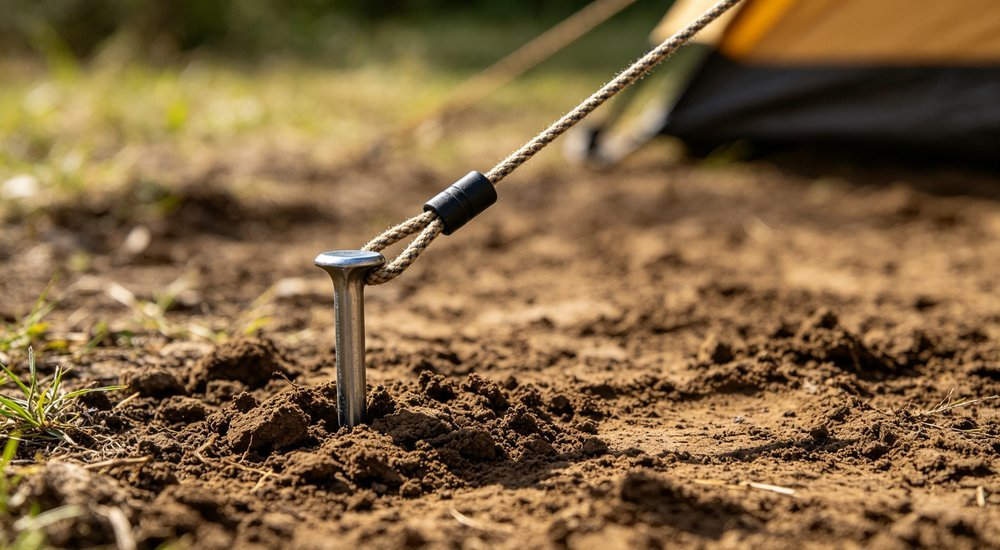
For disaster relief in rural terrain, concealment matters less for hiding from view and more for not alarming local residents or livestock. A quiet, low-profile green shelter blends into the landscape where a bright white relief tent draws a crowd. This is why military-spec camouflage covers sometimes work well for forestry stations, search-and-rescue forward posts and remote medical points.
The 5×4 m footprint gives about 20 m2 of external floor, less once corner poles, the center rib and the door swing eat into it. Plan on a usable floor around 17–18 m2. On military cots of 0.6 m by 2 m, two rows of four cots leave a 60 cm center aisle: that is eight sleepers comfortably. Stack a third cot row or use narrower cots and the figure rises to 10–12, but the aisle disappears and evacuation gets slower.
Standard military tent dimensions are 5x4 meters with 2.5 meter side height, providing 20 square meters of usable floor space. Military tent setup time averages 15-20 minutes with a trained 4-person team, including frame assembly and fabric securing.
This heavy duty military tent accommodates 8-12 personnel with gear. As a military camping tent, it provides comfortable living quarters for extended field deployments. As a leading tent supplier, Think through what the space actually holds. A rest-and-sleep squad needs cots and a gear rack. A command post needs foldable tables, radio equipment and a map wall. A patrol post needs a weapons rack, ammo box storage and a stove corner. A relief medical point needs a stretcher and a small examination table. Pick the occupancy number from the internal layout, not from the external footprint.
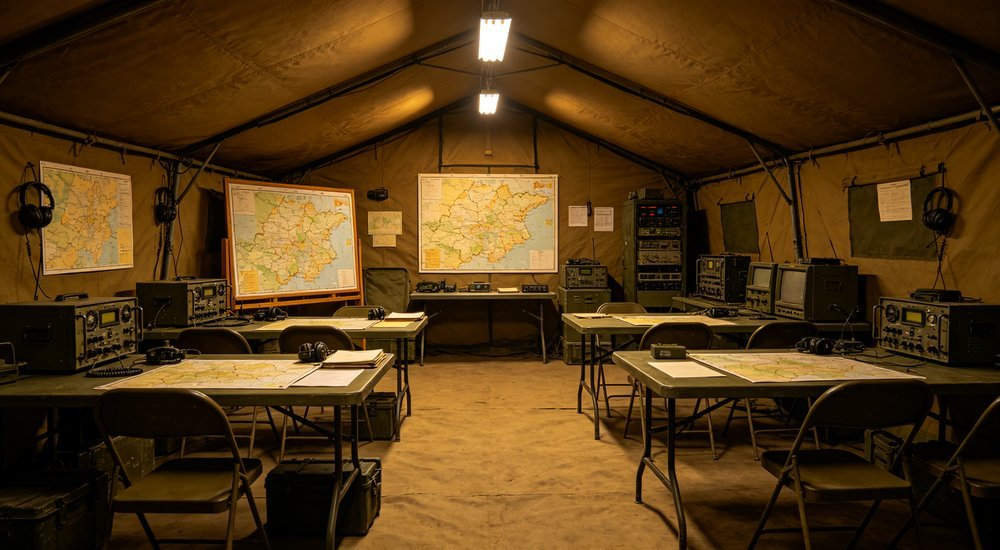
Hanging weight matters. The steel frame supports racks, hooks and lights; an air beam does not. If the unit stores rations, radios or medical supplies on shelves, the steel-frame version is the safe choice. Never hang heavy gear from the cover fabric — the poles carry the load, the cloth only keeps weather out.
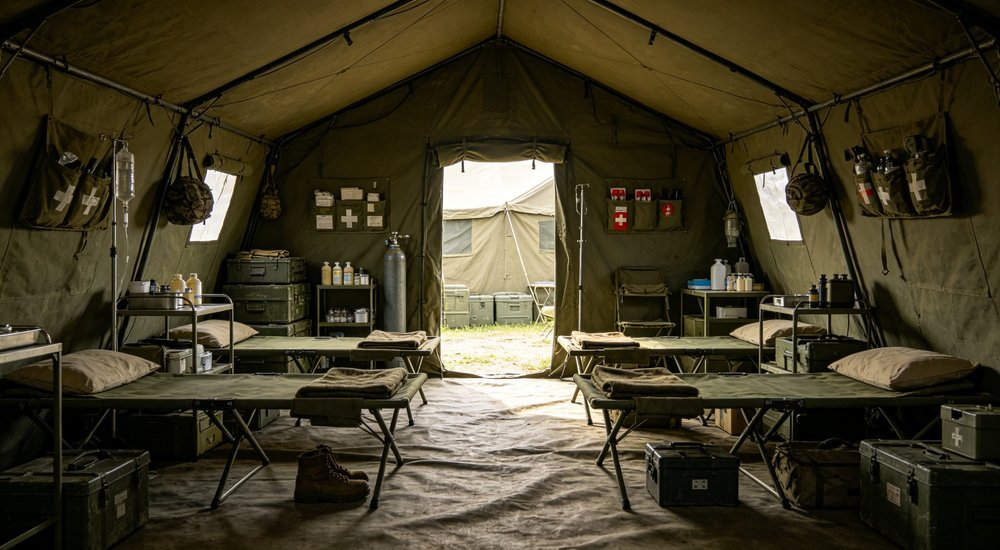
For bigger squads, link two 5×4 m units side by side with a connecting tunnel, or step up to a 6×5 m (30 m2) or 6×6 m (36 m2) block on the same frame system. Keeping the same frame family across sizes makes spare-parts planning much simpler.
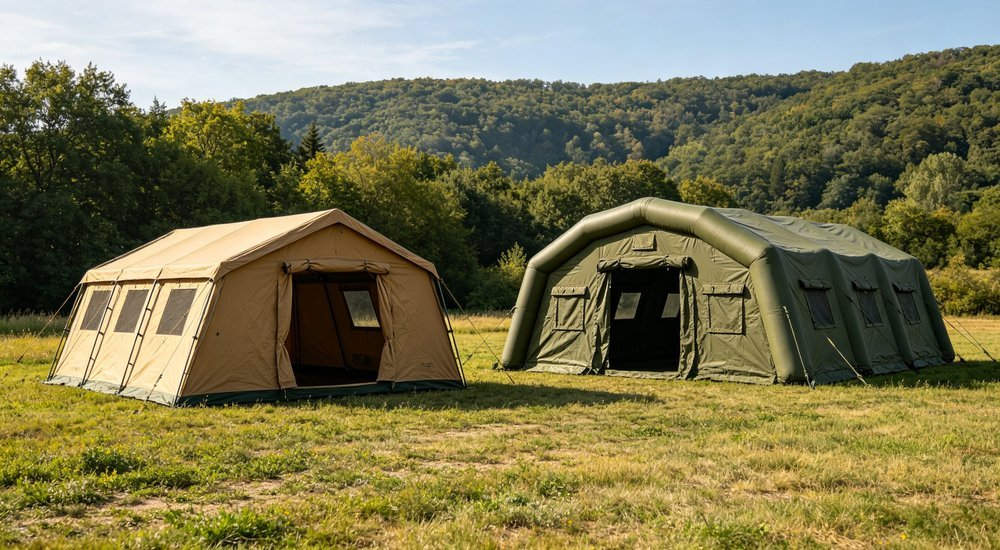
Many military and paramilitary buyers ask whether to take this steel-frame army camouflage shelter or an air-beam inflatable version. The honest answer depends on deployment frequency, power availability and temperature. Below is the side-by-side that our engineering team uses internally.
The steel frame military tent offers superior durability for long-term deployments, with a typical service life of 8-10 years under proper maintenance. Inflatable alternatives deploy faster but require ongoing air pressure monitoring and are more susceptible to puncture damage in rough terrain.
A military tent with stove jack is available as an optional upgrade for cold weather operations, allowing safe installation of wood-burning heaters inside the shelter. As a leading OEM tent, The combat tent design prioritizes durability over rapid deployment. A tactical tent with steel frame offers superior longevity compared to inflatable alternatives for long-term operations.
The rule of thumb: fixed base, no power, sub-zero nights, and heavy gear storage point to the steel frame. Rapid 15-minute insertion, daily relocation, and an available pump or vehicle power point to the air beam. For the full decision walk-through, our inflatable vs frame tent comparison walks through setup, weight, cost, cold, repair and total cost of ownership in detail.
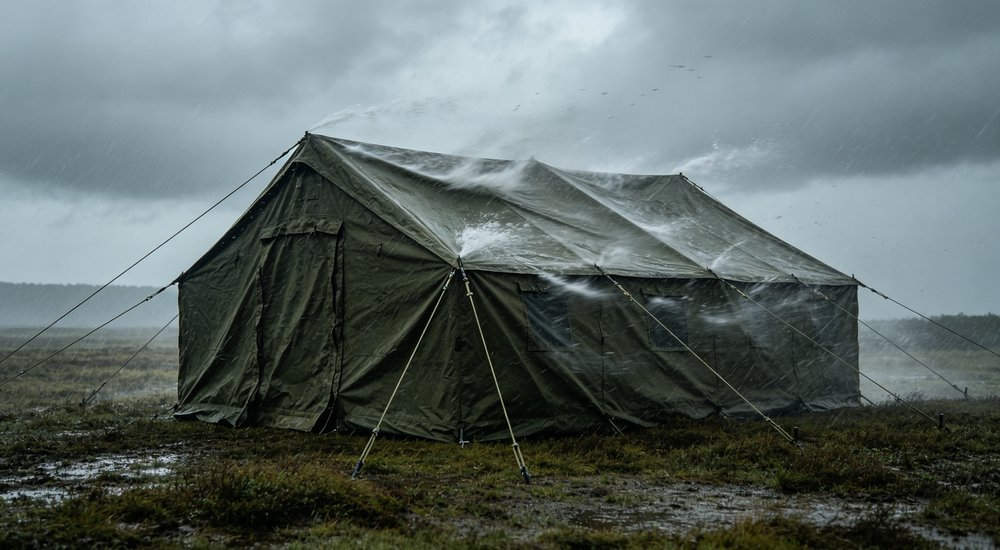
A field shelter is judged by what it does in bad weather. With correct staking and guying, this steel-frame camouflage unit is rated to Beaufort force 6–7 (60–70 km/h); a reinforced frame version reaches Beaufort 8. The rating always assumes proper anchors — on soft sand, screw stakes; on meadow, forged steel stakes; on hard ground, longer stakes and a hammer. A frame that arrives with too-short stakes will not meet its own wind number.
A military tent for winter operations can be equipped with an insulated liner and stove jack, maintaining interior temperatures 15-20°C above ambient even in freezing conditions. The 4-season design handles snow loads up to 50kg/m² without structural deformation.
Every military grade tent is tested against extreme weather conditions. Our field tent models withstand heavy rain, strong winds, and snow loads without structural failure. As a leading custom tent, Rain performance comes from three things together: PU3000–5000 mm coating on the cover, taped seams, and a sloped roof. A flat roof ponds water and seeps; a properly sloped ridge sheds rain. If the forecast calls for a storm event above the rated wind, rotate the ridge perpendicular to the wind, double guy lines, and add stakes. Do not leave field teams to improvise after a weather warning.
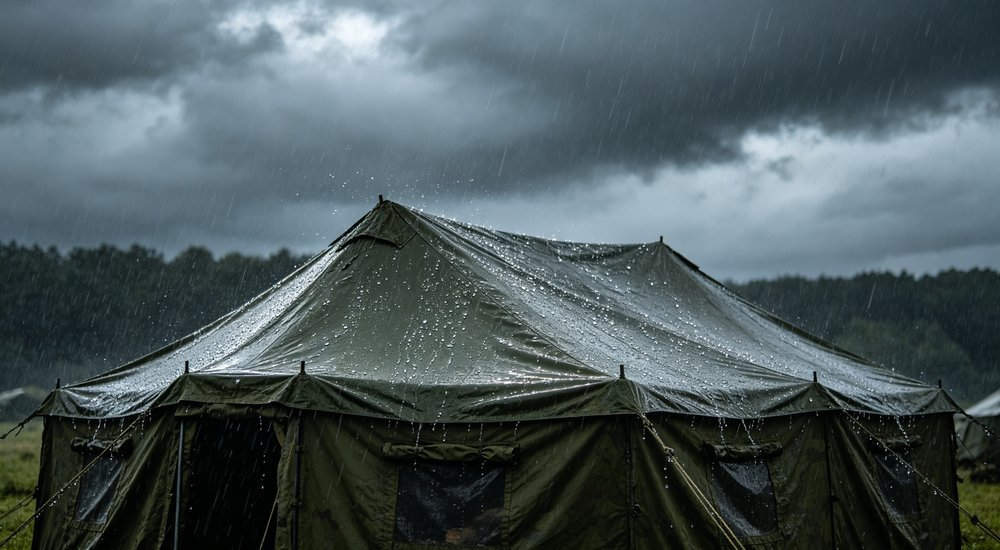
Cold is where the steel frame earns its place. At -20 to -30C, galvanized tubes stay rigid; PVC air beams stiffen, and the pump battery loses half its capacity. A winter field post also needs a removable inner liner and a vented heater. Expect 5–10C inside above outside when lined and heated. Never run an unvented combustion heater inside a closed camouflage shelter.
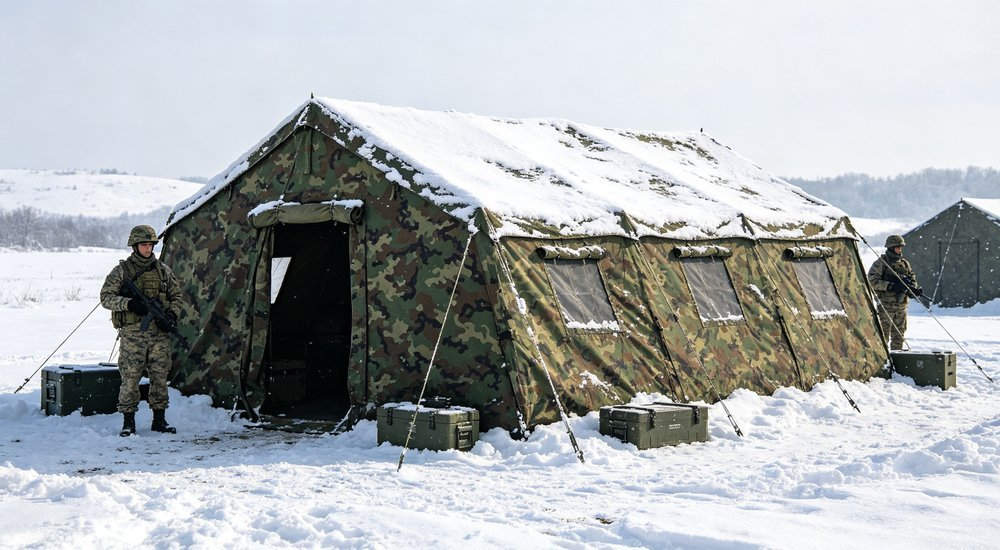
These military-grade shelters are engineered to meet the demanding requirements of field operations, providing reliable protection and functionality in any environment.
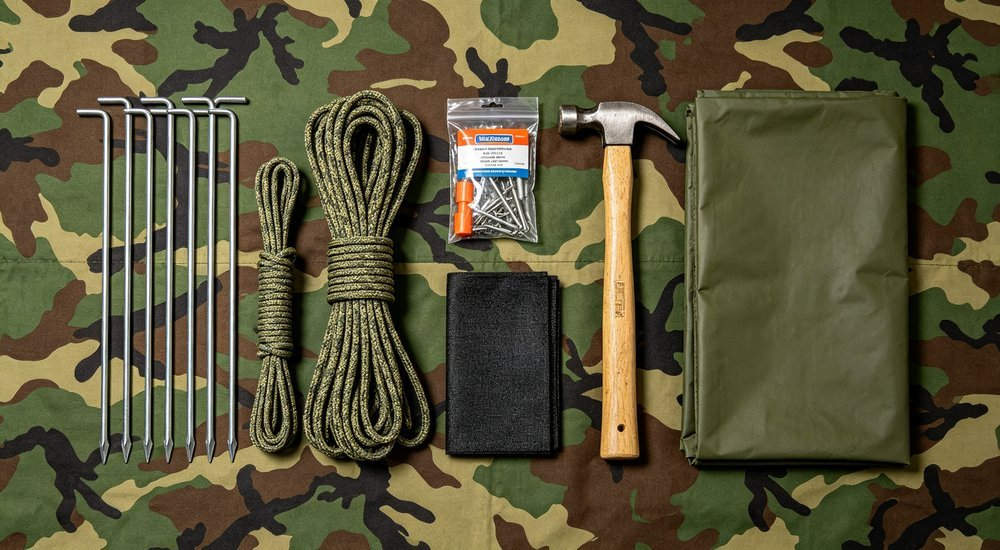
A standard set ships as: numbered steel poles, corner and ridge connectors, camouflage outer cover, optional removable floor, guy ropes, forged stakes, a repair kit (needle, thread, fabric patches matching the pattern, seam sealer), and a pictorial instruction sheet. Winter orders add a quilted inner liner and a chimney vent flap.
Standard accessories include steel stakes, guy ropes, a mallet, repair patch kit, and a storage bag. Optional upgrades include a military tent with liner for added insulation, mosquito netting for insect protection, and a removable floor for improved cleanliness.
A military tent ventilation system with adjustable windows and roof vents prevents condensation buildup, maintaining comfortable interior humidity levels even in cold weather conditions. As a leading bulk tent, Replacement parts and accessories keep your army tent operational for years. We also offer military surplus tent components for older models in service worldwide.
Maintenance after each deployment decides whether a set lasts 10 years or three. Air-dry the cover completely before rolling it — a damp pack grows mold and rots seams in one season. Inspect welds and connector bolts; tighten what loosened. Scratch a galvanized tube? Touch it with zinc paint. Replace a bent pole with the spare from your stock; do not bend it back in the field.
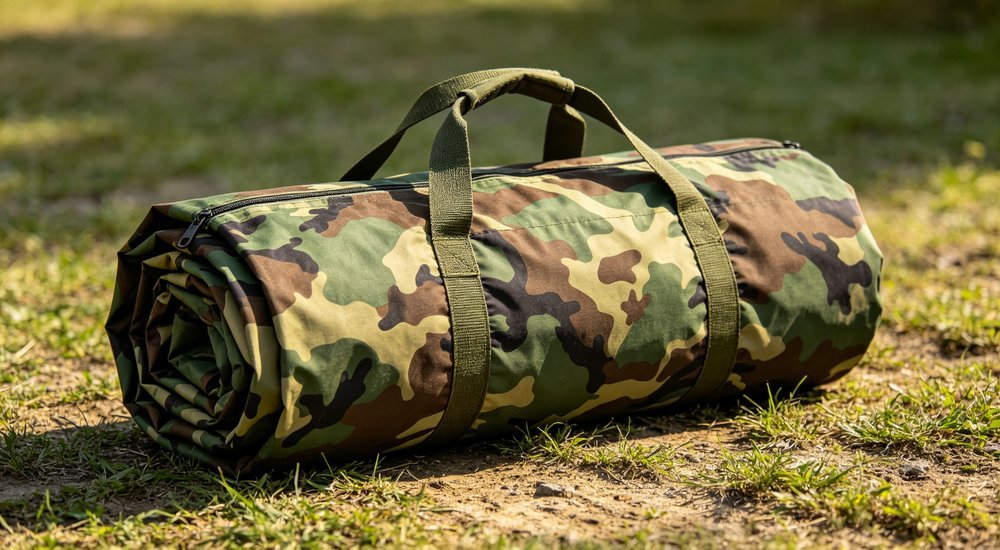
A military camouflage tent is not only for armed forces. The same 5×4 m platform works across several civilian and government use cases where a low-profile, tough shelter is the right tool. Field training units and paramilitary teams use it for live-exercise rest and command points. Border and forestry patrols use it as a remote rest and observation post. Search-and-rescue teams use it as a forward operating base in wooded terrain. Outdoor clubs and hunting camps use it for multi-week stays where a bright camping tent would look wrong.
Camouflage tent wholesale pricing makes these shelters accessible for disaster relief organizations and outdoor event companies. Our army tent factory produces both standard military patterns and custom civilian variants for dual-use applications.
The digital camo tent pattern works equally well for military and civilian applications. This versatility makes our camouflage tent a popular choice for disaster response and outdoor events. As a leading tent export, For pure humanitarian relief for displaced families in open camps, a camouflage cover is usually the wrong choice — those programs call for white, olive or relief-blue covers with clear agency markings. That is the product family covered in our civil affairs relief frame tent guide and our humanitarian relief procurement guide. The camouflage line is for field, training, patrol and rural low-visibility deployments.
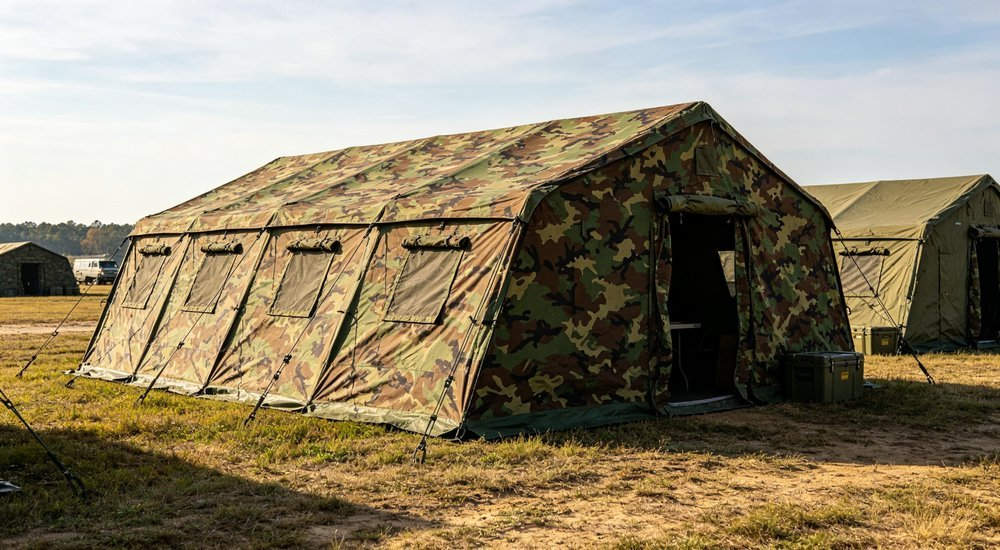
Medical or clinical use in the field needs a different interior: see our medical emergency tent guide for clean-zone layout, flooring and lighting. Fireground command needs heat and smoke ventilation: see the fire rescue command tent guide. Chemical or contamination response needs a wet-zone design in the decontamination wash tent.
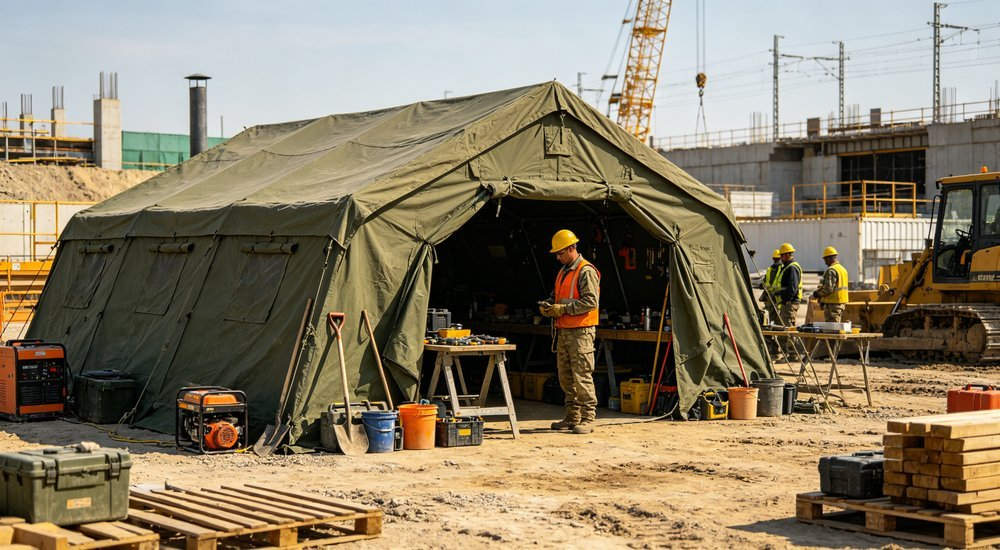
The dual-use point matters for procurement planning. A defense or interior-ministry buyer can stock one frame family and deploy it across training, patrol, exercise and disaster-surge tasks. That reduces spare-part variety and makes logistics simpler. It also explains why the 5×4 m camouflage unit is one of the most requested sizes in this product range.
Below are indicative FOB ranges for the 5×4 m steel-frame camouflage line. Final price depends on fabric choice, frame wall thickness, flame-retardant treatment, printed markings, liner inclusion and order quantity.
Pricing varies by configuration: standard 5x4m woodland pattern starts at competitive factory-direct rates. A military tent 5x4 with 600D Oxford fabric and steel frame represents the best value for most procurement needs. Custom camouflage prints and upgraded fabrics carry additional costs but offer superior field performance.
The military tent waterproof rating reaches PU3000mm on standard models, with upgraded options available for extreme weather requirements. All prices include standard accessories and export packaging. As a leading China tent, Our military tent for sale options cover standard and custom configurations with transparent pricing. The military tent price range varies by size, fabric grade, and frame type, with volume discounts available for large procurement programs.
We offer competitive military tent wholesale prices directly from our factory in China. Custom OEM and ODM services are available for branded orders, and we export worldwide with flexible shipping options.
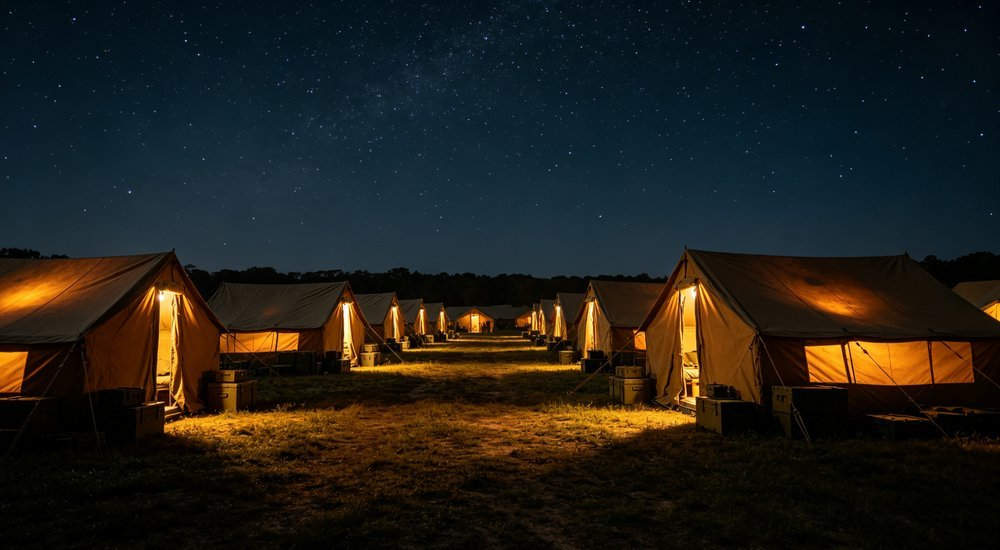
13. MOQ and lead time
This comparison table provides essential specifications for procurement evaluation. Buyers use this data to compare configurations, assess material quality, and calculate total project costs. As a professional tent manufacturer with extensive export experience, we ensure all parameters meet international standards and field deployment requirements. This information is particularly valuable for government procurement teams, NGO aid organizations, and international relief agencies evaluating bulk supply contracts. The following table breaks down critical dimensions for army shelter tent. Buyers reference this information when assessing tactical field tent configurations, lead times, and total cost of ownership. Our role as a trusted tent manufacturer means these specifications are validated through real-world emergency deployments and rigorous quality testing. This information is particularly valuable for government procurement teams, NGO aid organizations, and international relief agencies evaluating bulk supply contracts.
|
Configuration |
MOQ |
Lead Time |
Notes |
|
Stock camouflage pattern (jungle / desert / digital) |
10–20 units |
25–35 days |
Stock fabric and tube sizes |
|
Custom camouflage print |
50–100 units |
40–55 days |
New print screen, dye lot run |
|
Unit markings / insignia printing |
50 units |
35–45 days |
Print on cover and storage bags |
|
Cotton winter liner included |
10–20 units |
30–40 days |
Quilted liner sewn to order |
|
Custom size (12m2 / 30m2 / 36m2) |
20–30 units |
45–60 days |
New cutting pattern required |
As an established military tent supplier, we offer flexible MOQ terms for both stock and custom orders. Military tent OEM services allow branded packaging and custom camouflage prints. Military tent bulk order pricing applies for quantities exceeding 100 units.
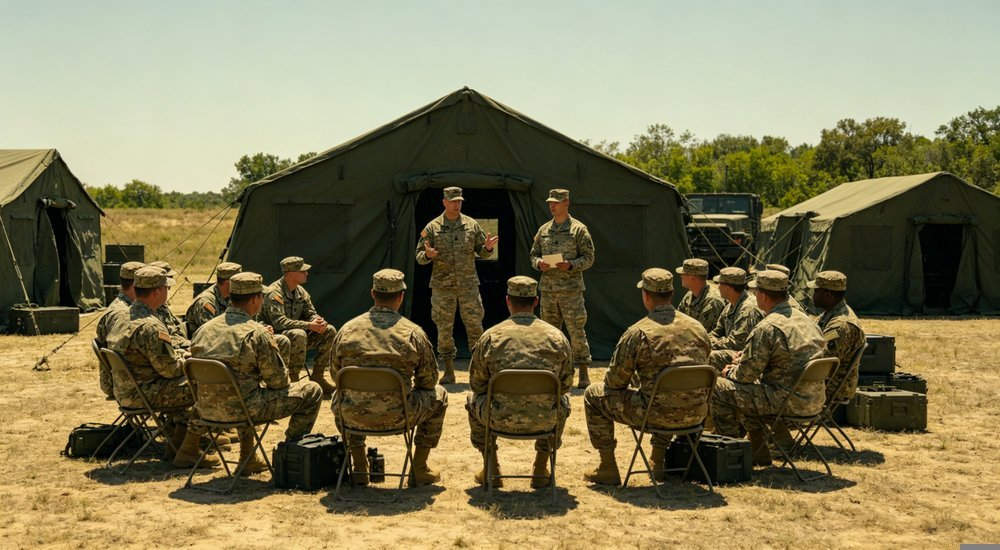
Bulk order discounts apply for large military tent procurement programs. Custom camouflage patterns and sizes can be arranged for orders meeting minimum quantity requirements. As a leading tent price,This comparison table provides essential specifications for procurement evaluation. Buyers use this data to compare configurations, assess material quality, and calculate total project costs. As a professional tent manufacturer with extensive export experience, we ensure all parameters meet international standards and field deployment requirements. This information is particularly valuable for government procurement teams, NGO aid organizations, and international relief agencies evaluating bulk supply contracts.Group of soldiers receiving briefing outside military tent, field operation meeting, sunny day, outdoor grassy field, realistic documentary photography professional high quality realistic photography with detailed composition and natural lighting conditions
Understanding tactical field tent requires careful analysis of the parameters below. This table helps procurement officers compare tent manufacturer solutions, identify cost-saving opportunities, and select configurations that match their operational needs. We manufacture OEM military tent with strict quality control at every production stage. This information is particularly valuable for government procurement teams, NGO aid organizations, and international relief agencies evaluating bulk supply contracts.
|
Size |
Cartons / Set |
Weight |
20ft Container |
40ft Container |
|
12m2 (3x4m) |
2–3 cartons (long tubes) |
90–120 kg |
35–45 sets |
80–100 sets |
|
20m2 (5x4m) |
3–4 cartons |
140–190 kg |
22–28 sets |
50–65 sets |
|
30–36m2 (6x5 / 6x6m) |
4–5 cartons |
220–300 kg |
14–18 sets |
32–42 sets |
* Steel tubes are bundled and strapped; the camouflage cover folds into a woven bag. Cartons are numbered and labeled to match the packing list. Air-freight options for urgent orders are quoted separately; sea freight is the default for bulk field procurement.
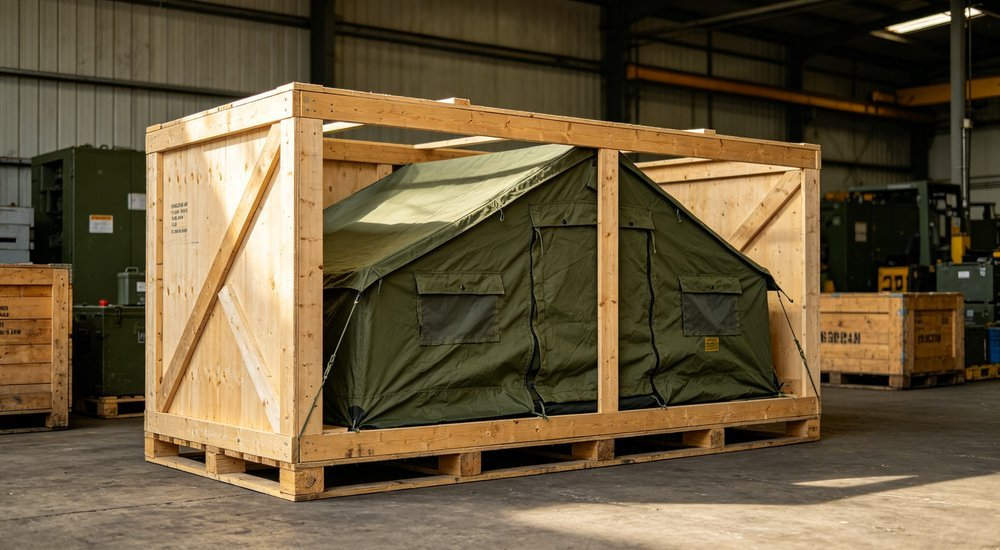
Every camouflage shelter ships with the documents below. Buyers should require the reports to match the fabric lot and frame model actually ordered — a generic lab sheet from a different product does not transfer.
Every military tent undergoes a 12-point quality inspection before shipment, including fabric tensile testing, waterproof verification, flame retardancy testing, frame load testing, and stitching reinforcement checks. The military tent wind rating meets Level 8 (62-74 km/h) standards when properly staked and guyed.
A military tent fire retardant treatment is applied to all fabrics, meeting CPAI-84 flame resistance standards. Each unit ships with a test report and quality certificate for procurement documentation.
Each military shelter passes comprehensive quality inspections before shipping. Our camouflage shelter products undergo tensile, waterproof, and flame retardancy testing.
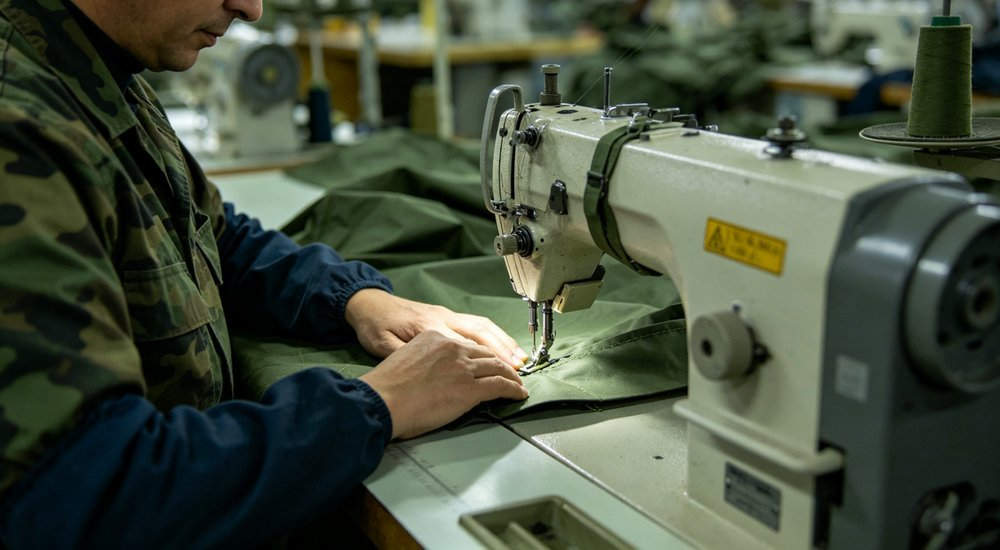
The standard unit in our line is the 5×4 m (20 m2) camouflage relief tent, housing 8–12 people. We also build 3×4 m (12 m2), 6×5 m (30 m2) and 6×6 m (36 m2) units on the same steel frame system. Custom dimensions are available at order quantity.
Match the pattern to terrain. Jungle woodland print suits green forest and scrub. Desert sand print suits arid and rocky terrain. Digital or urban pixel print suits mixed built-up and grey terrain. A wrong pattern defeats the concealment purpose of the shelter.
We reference military-standard expectations for tensile strength, seam strength, flame retardancy and hydrostatic head, and provide test reports. "Military grade" is a marketing term unless it traces to a specific clause or lab report. Ask which fabric lot the report covers.
For fixed field camps, border posts and below-freezing training, the galvanized steel frame wins: no pump, no pressure loss, stable at -30C. For 15-minute rapid insertion, an air beam deploys faster. Our 5×4 m camouflage shelter uses a steel frame because most deployments stay put for days or weeks.
With military cots, plan 8–12 occupants and leave a 60 cm center aisle. The same floor holds a 10-person command group, a small field clinic, or a gear store with shelving. Do not double-count cots and standing space.
The 600D Oxford option carries PU3000–5000 mm hydrostatic head; the 420 g/m2 PVC option is waterproof by construction. Seams are taped. Ask for the actual hydrostatic head number and seam-taping method, not just the word waterproof.
Indicative FOB pricing runs $800–$1,800 per unit depending on fabric choice (Oxford vs PVC), frame wall thickness, flame-retardant treatment and printed markings. Bulk orders, custom patterns and liners change the number. Always compare a complete set, not the shell alone.
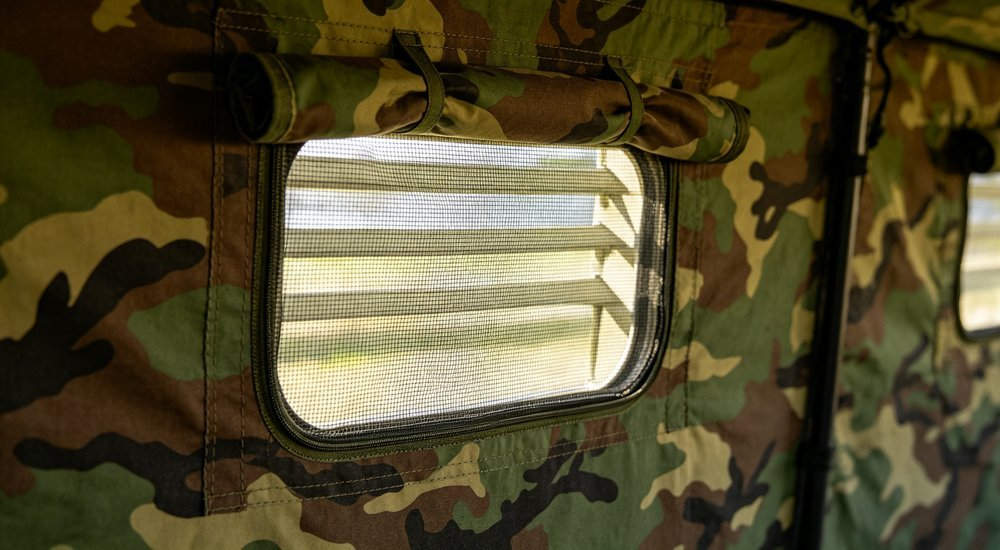
Stock camouflage patterns usually start at 10–20 units with a 25–35 day lead time. Custom camouflage printing or special markings typically start at 50–100 units and need 40–55 days. Confirm at inquiry; sample orders are possible at a higher unit price.
Yes, all printed camouflage fades over years of direct UV exposure. Our printed fabric uses UV-resistant pigmentation and an outer PU coating that slows fading. Expect noticeable color shift after 3–5 outdoor years. Indoor storage between deployments doubles pattern life.
Yes. The 5×4 m camouflage shelter is dual use: field training, border patrol posts, hunting camps, forestry stations, outdoor rescue teams and disaster relief in wooded or rural terrain. For white or green relief camps for displaced families, see our civil affairs relief frame tent guide instead.
The fabric can be treated to CPAI-84 or NFPA 701, and the report is provided. Flame retardant slows spread; it does not make the tent fireproof. A shelter still needs ventilation and safe heater placement. Never run a combustion heater in an unvented closed tent.
Plan 5–10% spare steel poles, a bag of joint pins and bolts, extra guy ropes and forged stakes, camouflage fabric patches matching your pattern, and seam tape. Remote border posts should keep a complete second frame kit if resupply by air is slow.
Military surplus tents are highly sought after for outdoor expeditions, hunting camps, and disaster relief due to their exceptional durability. A military grade tent construction means the shelter can withstand years of heavy use in harsh conditions, making it a cost-effective long-term investment for both government and civilian buyers.
Ready to procure military camouflage tents?
Factory-direct pricing, MIL-SPEC quality, worldwide shipping
 |
 |
Przyjazne linki :
prawa autorskie © Custom Disaster - Relief Bedding: Tents, Sleeping Bags, Blankets Wszelkie prawa zastrzeżone
profesjonalny zespół do obsługi !