I. What Is the Fundamental Difference Between Professional Relief Bags and Camping Bags?
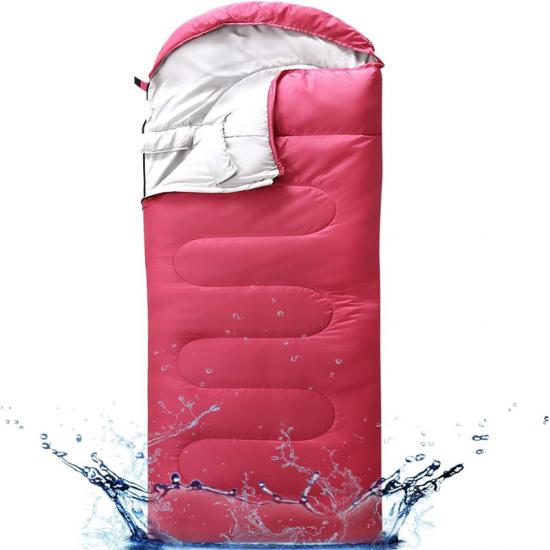
Emergency relief sleeping bags designed for post-disaster shelter camps are fundamentally different from consumer camping products in terms of design priorities.
Professional relief-grade products focus on three core requirements: the ability to be stacked in bulk storage without early deterioration; rapid deployment for individual distribution; and passing basic safety inspections (flame retardancy, no harmful chemical residues) in crowded, damp shelter environments. Consumer and camping-grade sleeping bags prioritise comfort and lightweight performance, but are rarely tested for bulk-storage mould resistance, repeated disinfection durability, or the logistics compatibility required for emergency mass distribution.
At the needs-definition stage, it is advisable to include a clear statement in the internal requirements summary — "intended for post-disaster shelter or government stockpile, not outdoor recreational camping" — in order to filter out suppliers outside the correct supply track from the earliest inquiry stage.
Different stakeholder roles also carry distinct priorities. Government emergency and disaster preparedness departments place the greatest emphasis on regulatory compliance, completeness of inspection documentation, and ease of rotation management for large-scale stockpiles. NGOs and international aid organisations focus more on delivery speed, cross-border customs cooperation, and in-country usability at the destination. Overseas distributors, beyond ensuring compliance, also need to evaluate pricing structure, consistent supply capacity, and the breadth of one-stop complementary products.
II. Materials and Safety Standards: How to Read a Technical Specification Sheet?
This is the most operationally critical section when drafting technical clauses for a tender document. Descriptors such as "high quality" and "durable" carry no practical value in procurement. A technical specification sheet requires verifiable, checkable parameters.
Outer shell fabric thread count determines tear resistance and abrasion performance. Common options include 170T polyester and 190T Oxford polyester fabric. Higher thread counts improve abrasion resistance and water repellency while adding some weight. For bulk emergency relief sleeping bag projects that involve frequent handling and repeated distribution cycles, a shell thread count of no less than 190T is recommended to reduce in-service loss rates.
Fill type is the primary variable controlling thermal performance. Relief projects typically favour synthetic fill (such as 3D hollow-fibre polyester). Synthetic fill retains meaningful insulation even when damp, carries far lower storage maintenance costs than down, and is far better suited to large-scale uniform stockpiling. The relief sleeping bag fill weight should be determined based on the extreme overnight minimum temperature at the intended shelter location. Technical specifications should include allowable fill weight tolerances (a common reference range is ±5%) so that acceptance checks have a contractual basis. Where neither the knowledge base nor the supplier can provide a confirmed figure, writing "to be confirmed per project climate profile" is preferable to estimating a precise number.
Flame retardancy is increasingly a mandatory requirement in government and NGO projects. In tent camps or indoor shelter facilities operating at high density, non-flame-retardant fabrics spread dangerously fast on contact with an open flame. It is recommended that relief sleeping bag technical specification sheets require suppliers to provide corresponding test reports, with the referenced test method standard clearly identified, so that bids can be meaningfully compared at evaluation stage.
Harmful substance safety: some projects require textile harmful substance test documentation. Whether a specific certification (such as OEKO-TEX or an equivalent test report) is mandatory should be confirmed against the regulations of the destination country and the requirements of the donor organisation. Writing "must provide a third-party test report covering [specific test categories]" in tender documents is more practical than writing "must hold a specific certification", as it allows suppliers to prepare targeted documentation and evaluators to make clear comparisons.
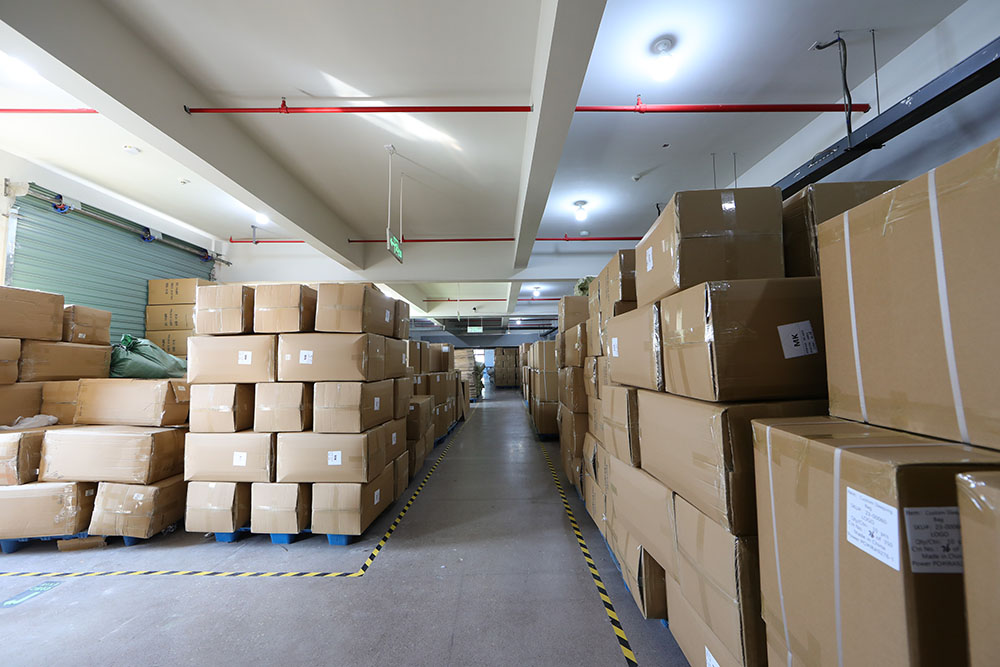
Storage compatibility is also worth addressing in technical specifications. Emergency relief sleeping bags are typically held in warehouse stockpiles for extended periods. Specifications should note moisture barrier requirements, a recommended maximum stacking height, and a suggested service life or inspection interval, providing a clear framework for later rotation management.
III. Specification Selection: Which Configuration Is Right for Your Project?
Relief sleeping bag specification selection is not about "spending more for a better product" — it is about finding the right combination based on the specific use scenario, population profile, and intended duration of use. Three dimensions are central to this judgement.
Dimensions and population fit: a standard adult size will work for most shelter residents, but if the project population includes significant numbers of children, elderly individuals, or larger-framed adults, it is advisable to include a proportion of wide-fit or children's sizes alongside the main specification. As a general approach, keeping special sizes to 10%–20% of the total order as a flexible buffer — rather than specifying all sizes uniformly — helps avoid supplies that go unused because they do not fit.
Warmth rating and extreme temperature: the selection baseline should be the coldest night likely to be experienced, not the average overnight temperature at the shelter site — particularly in cold-season operations or high-altitude locations. For elderly residents, infants, and those with pre-existing health conditions, a higher warmth rating is recommended as a dedicated allocation within the emergency supply sleeping bag stockpile for high-risk groups.
Packaging and logistics efficiency: sleeping bags with a small compressed footprint and high compression ratio offer clear advantages in warehouse storage and container loading. It is recommended that suppliers be asked at the inquiry stage to provide compressed volume and weight per unit. Running a space utilisation calculation against warehouse shelving dimensions and container specifications avoids the problem of "enough on paper, but physically won't fit." It is also advisable to require that packaging clearly display batch number and production date, supporting later rotation management and inspection records.
IV. The Core Advantages of Sourcing Emergency Relief Sleeping Bags from China
Why do a large proportion of government and NGO projects favour China as the primary supply source? The reasons go well beyond unit price.
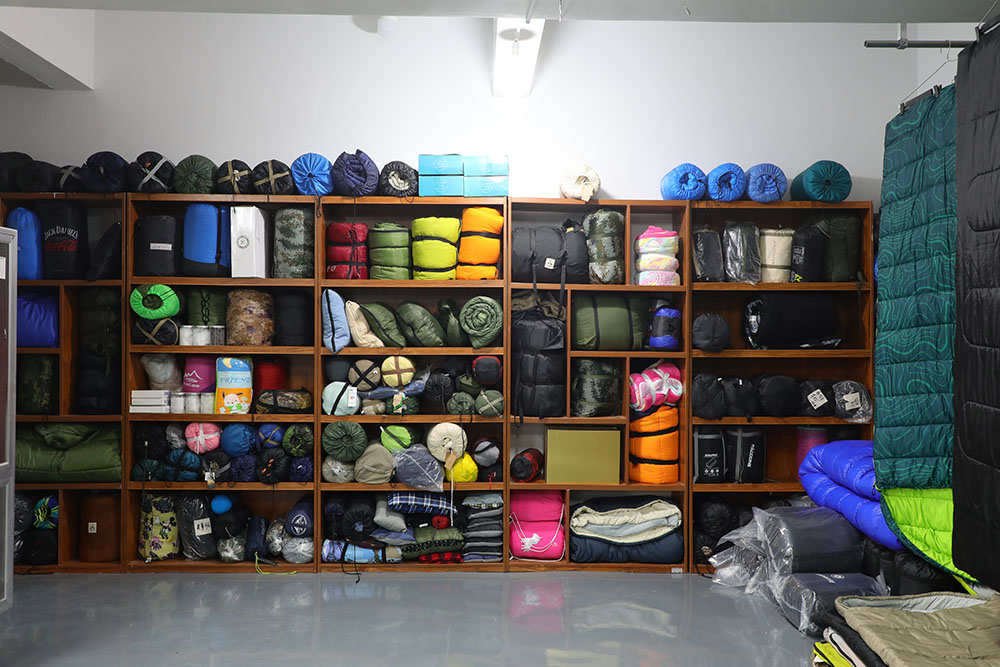
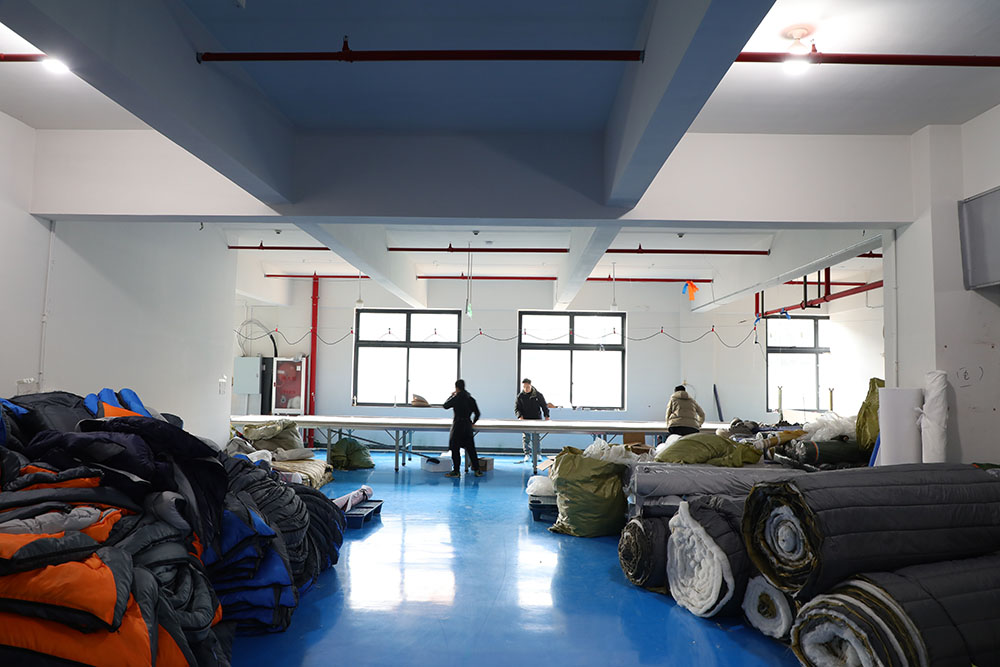
Chinese emergency relief sleeping bag suppliers have a clear advantage in supply chain completeness: mature industrial clusters have formed in multiple regions, spanning fabric, fill material, accessories, and finished products. This means that when project demand surges, production capacity can be scaled up through multi-factory coordination rather than relying solely on one plant's scheduling capability — a factor that becomes especially critical when a natural disaster triggers a short-term global spike in demand for relief supplies.
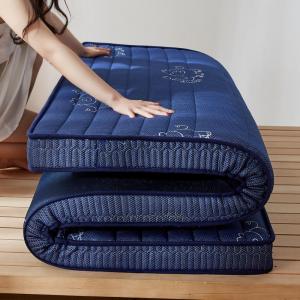
One-stop complementary supply capability is another significant advantage. Many Chinese relief supply manufacturers produce not only sleeping bags but also moisture-proof mats, emergency blankets, folding beds, and other complementary items, enabling consolidated container loading and customs clearance and reducing the coordination and logistics costs associated with sourcing from multiple separate suppliers. For NGO aid project sleeping bag procurement or government stockpile projects that require multiple supply categories simultaneously, one-stop sourcing can substantially reduce overall project management burden.
The maturity of export services is also worth noting. Factories with established export systems can support common trade terms such as FOB, CIF, and EXW, and can assist in preparing technical parameter sheets, inspection reports, and product documentation for tendering and customs purposes — particularly useful for NGO and government emergency procurement projects participating in international competitive procurement.
Of course, working with Chinese suppliers also requires proactive risk management: factory quality levels vary considerably, making qualification checks and sample verification essential for proper screening; key technical terms should be confirmed in writing in both languages to prevent misunderstandings in remote communication; logistics and customs lead times should be budgeted generously in advance — especially for intercontinental projects, where greater time pressure makes early production scheduling discussions even more important.
V. Five-Step Procurement Process: From Needs Confirmation to Contract Signing
Step 1: Prepare a needs summary. Before issuing any inquiry, compile a one-page internal needs summary covering: number of shelter residents and population composition (including proportions of elderly and children); target location and extreme minimum temperature; planned usage duration (short-term weeks vs. medium-to-long-term shelter); packaging language and labelling requirements; budget range. The more specific the needs summary, the more comparable the responses from different suppliers will be.
Step 2: Draft a relief sleeping bag technical specification sheet. Translate the needs summary into technical clauses suitable for inclusion in a tender document. At a minimum, include: outer shell thread count requirement; fill type and weight requirement (including tolerance statement); flame retardancy test requirement (with reference standard identified); dimensional tolerances; packaging and labelling specifications. This draft becomes the shared reference baseline for both bid evaluation and acceptance inspection.
Step 3: Screen candidate suppliers. Focus on the following checkpoints: possession of relevant production qualifications and emergency supply inspection reports; an explanation of experience supplying comparable projects (project type and scale only is sufficient); monthly production capacity range and urgent order handling capability; whether one-stop complementary supply and export services are available.
Step 4: Sample confirmation and overall evaluation. Request samples from two or three shortlisted suppliers and check each one against the technical specification sheet, covering workmanship, evenness of fill distribution, zip function, and completeness of accompanying documents. Comparing samples, production capacity and lead time, price reasonableness, and service capability — and recording the results in a scoring document as the award basis — is the step that separates "looks similar on paper" from "actually meaningfully different."
Step 5: Lock in key contract terms. Attach the technical specification sheet to the contract, clearly stating the phased delivery schedule, relief sleeping bag acceptance standards (including inspection method and non-conforming goods handling procedure), warranty period, and defect response timeframe. For higher-value projects, it is advisable to specify that a small first-batch acceptance must pass before the main production run begins.
In disaster emergency situations, certain countries and organisations permit simplified procurement procedures (such as compressed tender windows or direct call-off from a pre-approved supplier framework). Even under simplified procedures, three categories of basic documentation should be retained: a needs statement, supplier selection rationale, and price reasonableness record — to support post-event audit.
VI. Goods Acceptance: Which Items Must Be Inspected On-Site?
Problems identified at the acceptance stage can still be remedied. Issues discovered only after goods have been shelved become substantially harder and more expensive to address. The following items are recommended for inclusion in on-site inspection:
(1)Appearance and workmanship: Sample several units and check for damage, staining, skipped stitches, significant colour variance, zip function, and whether label language matches contract requirements.
(2)Dimensions and weight: Measure against contract specifications and confirm that deviations are within the allowable range. Where measured fill weight shows a material discrepancy from contract specifications, this should be resolved in writing before the full batch is warehoused, rather than traced retrospectively.
(3)Documentation check: Confirm that accompanying documents include flame retardancy test reports and harmful substance test reports (where required by the project); report batch reference numbers should correspond to the current goods batch. Verify that product conformity certificates and packing lists are complete.
(4)Packaging and labelling: Confirm outer packaging integrity, batch number labelling, and whether labelling language matches contract requirements.
(5)Quantity verification: Physically count cartons and units, and confirm that packing list, contract, and actual received quantities are fully consistent.
When non-conformities are found, retain physical samples and photographic or video evidence immediately, and process in accordance with contract provisions. Goods should not be warehoused before non-conformities are addressed.
VII. Common Procurement Pitfalls and Warnings
Pitfall One: Substituting camping-grade products for professional relief-grade ones. Common consequences include failure to meet flame retardancy standards, poor mould resistance, or being found non-compliant with emergency supply applicable standards at final project inspection. Prevention: state the intended supply track clearly at the needs stage, require suppliers to confirm whether the product is specifically designed for bulk storage and uniform mass distribution, and request corresponding test reports.
Pitfall Two: Vague technical language in the contract. Specifying only "emergency relief sleeping bags, quantity X" without noting fill weight, shell thread count, or flame retardancy requirements leaves no contractual basis for pursuing quality deviations on delivery. Prevention: attach the relief sleeping bag technical specification sheet as a contract annex, with primary parameters and tolerances clearly stated.
Pitfall Three: Using the lowest quoted price as the sole selection criterion. When unit prices are compressed to an extreme, the result is typically reduced fill weight, downgraded fabric, or simplified quality inspection processes. For government stockpile sleeping bag projects with long holding periods, comprehensive cost should be assessed across "unit price + service life + storage and logistics costs + acceptance risk" rather than a single-dimension analysis. A more prudent approach is to target "competitive pricing within a reasonable range, conditional on meeting technical specifications" rather than "absolute lowest price wins" — the latter frequently backfires in emergency supply procurement.
VIII. YRF Recommended Solution
YRF Emergency Relief Supplies is a Chinese source manufacturer specialising in emergency relief supplies. Its product line covers emergency relief sleeping bags and complementary items including moisture-proof mats, emergency blankets, and folding beds, with one-stop consolidated supply capability suited to government-grade emergency stockpile programmes, NGO aid missions, and bulk orders from overseas distributors.
In terms of compliance documentation, YRF holds OEKO-TEX certification (textile harmful substance safety) and amfori BSCI certification (social compliance audit), and can provide technical parameter sheets, inspection reports, and product documentation required for tendering and customs clearance. FOB, CIF, and EXW trade terms are supported, accommodating a range of international aid project procurement formats. Where a project requires additional specific certifications, YRF can assist in coordinating third-party testing organisations.
For medium-sized orders, standard production lead times are typically around two to three weeks, depending on specification configuration and order quantity, with the final timeline subject to the signed contract. For projects with fixed delivery milestones, early discussion of production capacity and scheduling during the specification confirmation stage is recommended to secure a production window in advance.
YRF is particularly well-suited to the following project types: government-grade emergency stockpile programmes, large-scale post-disaster shelter and international aid sleeping bag procurement, and long-term supply projects from overseas distributors serving target markets. Project configuration proposals can be requested by submitting a brief project summary through the contact window on this site. YRF will provide a reference configuration proposal on that basis, with all final terms subject to the formally signed contract between both parties.
IX. Recommended Next Steps
If you are currently in the preparation stage for government emergency relief sleeping bag procurement, the following steps can be initiated immediately:
(1)Prepare a needs summary: covering shelter population and composition, extreme minimum temperature at the target location, intended usage duration, budget range, and packaging language requirements.
(2)Draft a technical specification sheet: drawing on Section II of this article, identify shell thread count, fill type and weight, flame retardancy requirements, and dimensional tolerances as the foundation for the tender technical annex.
(3)Request samples from candidate suppliers: select two to three suppliers, run a small-batch check against the acceptance checklist in Section VI, and document any discrepancies and follow-up actions.
(4)Confirm the destination country customs documentation checklist: for projects involving cross-border shipment, confirm required certification documents and report formats in advance to avoid customs delays affecting project milestones.
(5)Lock in key parameters in the contract: attach the technical specification sheet as a contract annex, clearly assigning inspection method and responsibility for handling non-conforming goods.
If you need technical clause examples or a sample acceptance checklist suitable for use in tender documentation, you are welcome to submit a brief project background summary through the contact window on this site. YRF will provide a general reference template without reference to any specific client information, for internal discussion and benchmarking purposes only. All final terms are subject to the formally signed contract between both parties.
prawa autorskie © Custom Disaster - Relief Bedding: Tents, Sleeping Bags, Blankets Wszelkie prawa zastrzeżone
profesjonalny zespół do obsługi !